
A legal project charter is a short, agreed document that records why a matter or legal project exists, what it will deliver, what falls outside it, who is responsible, what it will cost and what could go wrong. It is signed off before substantive work begins. For a law firm or in-house team, it is the most economical tool available for aligning the client, the supervising partner and the working team on the same expectations.
This guide explains what the charter is, how it differs from an engagement letter, what to include, how to approve and maintain it, and how South African professional requirements shape its use.
Key takeaways
- A project charter is a common agreement on scope, a formal announcement that the project exists, and its terms of reference, according to South Africa’s Government Technical Advisory Centre (GTAC).
- In legal work it complements the engagement letter. The letter binds the client and the firm; the charter organises the team and the work.
- A sound charter covers purpose, scope and exclusions, deliverables, budget, resources, stakeholders, assumptions and risks, and it is agreed collaboratively and signed by a sponsor.
- It is a management document, not a substitute for the client’s written terms of engagement, and it should be revisited when scope materially changes.
Table of Contents
- What a legal project charter is
- Charter, engagement letter, matter plan and scope document
- What a legal project charter should contain
- A worked example: commercial contract review
- How to prepare, approve and maintain the charter
- South African professional considerations
- Why the charter matters commercially
- Building the capability across your practice
- FAQ
- Sources
What a legal project charter is
Project management literature has long used the charter to launch a project. GTAC, the South African National Treasury body that publishes public-sector project guidance, describes it as a document that forms a common agreement on scope, formally announces the project’s existence and serves as its terms of reference. The same guide notes that it provides the basis for scope management and helps to prevent scope creep.
Transposed to legal practice, the “project” may be a transaction, a due diligence exercise, a regulatory investigation, a litigation matter, a contract-review programme or an internal initiative such as introducing a new precedent bank. The charter answers a small number of questions in writing before the first hour is billed:
- What are we doing, and for what business or legal purpose?
- What will be delivered, and what will count as finished?
- What is expressly excluded?
- Who does what, and who decides?
- What will it cost, and by when must it be done?
- What are we assuming, and what could derail us?
Steven B. Levy, writing for the Canadian legal journal Slaw, describes the charter as the biggest and most easily implemented key to project success, because it sets the stage at the start. Anyone who has inherited a matter where nobody could say what had been promised will recognise the point.
Charter, engagement letter, matter plan and scope document
The keyword attracts confusion because several documents overlap. The distinctions below reflect common practice rather than any statutory classification.
| Document | Main purpose | Parties | Typical character |
|---|---|---|---|
| Engagement letter | Records the terms on which the firm acts: services, fees, responsibilities, confidentiality, termination | Firm and client | Contractual |
| Project charter | Authorises the project and aligns scope, deliverables, roles, budget and risks | Sponsor, matter lead and team (client may be a signatory or reviewer) | Management document |
| Matter plan | Breaks the work into tasks, owners, dependencies and dates | Internal team | Working schedule |
| Scope statement | Defines inclusions and exclusions | Often embedded in either of the above | Depends on where it sits |
An engagement letter is, in the usual description, a formal, matter-specific agreement setting out what the firm is retained to do, what it will cost and who will be responsible. It is the contract. The charter sits beside it and does a different job: it translates the commercial terms into an operating agreement for the people doing the work.
Is a legal project charter legally binding?
By itself, a charter is a planning and governance instrument. Whether any part of it creates enforceable obligations depends on how it is drafted and who signs it. If the client countersigns a charter that contains scope and fee statements, those statements may be argued to form part of the terms of engagement. For that reason, firms should decide deliberately which document is the contract. The safest approach is to keep contractual terms in the engagement letter and to have the charter refer to it, so that the two never contradict each other. Where a point of enforceability matters, the firm’s risk partner or general counsel should settle the position.
What a legal project charter should contain
The Association of Corporate Counsel’s project charter worksheet lists a business problem, a vision, a definition of “done”, out-of-scope items, dates and deadlines, budget, staffing and resources, stakeholders and risks. That list adapts readily to a legal setting. The sections below show how.
Purpose and objectives
State the business or legal problem in a few sentences, then the outcome sought. “Review the supplier contracts” is an activity. “Identify, before the board meeting, every supplier contract containing a change-of-control clause so that the board can decide whether to proceed with the sale” is an objective. The second version tells the team what matters and when.
Scope, deliverables and acceptance criteria
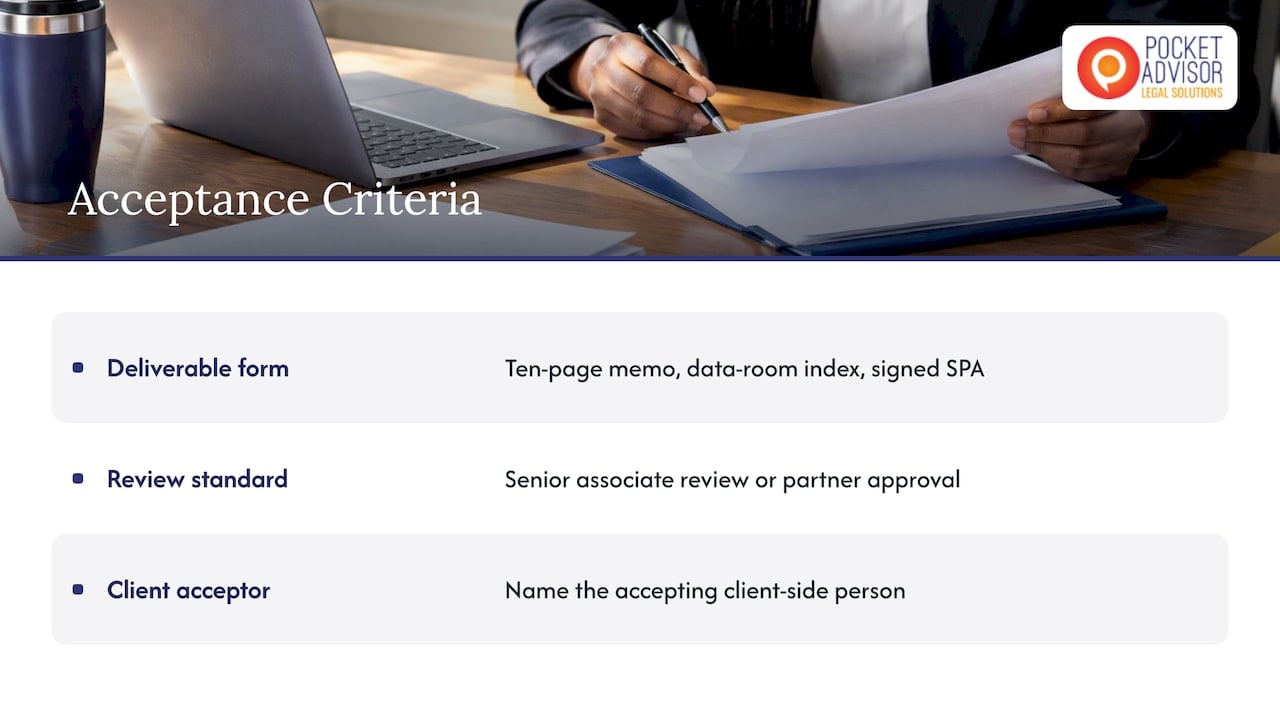
The GTAC guide notes that the in-scope items should include specific deliverables, the work to be done and acceptance criteria. For a legal team, acceptance criteria are the discipline that most often goes missing. Specify the form of the deliverable (a memorandum of ten pages, a data-room index, a signed share purchase agreement), the standard (reviewed by a senior associate, approved by the partner) and who accepts it on the client side.
Exclusions
Listing what is out of scope is where the charter earns its keep. A due diligence charter might exclude tax structuring, competition filings and any jurisdiction outside South Africa. Each exclusion removes an argument later, and each is a prompt to discuss whether the client expects the work anyway.
Budget and fee basis
GTAC’s guide addresses high-level project costs in the charter. In a law firm that means the fee estimate or fixed fee, the assumptions behind it, the disbursements expected and the point at which the team will tell the client that the estimate is at risk. Section 35 of the Legal Practice Act 28 of 2014 deals with fees for legal services and allows a client and practitioner to agree in writing on fees above or below the tariff, so the budget statement should be consistent with whatever fee agreement has actually been concluded.
Roles, resources and stakeholders
Name the sponsor (the partner or head of legal who authorises the project), the matter lead, team members, the client contact, any external experts and any approval authority. A short responsibility table is usually enough:
| Role | Name | Responsibility |
|---|---|---|
| Sponsor | Partner | Approves the charter and any change in scope |
| Matter lead | Senior associate | Day-to-day delivery, budget tracking, reporting |
| Client representative | General counsel or business owner | Provides instructions and information, accepts deliverables |
| Specialist input | Tax or employment adviser | Defined advice on defined questions |
Timeline and milestones
Set the final deadline, then the milestones that govern it: documents received, first draft, client comments, signature. Note any dependency on the client or a third party, because those are the delays a firm cannot control but can document.
Assumptions, constraints and risks
Assumptions are the facts the estimate depends on: the data room contains no more than 300 documents, the counterparty will respond within five business days, the contracts are in English. The GTAC guide asks the drafting team to define scope, assumptions and constraints together, and notes that assumptions must be validated. Risks follow naturally from this list. For each, record the likelihood, the effect on cost or time and the person who will watch it.
A worked example: commercial contract review
A mid-sized Johannesburg firm is instructed by a logistics client to review 120 supplier contracts ahead of a potential investment. Without a charter, the instruction arrives as a two-line email.
With a charter, the matter lead drafts a two-page document containing:
- Purpose: identify termination, exclusivity and change-of-control provisions that could affect the investment decision.
- Deliverables: a spreadsheet summary of each contract and a ten-page report of material findings, accepted by the client’s general counsel.
- Exclusions: tax analysis, review of employment agreements and any contract with a value below an agreed threshold.
- Budget: a fee estimate based on an average review time per contract, with the assumption stated, and a commitment to flag the position when 80% of the budget is consumed.
- Risks: late delivery of documents, scanned files that cannot be searched, and a change in the transaction timetable.
When the client later asks whether the team can also look at the employment agreements, the answer is a conversation about a scope change rather than a quiet absorption of unpaid work. This is the practical meaning of scope management, and it is why the charter is so closely associated with the control of scope creep in law firms.
How to prepare, approve and maintain the charter
The GTAC guide recommends that the charter be prepared collaboratively, with scope, assumptions and constraints defined together, then reviewed with the team for agreement and signed off by the sponsor. Applied to a legal matter, the process runs as follows.
- Draft at intake. The matter lead prepares the first version from the client’s instructions, the engagement letter and the pricing assumptions.
- Workshop with the team. A thirty-minute discussion with the people who will do the work is usually enough. Levy observes that writing the charter as a team helps to clarify grey areas of interpretation among its members, and in practice this is where the hidden assumptions surface.
- Share with the client. Present it as a mutual understanding of how the matter will run. Clients generally value seeing the exclusions and the assumptions before the work starts.
- Obtain sponsor sign-off. The responsible partner or head of legal approves it. Where the client signs too, make sure the engagement letter remains the contractual reference.
- Use it. Refer to it in status reports, budget reviews and change discussions. A charter that is filed and forgotten achieves nothing.
- Maintain it. Record material changes through a change note signed by the sponsor. The GTAC guide advises that if a change significantly alters the scope and purpose of the project, a new charter should be created rather than patching the old one.
Keep it short
For most matters, one to three pages is sufficient. A charter that runs to twenty pages will not be read, and a document that is not read cannot align anyone. Reserve fuller versions for large, multi-workstream projects such as a regulatory remediation programme or a firm-wide knowledge-management initiative.
South African professional considerations
The charter should work with, not against, the client-facing obligations of South African practitioners. The Law Society of South Africa’s summary of your rights as a client states that clients of attorneys may agree on the type of service they can expect, know who will handle their matter and receive an explanation of the cost implications. Each of these maps directly to a section of the charter: scope and deliverables, roles, and budget.
Two practical points follow.
- Consistency. The service description, the named team and the cost explanation given to the client in the engagement letter must match the charter. If they diverge, the client-facing document prevails in any dispute and the internal one loses credibility.
- Confidentiality and privilege. An internal charter often contains candid assessments of risk. Restrict its circulation, label it appropriately, and decide in advance whether a client-facing version should omit internal commentary.
In-house teams face a related discipline. A charter between the legal department and the business unit makes explicit who owns decisions, what turnaround the business can expect and how external counsel will be instructed and managed. That clarity helps legal departments control workload and demonstrate value to the business.
Why the charter matters commercially
Legal work is often priced on estimates, and the estimate is only as good as the scope behind it. The charter documents that scope and records the assumptions, so that variations can be identified early and discussed with the client while there is still goodwill. It also gives juniors a clear picture of what “good” looks like, reduces rework and creates a record that can be reviewed after closing. A firm that reviews its charters against outcomes learns where it habitually underestimates and can adjust its pricing and staffing. That is the continuous-improvement element of legal project management, and it is what separates a structured practice from one that relies on individual heroics.
It is also where technology decisions become clearer. Once the steps, handovers and recurring deliverables of a matter type are written down, a team can see which tasks are repetitive enough to benefit from automation and which depend on judgement. Choosing tools before mapping the work usually leads to expensive software that nobody uses.
Building the capability across your practice
A charter is one tool within a wider discipline. Teams that want to extend the approach will find related guidance on how to manage a legal matter, law firm project management in South Africa and the broader legal project management framework, and a companion article on legal matter management.

For lawyers who want structured training, the Applied Legal Project Management Course is priced at R9 500 and teaches scoping, budgeting, risk management, team leadership and client communication in a legal context. It brings structure, commercial awareness and a continuous-improvement mindset to legal work, and it helps firms and legal departments decide where technology and automation add genuine value. Students who successfully complete the course receive international accreditation through the International Institute of Legal Project Management (IILPM), subject to the programme’s completion requirements. The credential supports lawyers in strengthening their expertise and distinguishing themselves in a competitive profession.
Explore PocketAdvisor’s internationally accredited Legal Project Management Course: https://pocketadvisor.co.za/legal-project-management-course/

FAQ
What is the purpose of a project charter in project management?
Its purpose is to authorise the project and to record a common agreement on scope, objectives and responsibilities before work starts. GTAC describes it as the project’s terms of reference and the basis for scope management. In legal work, that translates into fewer misunderstandings about what the client expects.
What are the three essential items in a project scope and approval document?
At the minimum, the document should state the purpose and objectives, the scope and deliverables, and the high-level costs. These are the three areas the GTAC guide addresses in its charter-writing process. For a legal matter, add exclusions, assumptions and named responsibilities as soon as the matter has any complexity.
What type of document is a project charter?
It is a governance and planning document rather than a contract. It announces the project, fixes its scope and sets out how it will be run. Any binding commercial terms should sit in the engagement letter, to which the charter can refer.
Does a law firm need a charter for every matter?
Not necessarily. A short, one-page charter suits repeatable or small matters, and a fuller version suits complex, multi-person or fixed-fee work. A useful rule is to prepare one whenever more than one person will work on the matter or the fee depends on a stated scope.
Sources
- Guide to Effective Project Charter Writing, GTAC
- Project Charters and the Five-Tools Project Manager, Slaw
- Project Management Tools and Templates, Association of Corporate Counsel
- Your Rights as a Client, Law Society of South Africa
- Legal Practice Act 28 of 2014, section 35, Fees in respect of legal services
- Outside Counsel Guidelines vs. Engagement Letters
Recommended
- Law Firm Project Management: A 2026 Guide for SA Practices
- Legal Project Management: A 2026 Guide for SA Practice
This article is for educational and informational purposes only. It is not a substitute for professional advice.