
Assigning a trade mark in South Africa means permanently transferring ownership of it to someone else. The Trade Marks Act 194 of 1993 requires the assignment to be in writing and signed by or for the person handing it over. To protect the new owner against outsiders, you then record the change with CIPC using form TM6. This guide walks through the practical steps, with realistic business scenarios, so you can make the decisions before you sign.
Key Takeaways
- An assignment transfers ownership of the mark. A licence only gives someone permission to use it while you stay the owner.
- Under section 39(7) of the Trade Marks Act, an assignment has no force unless it is in writing and signed by or for the assignor.
- A mark can be assigned with or without the goodwill of the business behind it, so agree clearly on which one you are doing.
- Recording the assignment at CIPC on form TM6 makes it valid against third parties. Without recordal it is valid only between the two parties.
- CIPC publishes the recordal fee of R150 for the first mark and R26 for each extra one. Check the current fee schedule before you file.
Table of Contents
- What a trade mark assignment really is
- Assignment or licence: choosing the right route
- What the Trade Marks Act says about assigning
- What a good assignment agreement should cover
- Recording the assignment with CIPC
- Questions to ask before you assign
- Where trade mark assignment fits in your legal foundations
- Build your legal readiness with a practical toolkit
- FAQ
- Sources
What a trade mark assignment really is
Imagine Naledi runs a small skincare brand in Durban. She has built a name and a logo over six years, and registered both. Now a larger distributor wants to buy the brand outright so Naledi can start a new venture. When she sells the brand, she is the assignor and the distributor is the assignee. Ownership moves completely. After the deal, the distributor decides how the brand is used, who else may use it and whether it is ever sold on.
That is the key point to understand. CIPC describes assignment as an outright sale of intellectual property that transfers ownership. Naledi cannot take the brand with her to her next venture, so the decision deserves proper thought.
The same logic applies when a co-founder leaves and hands their share of the brand to the remaining founders, or when a freelancer who registered a name personally moves it into a new company. In each case the question is the same: who owns the mark after the paperwork, and can everyone prove it?
Assignment or licence: choosing the right route
Before signing anything, ask whether you really want to give up ownership. Often, what a business wants is to let someone else use the brand while it keeps control.
A licence works differently. CIPC explains that a licence gives another person permission to use the intellectual property on agreed terms, such as a defined purpose, territory and period. The owner usually receives royalties, and the licence can be exclusive or non-exclusive.
| Assignment | Licence | |
|---|---|---|
| Who owns the mark afterwards | The assignee | You, the original owner |
| Can it cover only some goods or services | Yes | Yes, through the agreed terms |
| Typical payment | A purchase price | Royalties or fees |
| Control over how the mark is used | Passes to the assignee | Stays with you, through the licence terms |
| Best for | Selling a brand, restructuring, moving a mark into a company | Letting partners, distributors or franchisees trade under your name |
The WIPO guide for South African businesses, Making a Mark, draws the same line between control and title. A licensing owner can keep quality control, while an assignment hands the mark over and leaves the new owner to seek registration in its own name at CIPC.
A useful test: if you would be comfortable never using this mark again, assignment may suit you. If you want the brand to keep working for you through other people, a licence is the better fit. If you are on the receiving end of a licence, you can see how this works in practice in a guide on using a licensed trademark safely, which shows how permission-based use is handled inside a branded network.
What the Trade Marks Act says about assigning
Three rules in section 39 of the Act shape almost every assignment.
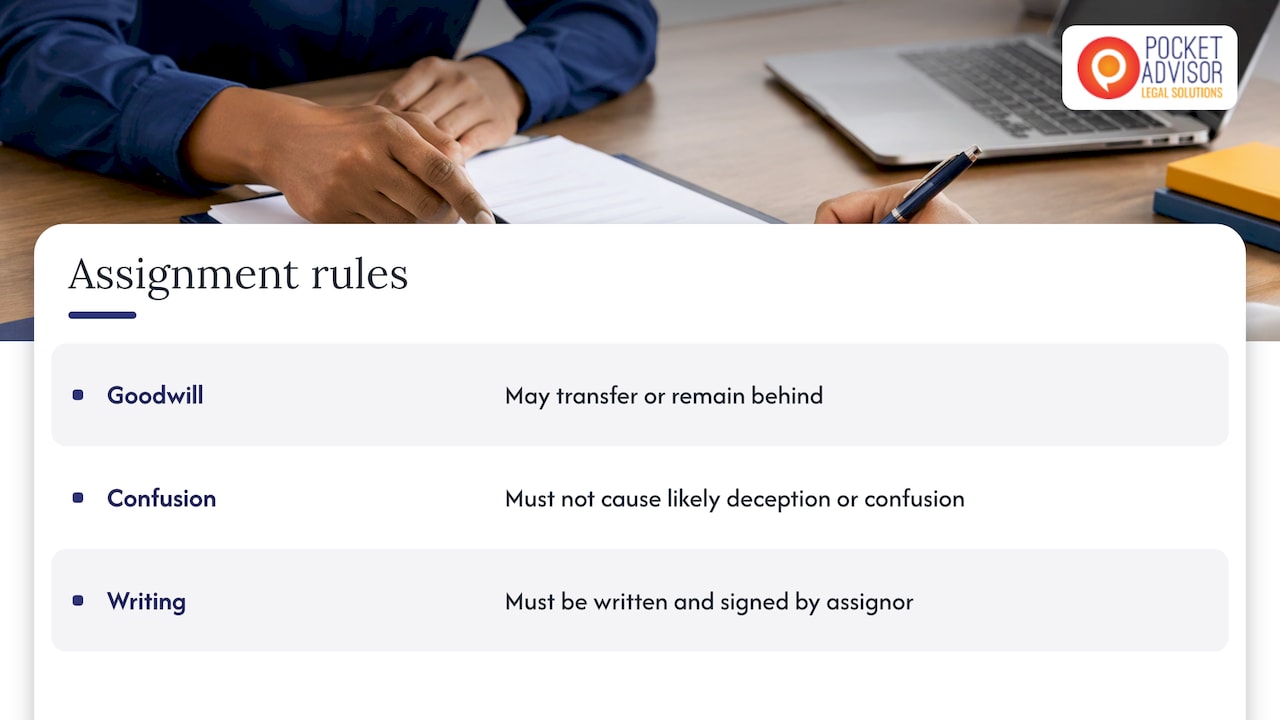
Goodwill is your choice
Section 39(1) says a registered trade mark can be assigned and transmitted either with or without the goodwill of the business concerned in the goods or services it is registered for. Goodwill is, in plain terms, the customer relationships and reputation that come with the brand.
This matters in practice. If Naledi sells the brand together with her customer lists, supplier relationships and reputation, the distributor steps into a running business. If she sells the name alone, the distributor gets a name and has to build the rest. Neither is wrong, but the agreement should say clearly which one it is, so both sides price and plan for the same thing.
The Act also allows an assignment to cover only some of the goods or services the mark is registered for. A clothing brand could, for example, sell the mark for footwear while keeping it for apparel. Think carefully before splitting a mark, because you must also consider the next rule.

The assignment must not cause confusion
Section 39(4) says a registered mark cannot be assigned if, as a result of the assignment and use of the mark by different people, there would be a likelihood of deception or confusion. If you split a mark between two owners selling similar products, customers could easily mix them up.
Section 39(6) offers a way to check first. You can apply for the registrar’s certificate on a proposed assignment, using form TM2(n). CIPC’s forms and fees page lists the fee for this as R48. If you plan to divide a mark, or you simply want certainty before the sale closes, this is a sensible proactive step.
Writing and signature are non-negotiable
Section 39(7) says no assignment of a registered mark, or of a mark that is the subject of an application, has any force or effect unless it is in writing and signed by or on behalf of the assignor. A handshake, a WhatsApp message saying “it’s yours” or an invoice is not enough.
The same section covers applications that are still pending. Under section 39(5), if a mark that is the subject of a pending application is assigned, the registrar may allow the new owner to be substituted as the applicant. So you do not have to wait for registration to move a mark along with a sale of the business.
What a good assignment agreement should cover
The Act sets the minimum: writing, and the assignor’s signature. A well-run business wants more clarity than that. Whatever the format, these are the questions to settle before you sign.
- Which marks exactly? List each registration or application number, the class and the goods or services covered.
- With or without goodwill? State it plainly, and say what travels with the mark: domain names, social media handles, customer lists, stock bearing the mark.
- What is the effective date? The date matters for recordal timing, and the CIPC form asks for it.
- What is the price and when is it paid? Say whether payment is a lump sum or in instalments, and when ownership passes.
- Does the assignor keep any right to use the mark? If Naledi needs to sell off remaining stock, say so, and for how long.
- Who signs, and in what capacity? If a company is the assignor, confirm the signatory has authority to sign for it.
- Who handles the CIPC recordal and who pays? Decide this up front so nothing falls between the cracks.
Take the scenario of two co-founders, Sipho and Lerato, who registered their café brand in Sipho’s personal name before incorporating. When they set up the company, the sensible move is for Sipho to assign the mark to the company in writing, and for the company to record it. This is a straightforward way to make sure the business, not one individual, owns its most visible asset. If you are still setting up that company, our guides to registering a company through CIPC and to the Memorandum of Incorporation cover the groundwork.
Recording the assignment with CIPC
Signing the agreement transfers the mark between the two parties. Recording it makes the change visible and enforceable beyond them. CIPC states that an assignment must be recorded in the relevant register to be valid with regard to third parties, and that if it is not recorded, it is valid only between the parties.
In business terms, recording is what lets the new owner act confidently as owner: dealing with the register, answering questions from a bank or investor, and licensing the mark onward.
Documents you need
According to CIPC’s IPOnline guidance, recordal needs:
- Form TM6, submitted to the Registrar requesting recordal of the assignment.
- A document concluded between assignor and assignee that evidences the assignment, such as a Deed of Assignment.
- A Power of Attorney in the name of the assignee.
- The prescribed fee.
The TM6 form asks for the full name and business address of the existing proprietor (the assignor), and of the proposed new owner (the assignee). It also asks for the section of the Act the application is made under, the effective date, the reasons for the application, the documents lodged in support and an address for service.
The fact that the form asks for the effective date and the supporting documents is a good reason to prepare your assignment agreement with the TM6 in front of you. If the names, dates and mark details match across both documents, the filing is simpler.
Fees and timing
The fees below are as CIPC publishes them at the time of writing. They can change, so confirm them on the CIPC forms and fees page before you file.
| Item | CIPC fee |
|---|---|
| Recording an assignment, first mark | R150 |
| Each additional mark in the same assignment | R26 |
| Assignment certificate in the assignee’s name | R34 |
| Registrar’s certificate on a proposed assignment (TM2(n)) | R48 |
| Late recordal penalty, per 12 months or part thereof | R48 |
The fee for recording and the penalty are listed on both the IPOnline page and the CIPC forms and fees page. CIPC asks that you lodge the application within 12 months of the effective date of the assignment. Simply put, build the filing into your closing checklist, and do not leave it for later.
These are official fees only. If you use an attorney to prepare the deed or lodge the filing, their professional fees are separate.
A simple step-by-step
- Confirm the mark is registered or applied for in the assignor’s name, and that the details on the register are correct.
- If the assignment affects only some goods or services, consider applying for the registrar’s certificate on the proposed assignment.
- Agree the terms, including goodwill, effective date and price.
- Have the assignor, or someone authorised for the assignor, sign the written assignment.
- Prepare the Power of Attorney in the assignee’s name.
- Complete form TM6 and lodge it with the supporting documents and fee.
- Request the assignment certificate if you want one for your records or for a transaction.
- Update your own records: contracts, packaging, website notices and any licences that referred to the old owner.
Questions to ask before you assign
The paperwork is the easy part. The decisions behind it are where a business benefits from slowing down.
If you are selling:
- Will I still need this name for anything, such as a new venture or an existing customer base?
- Should I keep some goods or services and assign others, and would that confuse customers?
- Would a licence give me the income I want while I keep the brand?
- Is the price based on the mark alone, or on the business that stands behind it?
If you are buying:
- Is the seller the registered owner, and do the register details match the seller’s legal name?
- Are there any existing licences or other rights over the mark that will continue after the purchase?
- Do I receive the goodwill, domain names and social media accounts that make the brand useful?
- Who will record the assignment, and by when?
If you are moving a mark into a company:
- Is every mark that the business uses in the founder’s personal name, or in the company’s name?
- Do the people who built the brand all agree to the transfer?
- Does the company’s governance record who can approve and sign such deals?
A scenario shows how these questions work together. Thandi, a freelance designer, registered her studio name personally. A client wants to buy it to launch a product line. Thandi realises she still uses the name for her other clients. Rather than assign the whole mark, she and the client agree to a licence limited to the product category, which keeps her studio brand intact. The right answer was found by asking questions, not by filling in a form.
For legal questions specific to your mark, such as a split assignment or a mark with an existing licence, speak to a registered trade mark attorney.
Where trade mark assignment fits in your legal foundations
A brand is usually among the first assets a business creates and among the most valuable. It deserves the same care as your company structure, your agreements with co-founders and your arrangements with contractors. Our guides to trademark registration for small businesses and intellectual property protection show how registration and ownership fit together, and why it matters that the right person or company holds the rights from the start.
Owning your brand cleanly at the outset also makes later deals easier. Investors, buyers and licensing partners tend to ask who owns the mark, and a clear answer helps a business look credible and well run.
Build your legal readiness with a practical toolkit
If you are setting up or growing a business and want to understand the legal foundations behind decisions like these, PocketAdvisor Legal Toolkits™ are designed to help. Each toolkit is a digital box of expert-led videos, practical workbooks, professionally drafted South African legal agreements and compliance resources, available on demand.

The Legal Toolkit™ for Start-Ups and Solopreneurs (R1 495, one-off) focuses on the legal foundations a new business needs. The Legal Toolkit™ for SMEs (R2 495, one-off) is built around the governance and commercial arrangements of a growing business. Explore PocketAdvisor Legal Toolkits™ and understand the legal foundations your business needs. A toolkit is a practical starting point and does not replace advice from an attorney on a specific transaction.
FAQ
Does a trade mark assignment have to be in writing in South Africa?
Yes. Section 39(7) of the Trade Marks Act says an assignment of a registered mark, or of a mark that is the subject of an application, has no force or effect unless it is in writing and signed by or on behalf of the assignor. A verbal agreement or an email exchange without a signed assignment is not a safe basis.
Can I assign a trade mark without selling my business?
Yes. Section 39(1) allows a registered trade mark to be assigned with or without the goodwill of the business. Your agreement should say which applies, and what else, such as domain names or customer lists, moves with the mark.
How much does it cost to record a trade mark assignment at CIPC?
CIPC lists R150 for the first mark and R26 for each additional mark on form TM6. An assignment certificate in the assignee’s name costs R34 more. Fees can change, so check CIPC’s current schedule before you file.
How long do I have to record an assignment?
CIPC asks for the application to be lodged within 12 months of the effective date of the assignment. A late-filing penalty of R48 applies for every 12 months or part thereof after that. It is simplest to file as part of closing the deal.
What is the difference between assigning and licensing a trade mark?
Assigning transfers ownership to someone else. Licensing lets another party use the mark on agreed terms while you remain the owner, often in return for royalties. Choose according to whether you want to give up the brand or keep it working through others.
Sources
- Trade Marks Act 194 of 1993
- CIPC: Intellectual Property
- CIPC IPOnline: Manage IP
- CIPC form TM6
- CIPC: Trade Marks Forms and Fees
- WIPO: Making a Mark (South Africa)
- Using a licensed trademark safely
Recommended
This article is for educational and informational purposes only. It is not a substitute for professional advice.