
A restraint of trade is a promise, usually in an employment contract, that limits what someone may do after they leave your business: working for a competitor, starting a rival firm or approaching your clients. In South Africa these promises are generally valid, but a court will only enforce one if it is reasonable and protects something that genuinely belongs to your business. This guide explains the reasoning, so you can decide what, if anything, to ask of the people you work with.
Key Takeaways
- A restraint of trade is generally valid in South Africa, but enforcement depends on whether it is reasonable in the circumstances.
- It must protect a real business interest: confidential information (trade secrets) or your customer and supplier relationships (trade connections).
- You cannot restrain someone from using the general skills and experience they built up while working for you.
- Duration and area need a reason. In a 2025 Labour Appeal Court case, a two-year, country-wide restraint was cut to one year.
- The best time to think about restraints is before you hire or take on a partner, not when someone resigns.
Table of Contents
- What a restraint of trade actually is
- Why South African law treats restraints the way it does
- What your business can legitimately protect
- How courts weigh reasonableness
- Duration and area: why the numbers need a reason
- Three business situations where restraints come up
- Practical steps for setting a fair restraint
- If you are the one being asked to sign
- Making restraints part of your wider legal readiness
- FAQ
- Sources
What a restraint of trade actually is
Picture Naledi, who runs a ten-person digital marketing agency in Johannesburg. Her senior account manager, Thabo, knows every client’s budget, preferences and renewal dates. If Thabo resigned on Friday and joined a competitor on Monday with that knowledge, Naledi’s business would feel it immediately.
A restraint of trade is how a business owner like Naledi tries to guard against that. It is a clause in which one person agrees, for a set period and in a set area, not to do certain things that would compete with the business. You will most often see it in:
- employment contracts;
- agreements with co-founders or business partners;
- the sale of a business, where the seller agrees not to start up again next door;
- some contractor and consultant arrangements.
The key point is that a restraint takes something away from the other person: part of their freedom to earn a living. That is why the law looks at it carefully, and why a clause that feels reasonable to you may not look the same to a judge.
Why South African law treats restraints the way it does
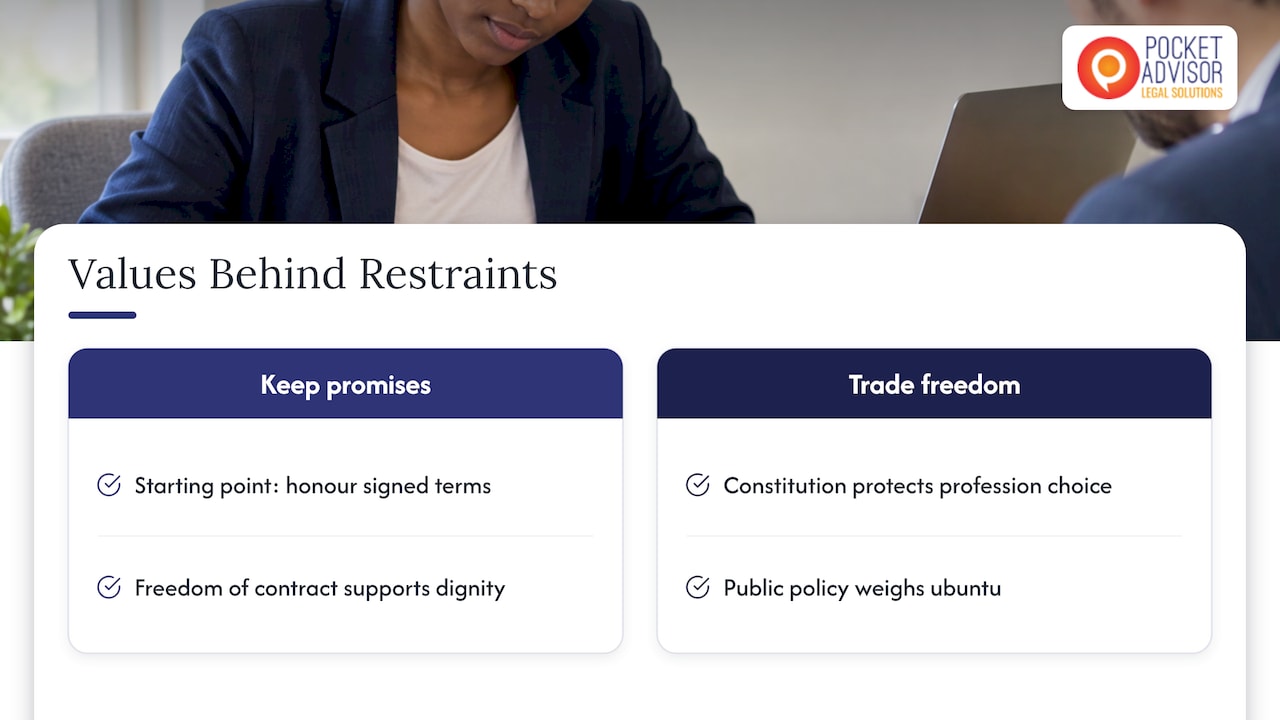
Two values pull in different directions.
The first is that people should keep their promises. If Thabo signed a restraint with his eyes open, the starting point is that he is held to it.
The second is that everyone should be free to choose and practise a trade or profession. The Constitution protects that freedom, and the courts treat it as part of public policy.
South African courts balance the two in a particular way. The High Court in the ADT matter reported by IOL in April 2026 put it this way: restraint agreements are valid, but enforcing one may be contrary to public policy if the enforcement is unreasonable. So the clause starts with the benefit of the doubt, but it is not a blank cheque.
A 2025 peer-reviewed discussion in the South African Law Journal adds that public policy also takes in ubuntu, and that freedom of contract is tied to a person’s dignity. In plain terms: the courts care about the person being restrained as well as the business doing the restraining.
What your business can legitimately protect
This is the question that matters most when you draft or review a restraint. You need to be able to say clearly what you are protecting. The law recognises essentially two kinds of interest, as set out in a professional overview of restraint agreements:
- Trade secrets. Confidential information that is useful in running the business and that a competitor could use to gain an advantage.
- Trade connections. Your relationships with customers, potential customers, suppliers and others that give your business its value.
When information counts as confidential
Not everything you would like to keep private qualifies. The same source explains that information must be useful, not public knowledge, known only to a small circle of people, and of real economic value to the person protecting it.
For Naledi, a client’s confidential campaign budget and renewal date could fit. The fact that agencies use social media to advertise does not.
What you cannot protect
The general skill, know-how and experience a person builds in your business belong to them, not to you. A restraint also cannot exist simply to keep a capable person away from the market. If the only honest reason is “I do not want them competing with me”, the clause is on weak ground. You have to be able to point to the specific thing that needs protection.
This has a practical benefit for you as an owner. It forces useful questions before anyone signs:
- Which clients does this person actually deal with, and how close is the relationship?
- What confidential information will they see that a competitor could use?
- Would a narrower promise, such as not approaching our clients, protect us just as well as a ban on working in our industry?
How courts weigh reasonableness
The standard test comes from the Appellate Division case of Basson v Chilwan (1993). As summarised in the professional overview, a court asks four things:
- Does one party have an interest that deserves protection when the relationship ends?
- Is that interest being prejudiced by the other party?
- Does that interest weigh, in quality and quantity, against the other party’s interest in not being economically inactive and unproductive?
- Is there another aspect of public policy that says the restraint should be upheld or rejected?
Think of it as a set of scales. On one side sits your interest: the secrets and relationships. On the other sits the person’s need to earn a living. A long, wide restraint on someone whose job gave them little sensitive information puts a lot of weight on the second side and very little on the first.
Who has to prove what
In South Africa, a restraint is treated as valid unless the person challenging it shows it is unreasonable. That is different from some other countries, where restraints start out as presumed void. It does not mean the business can relax. In the Sadan case discussed below, the analysis notes that evidence needs to be led by both employer and employee before a court is prepared to reach a conclusion. A business that has already thought through and recorded why it needs the restraint is in a much stronger position.
Duration and area: why the numbers need a reason
Owners often ask how long a restraint can run. There is no magic figure. The length and the area must fit the interest you are protecting.
The clearest recent illustration is Sadan v Workforce Staffing (Pty) Ltd. The Labour Appeal Court considered a restraint stopping an employee from working for competitors anywhere in South Africa for two years. It found that period unreasonable and contrary to public policy, and reduced it to one year because the employer had not given convincing and compelling reasons for two. The same commentary observes that courts take a conservative approach, and that where the justification for the duration and geographical area is not clear and convincing, a court may reduce the period.
The lesson for a business owner is practical, not scary. Ask yourself:
| Question | Why it matters |
|---|---|
| How long would it take for the person’s knowledge of our clients or pricing to go stale? | The restraint should roughly match that window, not exceed it. |
| Where do we actually compete? | A country-wide ban makes sense only if you genuinely trade country-wide. |
| What exactly is the person barred from doing? | Narrow, specific activities are easier to justify than “anything in the industry”. |
| Could a lighter protection do the job? | A promise not to approach clients or use confidential information may be enough. |
If you cannot explain a number in a sentence, that is a signal to revisit it.
Three business situations where restraints come up
Hiring someone who will see your client list
Sipho runs a small accounting practice in Durban and is hiring a client manager. This person will build close relationships with his clients. Sipho’s interest is in those relationships, so a restraint focused on not soliciting or dealing with those clients for a sensible period is easier to justify than a ban on working for any accounting firm in KwaZulu-Natal.
Before you offer the contract, say out loud what the role gives the person access to. If the answer is “not much”, a heavy restraint will be hard to defend and may put off good candidates for no benefit.
Bringing in a co-founder
Two founders building a software product share almost everything: code, plans, investor conversations. Restraints between co-founders are often more reasonable than those for ordinary staff, because both people hold deep confidential knowledge. They are also more personal. Talk about it openly at the start: what happens if one of you leaves, and what is fair for both?
The same conversation should cover who owns what has been created. Our guide to intellectual property protection for small businesses explains why ownership of your ideas and brand needs to be clear from the beginning.
Working with freelancers and contractors
A contractor is not an employee, and the way you set up the relationship affects what you can reasonably ask of them. A freelance designer who works for several clients usually expects to keep doing so. Before you copy an employment restraint into a contractor agreement, read our explanation of the difference between an independent contractor and an employee. Often a confidentiality promise and clear ownership of the work you paid for do more for you than a restraint would.
Practical steps for setting a fair restraint
A restraint that is thought through is more likely to be respected by the other person and more likely to be viewed favourably by a court. Here is a sequence you can follow.
- Name the interest. Write one or two sentences on what you are protecting: specific confidential information, or specific client and supplier relationships.
- Match it to the role. The more sensitive the access, the stronger the case. A junior admin and a head of sales are not in the same position.
- Choose the lightest tool that works. Confidentiality undertakings, non-solicitation of clients and a limited non-compete cover different risks. Use only what you need.
- Fit the period and area to your real business. Base them on how long your information stays valuable and where you actually trade.
- Explain it before signing. Walk the person through the clause. A person who understood what they agreed to is in a very different position from one who skimmed past page nine.
- Review it as the business grows. A clause written when you had five clients may not suit a business with five hundred.
- Get advice for high-stakes situations. Where a senior hire, a sale of business or a major partnership is involved, an attorney’s input is worth having. A restraint is a legal tool that needs to fit your exact facts.
If you are the one being asked to sign
Many readers are on the other side: you have been handed a contract with a restraint and are wondering about it. The same questions apply in reverse.
- What is the business actually protecting, and do you really have access to it?
- Are the period and area realistic for the work you do?
- Does the clause stop you from earning a living in your field, or only from using the other business’s secrets or contacts?
It is entirely reasonable to ask the business to explain its reasons and to propose a narrower clause before you sign. If a restraint is already in place and you are unsure where you stand, speak to an attorney or to a labour specialist before you act. The outcome depends heavily on the detail of the clause and your role.
Where an employer believes a restraint is being breached, it commonly asks the High Court for an urgent order to stop the conduct. That is a further reason to get the drafting right at the start, so that nobody has to find out how a court will see it.
Making restraints part of your wider legal readiness

Restraints are one piece of a larger picture. A business that knows who owns its intellectual property, how its people are engaged, how confidential information is handled and how its partners relate to each other is a more credible, better-run business. That matters when you hire, when you approach investors and when you grow.
PocketAdvisor Legal Toolkits™ are digital boxes of expert-led videos, practical workbooks, professionally drafted South African legal agreements and compliance resources, built to help you understand and put in place the legal foundations a business needs. The Legal Toolkit™ for Start-Ups and Solopreneurs (R1 495, one-off) focuses on the legal foundations of a new business. The Legal Toolkit™ for SMEs (R2 495, one-off) covers governance and commercial arrangements for a growing business.

They are not a substitute for professional advice where your situation is complex, but they give you the context to ask better questions and make informed decisions. Explore PocketAdvisor Legal Toolkits™ and understand the legal foundations your business needs.
FAQ
Are restraint of trade clauses enforceable in South Africa?
Generally yes, but only if they are reasonable. South African courts treat a restraint as valid, yet may refuse to enforce it if enforcement would be unreasonable and against public policy. The business must show a real interest worth protecting, and the length, area and scope must fit that interest.
What can a restraint of trade protect?
Two things: confidential information that could give a competitor an advantage, and your relationships with customers, suppliers and others that make up your trade connections. General skills and experience are not protectable in the same way, because they belong to the individual.
How long can a restraint of trade last?
There is no fixed legal limit. The period must be justified by the interest being protected. In Sadan v Workforce Staffing, a two-year, country-wide restraint was reduced to one year because the employer did not give convincing reasons for two.
Does a restraint of trade apply to independent contractors?
It can, if it is agreed in the contract and meets the same reasonableness standard. Whether it is sensible depends on how the relationship works in practice. Start with our explanation of contractors versus employees, and take legal advice for anything significant.
Sources
- High Court ruling in ADT case clarifies restraint of trade (IOL, 29 April 2026)
- The “Ins and Outs” of Restraint of Trade Agreements (CEOSA)
- Taut Knots Require Strong Rope: A Discussion of the Factors (South African Law Journal, 2025)
This article is for educational and informational purposes only. It is not a substitute for professional advice.