
A business legal health check is a structured review of the legal foundations of your business: how it is set up, who owns what, who works for it, what you have agreed with others and which registrations you must keep up to date. You do it before something forces you to. The best way to run one is to work through six areas in order and note what is in place, what is missing and what you are unsure about. This guide shows you how, using examples from South African start-ups and small businesses. Our Legal Toolkits™ are built around the same areas, with expert-led videos, workbooks and professionally drafted South African agreements in one digital box.
Key Takeaways
- A legal health check is a calm, regular look at six areas: structure, tax and registrations, people, agreements, protecting what you have built, and growth or investment readiness.
- Most of the questions have simple answers once you know why they matter. The gaps tend to be things nobody got round to, not things nobody could do.
- Your needs change as you grow. A solo founder needs solid foundations, while a growing business needs governance and clear commercial arrangements.
- Official guidance from CIPC and SARS gives you the baseline. A health check shows you where you stand against it and where to ask a professional.
Table of Contents
- What a legal health check actually is
- A story to hold on to: Thandi’s design studio
- Step 1: Confirm your structure and registration
- Step 2: Check your tax and registrations
- Step 3: Look at the people side
- Step 4: Review the agreements you work under
- Step 5: Protect what you have built
- Step 6: Check whether you are ready for growth or investment
- Score yourself in a single sitting
- Which toolkit fits where you are
- Make the health check practical
- FAQ
- Sources
What a legal health check actually is
Think of it like a service for your car. Nothing is necessarily wrong, but you want to know the state of things before a long trip.
South African companies already meet a version of this every year. The CIPC (Companies and Intellectual Property Commission, the body that registers companies) requires a compliance checklist to be completed before annual returns are filed. SAICA describes it as 24 yes, no or not-applicable questions on mandatory Companies Act sections for the previous calendar year. It covers things such as company name and registration number, annual returns, loans to directors and director eligibility.
The same SAICA summary makes a useful point: the questionnaire only cites sections of the law and gives no guidance, so directors need to understand their obligations themselves. That is the real value of a health check for an owner. It is not about ticking boxes. It is about understanding why each item exists, so that you can make decisions with your eyes open.
A story to hold on to: Thandi’s design studio
Thandi started a design studio from her spare room in Johannesburg. Two years later she has a part-time designer, three regular clients, a supplier who prints her work and an investor who has asked, very politely, for “your legal documents”.
She realises she has never looked at the business as a whole. Everything was done one decision at a time, when it came up. She does not need to panic. She needs a list, an order and a plan. Her health check, and yours, can follow six steps.
Step 1: Confirm your structure and registration
The question: Is the business set up in the form that suits what you are doing, and is it registered correctly?
Why it matters: Your structure decides who owns the business, who is responsible for its debts and how decisions get made. The Western Cape Government’s guide for new entrepreneurs names the choice between sole trader, partnership and company as the first legal step, and recommends professional advice before you finalise your business plan.
What to check:
- Does your structure still fit? A freelancer who started as a sole trader may now be carrying real client risk.
- Are your company details up to date with CIPC? A SARS webinar presentation on CIPC obligations advises updating CIPC as changes happen, including directors, business address and the Memorandum of Incorporation (the company’s founding rulebook), and diarising annual returns and beneficial ownership filings.
- Do you know who the directors and shareholders actually are, and does the paperwork say the same?
If you need to register or want to review your documents, our guides on business registration in South Africa and the documents you need to register a company walk through the basics.
Thandi’s result: She is a company, but the shareholder details at CIPC still show an old address. A quick update, put in her diary for the same month each year.
Step 2: Check your tax and registrations
The question: Are you registered for everything your business needs, and do you know your dates?
The Western Cape guide quotes SARS’s idea of tax compliance: you are registered for all the taxes you should be, you have submitted all required returns and you do not owe SARS money. Owning that is the business owner’s job.
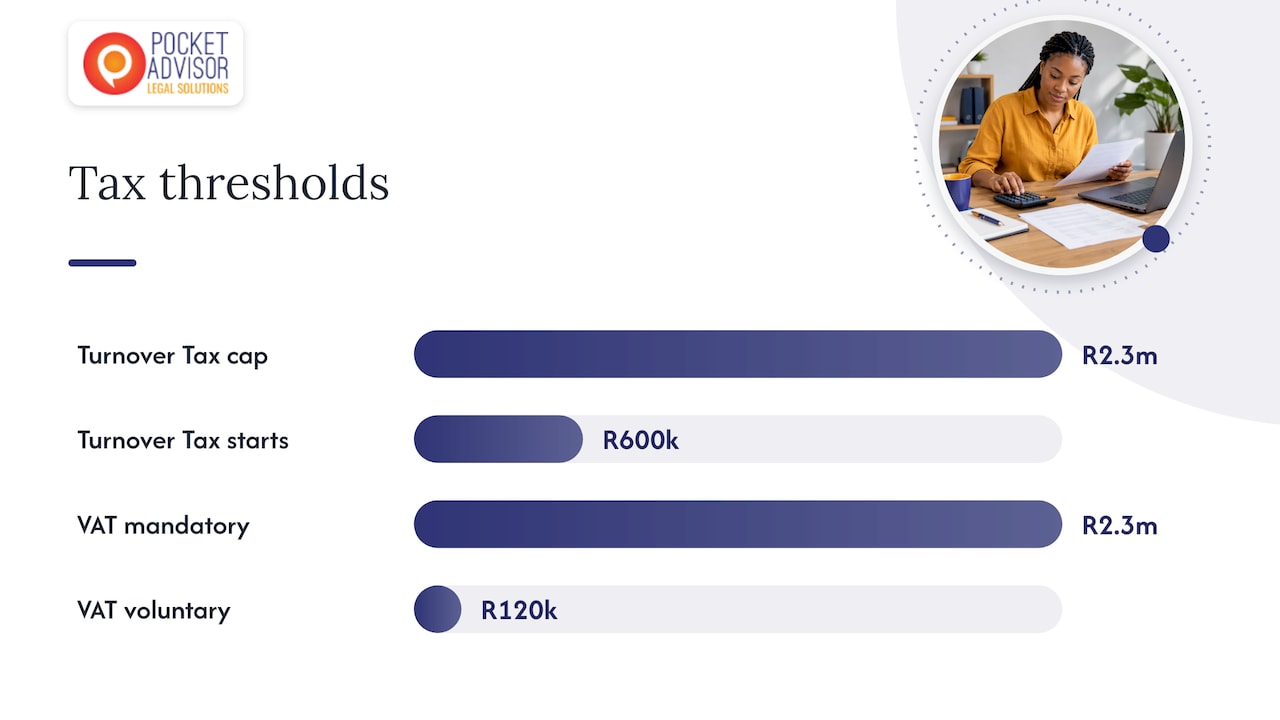
The SARS small business leaflet, updated on 13 April 2026, gives the figures to know. Use the leaflet for the latest numbers, as they can change.
| Question | What the 2026 SARS leaflet says |
|---|---|
| Could Turnover Tax suit you? | It applies to small businesses with annual turnover of R2.3 million or less, in place of income tax, VAT, provisional tax, capital gains tax and dividends tax. Qualifying businesses only start paying once turnover exceeds R600 000. |
| When must you register for VAT? | When taxable supplies exceed R2.3 million in any 12-month period, or are expected to under a written contract. Voluntary registration may apply once supplies exceed, or are likely to exceed, R120 000 in 12 months. |
| Are you an employer? | Register within 21 business days. Deduct PAYE and UIF from pay and submit the monthly EMP201 on or before the 7th. |
| What other returns apply? | ITR14 within 12 months of year-end, VAT201 every two months before the 25th for most, IRP6 twice a year, and EMP501 at the end of October and May. |
The CIPC’s Help for your Business page lists other areas to be aware of: FICA, UIF, workers’ compensation (COIDA), the Skills Development Levy, industry registrations, zoning, workplace health and safety, and B-BBEE. You will not need all of them. Your job is to know which apply to you.
Thandi’s result: With her part-time designer, she is an employer. She finds her monthly payroll submission is being done, but nobody has checked whether her COIDA registration is in place. That goes on her list.
Step 3: Look at the people side
The question: Is everyone who works with you set up in a way that matches reality?
This is where growing businesses most often have a mismatch. Someone starts as a helpful friend, becomes a part-timer, then a regular. The paperwork stays where it began.
Ask yourself:
- Who works for me, and are they employees or independent contractors? The difference changes what you owe them and what they owe you. Our guide to independent contractor versus employee in South Africa explains the thinking.
- Does each person know in writing what they are doing, for what pay and under what terms?
- If you have co-founders, have you written down who owns what share, who does what and what happens if one of you wants out?
The co-founder conversation is the one people avoid, because it feels awkward when things are going well. It is far easier to have it early, while everyone is friendly, than later when the business is worth something. A written agreement is how a good conversation becomes a clear one.
Thandi’s result: She has a verbal arrangement with her designer. She decides to put roles, pay and confidentiality into writing, and asks the questions she should: what is expected, who owns the work produced and what happens when the arrangement changes.
Step 4: Review the agreements you work under
The question: Do your most important relationships have clear, written terms?
List every customer, supplier and collaborator that matters to your income. For each, note whether there is a written agreement, whether it says what you think it says and whether it still reflects how you work.
A few relatable scenarios:
- A supplier delivers late and you lose a client. Who carries that cost? If the terms say nothing, you are guessing.
- A customer asks for extra work beyond the original scope. Is there a clear way to price and agree changes?
- A collaborator shares ideas and information with you. Is it clear what you may and may not do with it?
The point of an agreement is not the document. It is the conversation it forces: what we each expect, what happens if things change, and who decides. Going through that conversation is a negotiation tactic in itself, because you agree the hard parts while you are still on good terms.
Thandi’s result: Her printing supplier has no written terms at all, and her client contracts are copied from an old job. She marks both for review.
Step 5: Protect what you have built
The question: Do you know what is valuable in your business, and who has access to it?
For many small businesses the most valuable assets are not on the balance sheet: a brand name, designs, client lists, software, know-how, personal information about customers. Ask:
- Who created our work, and do we own it? When a freelancer or employee makes something for you, ownership should be clear in writing.
- Who sees confidential information, and what have they agreed to?
- What personal information do we collect about customers and staff, why, and how do we look after it?
These questions are about knowing your assets and handling other people’s information responsibly. They tie directly into the earlier steps: ownership is easiest to settle in your people and supplier agreements.
Thandi’s result: Her designer’s portfolio and her client work share a folder. She realises she has never stated who owns the finished designs. Another line for the list.
Step 6: Check whether you are ready for growth or investment
The question: If someone asked to see our documents tomorrow, could we show a clear picture?
Investors, banks and larger customers want to see that a business is well run. They tend to look for the same things you have just reviewed: a clear ownership structure, up-to-date registrations, tax in order, written terms with staff and key partners, and clarity over who owns the intellectual property.
The ILO’s study on the cost of compliance for South African SMEs notes that each additional registration is time-consuming and costly. That is a good reason to do your review in one sitting and find out what is outstanding, instead of discovering gaps one at a time while a deal is waiting.
Growth changes your legal needs too:
- More people mean more employment arrangements and more to keep up to date with SARS.
- More shareholders or directors mean governance becomes important: who decides what, and how decisions are recorded.
- Bigger customers and suppliers mean more formal commercial terms.
- The Companies Act asks more of a company as it grows, and the CIPC states that private companies need an audit only where the public interest requires it, based on prescribed criteria such as turnover or asset value.
Thandi’s result: Before talking to her investor, she has a clear list: update CIPC details, confirm COIDA, put the designer’s terms and ownership of work in writing, and review the printer and client terms. It is a short list, and every item has a reason.
Score yourself in a single sitting
Use this simple traffic-light approach. For each area, mark it green (in place and current), amber (partly done or unsure) or red (not done).
| Area | Green means | Typical amber or red |
|---|---|---|
| Structure and registration | Structure fits; CIPC details current | Old addresses, unclear shareholding |
| Tax and registrations | Registered, dates diarised | Unsure which taxes apply |
| People | Written terms for everyone | Verbal arrangements |
| Agreements | Key relationships in writing | Copied or outdated terms |
| Protecting what you have built | Ownership and confidentiality clear | Nothing stated |
| Growth and investment | Documents ready to show | Scattered records |
Start with the reds that touch money or ownership, then the ambers. Keep a record of the date and what you found, so next year’s check starts from this one. The SARS guidance also stresses keeping records for the required retention period, which helps here.
A health check shows you where you stand, not what to decide in every case. Where a finding involves a significant decision, such as restructuring, bringing in a shareholder or a complex tax position, speak to an attorney or a registered tax practitioner. The aim is to arrive at that conversation prepared.
Which toolkit fits where you are
Our two toolkits are designed for different stages of the same journey.
- The Legal Toolkit™ for Start-Ups and Solopreneurs (R1 495, one-off) covers the legal foundations of a new business.
- The Legal Toolkit™ for SMEs (R2 495, one-off) is aimed at the governance and commercial arrangements of a growing business.
A solo founder like Thandi in her first year would start with the foundations. By the time she has staff, shareholders and larger customers, the SME toolkit’s focus is closer to what she needs.
Make the health check practical
Each Legal Toolkit™ is a structured digital box: expert-led videos that explain the reasoning, workbooks that help you work through your own situation, professionally drafted South African legal agreements, templates and compliance resources. It is available on demand, so you can work through it at your own pace without necessarily starting with a traditional bespoke legal engagement. It does not replace professional advice, and it does not guarantee compliance. It helps you understand what to ask and what to decide.

Understand the legal foundations your business needs. Explore PocketAdvisor Legal Toolkits™ and discover a more practical approach to legal readiness.
FAQ
How often should I do a business legal health check?
Do a full review once a year, ideally at the same time as your annual returns, and a shorter one whenever something big changes: a new hire, a new partner, an investor or a major customer. Keeping each year’s notes makes the next review quicker.
Does a start-up or a one-person business need one?
Yes. A solo business still has a structure, tax registrations, clients and information to look after. The review is shorter, but the questions about ownership, client terms and who does what are the same.
How do I know if I am ready for investors?
Investors tend to look at ownership, registrations, tax, people arrangements, key agreements and who owns the intellectual property. If you can show each of these clearly and in writing, you are in a strong position. Make more informed decisions about your business’s legal readiness by finding your gaps before the conversation starts.
Can a health check guarantee that my business is compliant?
No. It shows you where you stand and what to ask. Requirements differ by industry, size and structure, so for specific decisions speak to an attorney or a registered tax practitioner.
Sources
- CIPC Compliance Checklist summary, SAICA
- SARS Small Business leaflet 2026
- CIPC: Help for your Business
- Western Cape Government: Starting your own business
- SARS webinar: CIPC presentation 2024
- SARS webinar: Understanding tax obligations for newly registered SMMEs
- ILO: The cost of compliance for South African SMEs
This article is here to educate and inform, not to provide legal advice. For guidance tailored to your situation, please refer to our Legal Toolkits and Legal Project Management (“LPM”) course content, or consult a qualified legal professional.