Most South African founders do not need a law degree. They need to know which legal decisions are coming, why each one matters and what to put in place before it arrives. A classroom-style course can teach concepts, but a busy owner usually gets further with a practical legal resource they can use on their own schedule: expert-led videos, workbooks and professionally drafted South African agreements in one place. That is how we built the PocketAdvisor Legal Toolkits™, and this article explains what to look for, whichever route you take.
Key Takeaways
- Good legal training for entrepreneurs is built around business decisions: taking on a partner, hiring, working with suppliers, protecting ideas and handling customer data.
- Check that the content is South African, current and practical enough for you to act on after finishing.
- A short course teaches concepts. A toolkit adds the workbooks and agreements you need to apply them to your own business.
- Our Start-Up Toolkit covers legal foundations (R1 495 once-off). Our SME Toolkit covers governance and commercial arrangements for growing businesses (R2 495 once-off).
- Legal readiness makes a business easier to run and easier to trust. It does not replace a lawyer when a decision is complex or high-stakes.
Table of Contents
- Why founders go looking for legal training
- What a legal course for entrepreneurs should actually cover
- Course, masterclass or toolkit: what is the difference?
- How to judge any legal course before you pay
- Why a toolkit suits a working founder
- Start-Up Toolkit or SME Toolkit: which fits you?
- Legal readiness is part of running a credible business
- Questions to ask before you sign anything
- Pairing legal readiness with financial readiness
- When a lawyer is still the right call
- A practical way to start
- FAQ
- Sources
Why founders go looking for legal training
Nobody starts a business because they love contracts. The search usually begins with a moment like this.
Thandi is a graphic designer in Cape Town. Two years of freelancing have turned into a steady stream of corporate clients, and one of them asks her to sign a services agreement she has never seen the like of. She wonders whether she should be a company, whether she needs her own terms, and who owns the logo she designs once the invoice is paid.
Or take Sipho and Lerato, who have built a small logistics app in Johannesburg. A friend wants to join as a third co-founder and put in a little money. Nobody has talked about how much of the business that buys, what happens if he leaves, or who decides when they disagree.
None of these is a crisis. They are normal growth steps, and each one is easier if you understand the reasoning before you are sitting across the table. That is what people mean when they type “legal training for entrepreneurs”: they want to feel in control of the decisions, not to become lawyers.
What a legal course for entrepreneurs should actually cover
A useful programme follows the life of a business, not the chapters of a law textbook. These are the areas worth looking for.
Ownership and structure
This covers how your business is set up, who owns what and how decisions get made. For a company, that starts with registration and the founding document that sets out how it runs. If you are still at that stage, our guides to business registration in South Africa and to registering a company through CIPC for R125 explain the first steps in plain language. The next question is how the founding document relates to any agreement between owners, which we unpack in shareholders agreement versus MOI.
People: co-founders, employees and contractors
The questions here are practical. What have we agreed about time, money and roles? Is this person an employee or an independent contractor, and why does the difference matter? South Africa’s Basic Conditions of Employment Act sets out that an employer must give an employee written particulars of employment when they start work, in section 29 of the Act. Good training explains the reasoning behind a rule like that, so you can apply it to your first hire rather than memorise it.
Customers, suppliers and partners
Every commercial relationship is a set of promises. What are you delivering, by when, for how much, and what happens if plans change? A course should teach you which questions to ask before you sign, and how to negotiate terms with confidence, whether you are the one offering the contract or the one receiving it.
Ideas and confidential information
Founders share business ideas with developers, designers, investors and potential partners all the time. Understanding who owns what is created, and how to share sensitive information without giving it away, is a core foundation, not an extra.
Customer data
If you collect names, phone numbers or email addresses, you handle personal information. South Africa’s data protection law is the Protection of Personal Information Act (POPIA). A practical course explains what it asks of a small business and turns that into everyday habits, such as being clear about why you collect information and who can see it.
Growth and governance
Once a business has staff, several owners or larger contracts, the questions change: who decides what, how are owners kept informed, how do we bring in investment or a new partner? This stage is about structure and commercial arrangements rather than basic set-up, and it deserves its own focus.
Course, masterclass or toolkit: what is the difference?
The words overlap, so it helps to compare the formats by what you walk away with.
| Format | Typical shape | What you take away |
|---|---|---|
| Short online course | Self-paced lessons, often with a quiz at the end | Knowledge of concepts |
| Masterclass or workshop | One or a few live or recorded sessions | Ideas and examples, usually on a single topic |
| Legal toolkit | A structured digital box you work through on demand | Understanding plus the workbooks and agreements to apply it |
A course answers “what does this mean?”. A toolkit goes one step further and answers “what do I do on Monday?”. For a founder with a business to run, that second question is usually the one that matters.
The official example shows what a short course can offer. The Companies and Intellectual Property Commission (CIPC) runs Learn-i-Biz, a self-paced digital course of about two hours with seven modules on what a company is, what a director is, director responsibilities, conflicts of interest, remuneration and distributions. It is aimed at the Companies Act of 2008 and director duties. It is a useful grounding in that one area. Running a business also involves employment, commercial agreements, ideas and data, and that is where a broader practical resource comes in.
How to judge any legal course before you pay
Use these five checks. They take ten minutes and save a lot of frustration.
- Is it written for South Africa? Company law, employment rules and data protection differ from country to country. Content built on UK or US examples will not map neatly onto CIPC, South African labour law or POPIA.
- Is it current? Laws change. For example, since the General Laws Amendment Act of 2022, companies have to keep beneficial ownership information with CIPC, filed within set periods after incorporation and updated when it changes. Check when the material was last updated and whether it reflects changes like this.
- Does it explain why, or only what? Rules make sense when you understand the reason behind them. Material that explains the reasoning helps you handle situations the course never mentioned.
- Can you use it afterwards? Look for workbooks, checklists and agreements you can adapt, not just slides.
- Is it clear about what it is? Some programmes are accredited and carry credits on the National Qualifications Framework (NQF); many practical business courses are not, and that is fine if you want skills rather than a qualification. If accreditation matters to you, the South African Qualifications Authority (SAQA) explains how its database lets you check accreditation and qualification legitimacy before you enrol.
Notice what is absent from the list: a certificate. For most owners, the goal is a business that is better organised, not a piece of paper.
Why a toolkit suits a working founder
Time is the scarce resource in a young business. A toolkit is built around that.
Our Legal Toolkits™ are structured digital boxes that you can open on demand. Each one brings together expert-led videos, practical workbooks, professionally drafted South African legal agreements, templates and other compliance resources. They guide founders through key legal requirements, from ownership and governance to employment, commercial agreements, intellectual property and data protection.
The difference from a course is in how you use it. You do not sit through a timetable. You open the section that matches the decision in front of you, watch the video that explains the reasoning, work through the questions in the workbook and then look at the agreement with an understanding of what each part is for. The aim is that you understand an agreement, not just hold a document.
Here is how that looks in practice.
Sipho and Lerato want to bring in their friend as a third co-founder. Before anyone mentions a percentage, they use the workbook questions to talk through what each of them expects: how many hours each will give, what happens if someone steps back, who has the final say on spending. These are the conversations that shape any later agreement, and having them early, while everyone still gets along, is what makes the paperwork straightforward.
Thandi, the designer, wants her own clear terms for corporate clients. She learns why it matters to define who owns the finished work, when ownership passes, and what happens if a client asks for a fourth round of changes. She can then read the client’s agreement with questions ready rather than just signing it.
Start-Up Toolkit or SME Toolkit: which fits you?
The two toolkits suit different stages, and picking the right one avoids buying more than you need.
Legal Toolkit™ for Start-Ups and Solopreneurs: R1 495 once-off
This one is about legal foundations. It suits you if you are a founder, freelancer or solopreneur setting up your business, bringing in your first co-founder, hiring your first person or signing your first big client. The focus is on getting the basics right so you can build on them with confidence.
Legal Toolkit™ for SMEs: R2 495 once-off
This one is about governance and commercial arrangements for growing businesses. It suits you if you already trade, have people and contracts in place and want your structure to keep pace: clearer decision-making between owners, stronger arrangements with customers and suppliers, and preparation for the next stage of growth.
A simple rule of thumb: if your main question is “how do I set this up properly?”, start with the Start-Up Toolkit. If your question is “how do I run and grow what I have with proper structure?”, look at the SME Toolkit. Both are one-off purchases, with no subscription.
Legal readiness is part of running a credible business
It is easy to treat legal work as a box to tick. In practice, readiness shows up in ordinary moments:
- A client asks who handles your customers’ personal information, and you can answer in a sentence.
- A supplier sends a contract, and you know which three clauses to read twice.
- A potential investor asks how decisions are made between owners, and the answer is written down.
- A new hire starts on day one with clear terms, so everyone knows what to expect.
Businesses that handle these moments smoothly look organised, because they are. That is what we mean by legal readiness: not paperwork for its own sake, but a business that others find easy to work with.
We have also put together a short guide on legal compliance for start-ups in South Africa if you want a broader overview of where to begin.
Questions to ask before you sign anything
Whichever resource you use, a few questions travel well across almost every agreement.
- What exactly is each side promising? If you cannot say it in two sentences, the agreement is not yet clear.
- What happens if things change? Prices, deadlines, team members and plans all move. Look for how the agreement deals with that.
- Who owns what is created? This matters for designs, software, content and data.
- How does this end? Every relationship ends eventually. Knowing the exit route at the start keeps the relationship friendly.
- What do I need to keep private, and who needs to know? Decide before you share, not after.
Working through these questions gives you a better conversation with the other side and, when you do bring in a lawyer, a better brief.
Pairing legal readiness with financial readiness
Legal and financial decisions often arrive together: a new partner means money, a new supplier means payment terms, a new hire means payroll. A financial consulting checklist for startups is a handy companion for thinking through the money side while you sort out the legal side. Having both in order makes each conversation, with an investor, bank or customer, much easier.
When a lawyer is still the right call
Legal readiness does not mean you never need professional advice. Some situations deserve a lawyer’s attention for your specific facts: a complex ownership structure, a large or unusual contract, a major investment or an acquisition. The practical benefit of understanding the foundations is that you arrive prepared, with clear questions and organised documents, so the time you spend with a lawyer goes further. If you are unsure where that line sits for your business, our article on whether you need a lawyer to start a business in South Africa walks through it.
A practical way to start
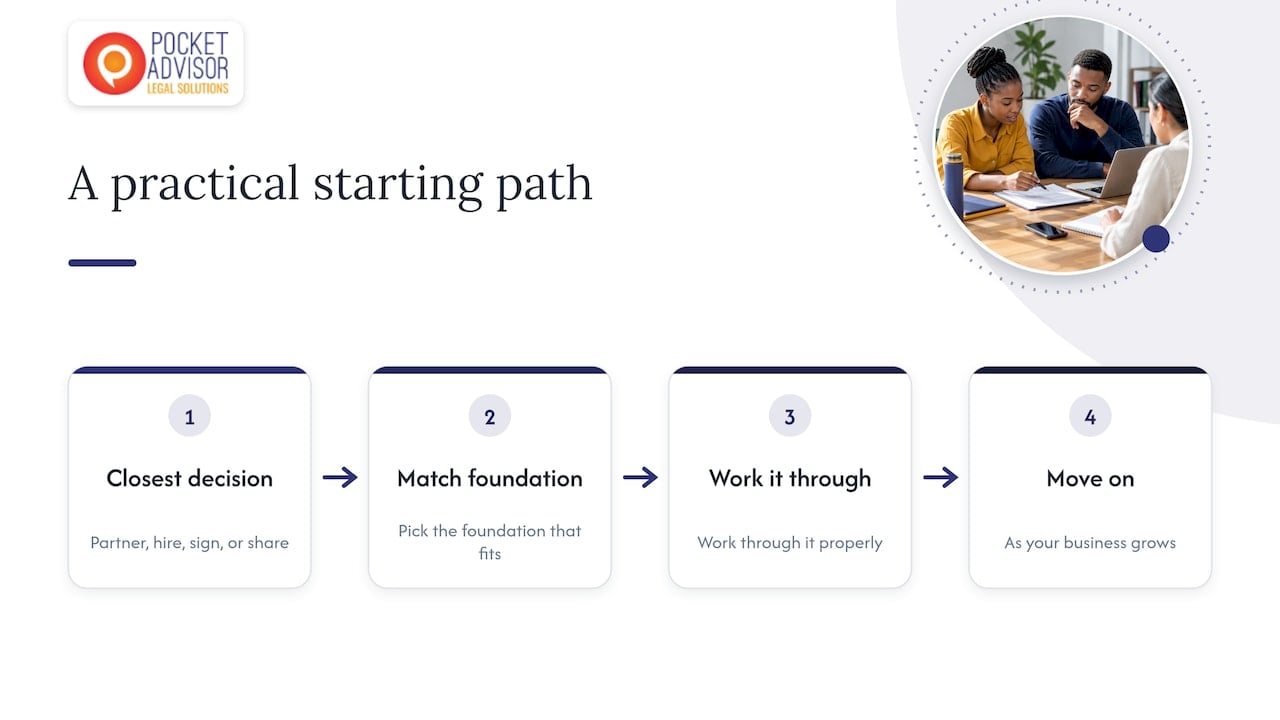
If you are weighing up a legal course for your business, begin with the decision that is closest. Are you about to take on a partner, hire someone, sign a big client or share your idea? Pick the foundation that matches, work through it properly, and move on to the next one as your business grows.
Our Legal Toolkits™ are designed for exactly that way of working. Each one is a digital box you can use on demand, with videos that explain the reasoning, workbooks that turn it into decisions and professionally drafted South African agreements you can understand rather than simply sign.

If this sounds like the right fit, you can explore PocketAdvisor Legal Toolkits™ and choose between the Start-Up Toolkit and the SME Toolkit. It is a way to understand the legal foundations your business needs and make more informed decisions about your business’s legal readiness.
FAQ
Is there a legal course for entrepreneurs in South Africa that is not aimed at lawyers?
Yes. Good business-focused legal training is written for owners, in plain language, and is organised around decisions such as partnerships, hiring and contracts. Our Legal Toolkits™ follow this approach, with expert-led videos, workbooks and South African agreements in one digital box.
Do I need any legal knowledge before I start?
No. Practical legal training for entrepreneurs assumes no background. CIPC, for example, designed its Learn-i-Biz course for prospective, new and existing small businesses, and welcomes anyone with a genuine interest in the subject.
Will a legal course give me an accredited qualification?
Not necessarily, and most practical business courses do not. CIPC states that its Learn-i-Biz course is not accredited and carries no NQF credit. If you need a recognised qualification, SAQA’s database lets you check accreditation before you enrol.
Which Legal Toolkit™ should I choose?
Choose the Start-Up and Solopreneur Toolkit (R1 495 once-off) if you are setting up or building the first foundations. Choose the SME Toolkit (R2 495 once-off) if your business is already trading and you want stronger governance and commercial arrangements as it grows.
Does a toolkit replace a lawyer?
No. It helps you understand your legal needs and prepare properly, and it makes conversations with a lawyer more focused. For complex or high-value decisions, you should still take professional legal advice.
Sources
- Learn-i-Biz Course, CIPC (5 February 2026)
- Basic Conditions of Employment Act, Department of Employment and Labour
- Beneficial Ownership webinar, CIPC (September 2023)
- Check your higher learning institution before you enrol, SAnews
This article is here to educate and inform, not to provide legal advice. For guidance tailored to your situation, please refer to our Legal Toolkits and Legal Project Management (“LPM”) course content, or consult a qualified legal professional.