
An alternative fee arrangement (AFA) is any method of pricing legal work that is not built on the billable hour. For a South African practice, the practical options are fixed or phased fees, capped fees, retainers, contingency fees within the limits of the Contingency Fees Act, and hybrids of these. Each can improve the client’s cost certainty. Each also moves risk onto the firm, which is why the pricing model matters less than the discipline used to scope, document and manage the matter behind it.
This article sets out the main models, the South African rules that frame them, a method for pricing a fixed fee, and the controls that stop an AFA from eroding profitability.
Key takeaways
- An AFA prices value, scope or outcome rather than time. The firm gains predictability for the client and takes on the risk of overruns.
- South African practitioners must charge reasonable fees, confirm instructions in writing and, for contingency work, comply with the Contingency Fees Act 66 of 1997.
- A fixed fee is only as sound as its scope: deliverables, assumptions, exclusions, disbursements and a change process must be written down before work starts.
- Legal project management, meaning scoping, budgeting, resourcing and change control, is what makes AFAs commercially sustainable.
Table of Contents
- What alternative fee arrangements are, and why firms consider them
- The South African rules that frame every fee arrangement
- The main models compared
- Pricing a fixed fee: a method
- Documenting the arrangement and controlling scope
- Advantages and risks for clients and firms
- What makes AFAs sustainable: legal project management
- Building the capability in your firm
- Frequently asked questions
- Sources
What alternative fee arrangements are, and why firms consider them
Altman Weil, the legal management consultancy, describes AFAs as methods of pricing services that are not based on the billable hour, intended to align price with the value delivered and to improve budget predictability.
The case for them rests on two observations. First, hourly billing is in effect a cost-plus model: the more time spent, the higher the fee. One US commentator argues that this may discourage effective management of the engagement, whereas an AFA forces client and lawyer to define objectives and value at the outset. Second, clients, particularly businesses with in-house legal functions, increasingly ask for a price before they instruct.
A caution is warranted. Deloitte observes that many corporate legal departments use “time-based” AFAs, which are essentially repackaged hourly work, while value-based arrangements that decouple fees from hours entirely remain modestly adopted. A flat fee that is merely the hourly estimate in disguise delivers little of the alignment AFAs promise. A fee earns the label only when the firm has priced the outcome and its own efficiency.
The South African rules that frame every fee arrangement
No South African statute prohibits fixed or retainer pricing. The constraints come from the profession’s conduct rules and, for one model, from legislation.
Reasonableness and transparency
The Legal Practice Council’s Code of Conduct requires that all fees charged be reasonable. If a dispute arises in a fees enquiry conducted by the LPC, the practitioner must be able to justify that reasonableness. A fixed fee does not escape this test. If a matter proves far simpler than priced, the firm should still be able to explain why the fee was reasonable at the time it was agreed.
The Law Society of South Africa sets out what clients are entitled to expect: agreement on the type of service, knowing who will handle the matter, explanations of costs, being kept informed of costs and progress, and a clear bill showing the work done and the amounts charged. An AFA should be drafted so that each of these can be met without improvisation.
Scope and written instructions
De Rebus reports that Rule 35 of the Legal Practice Act rules requires an attorney to define the intended scope with sufficient clarity, to seek written clarification where uncertain, and to confirm verbal instructions in writing as soon as practicable. For fixed-fee work this obligation and good commercial practice coincide: the scope is the price.
Contingency fees
The Contingency Fees Act 66 of 1997 governs “no win, no fee” arrangements. A success fee may not exceed the normal fee by more than 100 percent and, for claims sounding in money, may not exceed 25 percent of the total amount awarded. A valid agreement must be in writing and signed by the client and the practitioner, and must include advice on other financing options and on the client’s liability for the opponent’s costs if the claim fails. Practitioners should read the Act itself before drafting, since non-compliance affects enforceability.
The main models compared
The table summarises the arrangements most commonly used in practice. It is a framework for choosing, not a price list.
| Model | How the fee works | Suits | Principal risk to the firm |
|---|---|---|---|
| Fixed fee (whole matter) | One agreed amount for defined deliverables | Repeatable, well-understood work: standard commercial agreements, company-secretarial tasks, document reviews | Scope creep and underestimation |
| Phased or staged fee | A fixed amount per stage, agreed stage by stage | Transactions and projects with natural milestones | Cost of later stages unknown at the outset |
| Capped fee | Time-based billing up to an agreed ceiling | Matters with a defined upper limit but uncertain effort | Work above the cap is unrecovered |
| Retainer | A monthly amount for ongoing availability or an agreed volume of work | Continuing client relationships and general business advice | Demand exceeding the retained capacity |
| Blended or discounted rate | One rate across seniority levels, or a negotiated discount | Mixed-team matters; volume clients | Team mix drifting towards senior time |
| Contingency fee | Fee payable only on success, within statutory limits | Suitable claims for money, where the Act applies | Unrecovered investment if the claim fails |
| Third-party funded | An external funder finances the matter in return for a share of proceeds | High-cost litigation | Dependence on funder terms and on case selection |
Two points on the more specialised entries. Retainers in South Africa are typically used to give clients predictable costs, often with lower hourly rates in exchange for a continuous flow of work or a fixed monthly amount. Third-party litigation funding, as it is generally described in South African study material, involves an external funder supporting costly litigation in exchange for a portion of the winnings, with the client usually owing nothing if the case fails; the terms of any particular arrangement should be verified against primary law and the funding agreement itself.
Pricing a fixed fee: a method
A defensible fixed fee is built, not guessed. The following sequence works for most commercial matters.
- Define the deliverable. State exactly what the client receives: for example, a shareholders’ agreement, one round of client comments, and a final execution version.
- Break the work into tasks. List the tasks behind the deliverable: taking instructions, research, drafting, internal review, client consultation, finalisation.
- Estimate effort from your own data. Use time recorded on comparable past matters, by seniority level, rather than memory. Where there is no data, record time on the next few matters in order to create it.
- Identify the cost drivers. Complexity, risk, urgency, number of documents, number of parties and negotiation intensity all move the price. A published fee guide from one South African commercial practice lists these same variables, together with whether the matter is advisory or drafting work.
- Add contingency and margin. Price in the likelihood of ordinary variance. Do not price on the best-case outcome.
- State assumptions and exclusions. Everything not priced must be visibly excluded.
- Test the number against the value. Ask what the outcome is worth to the client, and whether the fee is reasonable in the sense the Code of Conduct requires.
What the quote should say
The same fee guide indicates that a fixed-fee quote should state the scope and deliverables, the included review rounds, assumptions and limitations, the treatment of disbursements, VAT treatment and the expected turnaround. It identifies as typical exclusions major scope changes, extensive negotiations, extra documents, urgent after-hours work, travel, third-party costs, counsel fees, and CIPC, Deeds Office and courier charges. Adopt the principle even if your list differs: whatever you would be unwilling to absorb belongs in the exclusions.
A worked illustration
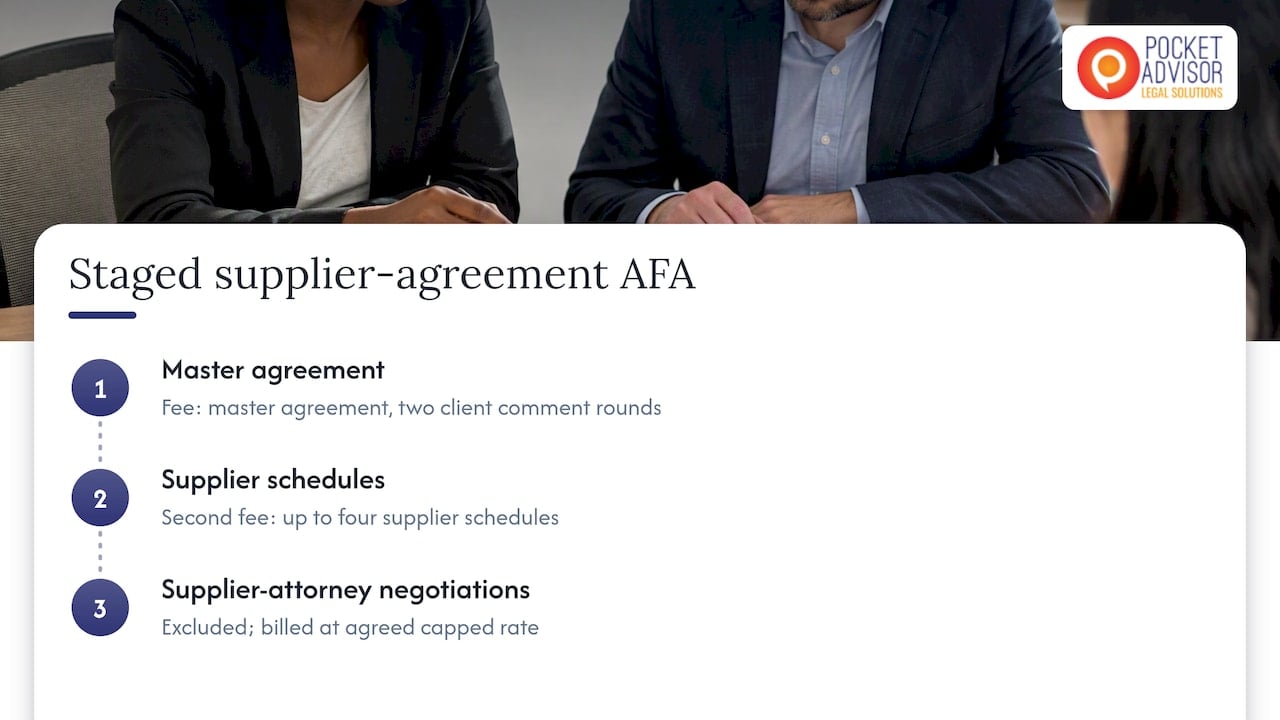
Consider a hypothetical mid-sized firm asked by a growing logistics company to prepare a suite of supplier agreements. Under hourly billing, the client cannot budget and may restrict the instruction to avoid cost. Under a staged AFA, the firm agrees a fee for the first stage: a master supplier agreement with two rounds of comments from the client. A second fee covers up to four supplier-specific schedules. Negotiations with the suppliers’ own attorneys are excluded and billed at an agreed capped rate. The client knows its exposure, the firm has bounded its risk, and the one genuinely unpredictable element is priced separately. The figures are illustrative, but the structure is the point: fix what can be defined, cap what cannot.
Documenting the arrangement and controlling scope
Most AFA losses arise after the fee is agreed. Scope creep, the gradual expansion of work beyond what was priced, is the usual cause. De Rebus advises that the firm set out the intended scope clearly in a signed document, confirm verbal instructions in writing, and, when changes arise, discuss and agree them and record them in an addendum or new document that specifies the additional services, fees and timelines.
A workable control process has four parts:
- A written mandate that attaches the scope, assumptions and exclusions to the fee.
- A change trigger. Define in advance what counts as a change, such as a new party, a new document or a further negotiation round, and who must be informed when it occurs.
- A named decision-maker at the firm who can approve a variation quickly, so that delay does not tempt fee-earners to absorb extra work silently.
- Interim reporting. Even on a fixed fee, record time and report progress. Time data is the raw material for pricing the next matter, and clients are entitled to be kept informed of progress.
Tone matters here. Presented early, a change request is a professional courtesy to the client. Presented late, it reads as a dispute. The conversation is far easier when the client signed a document that anticipated it.
Advantages and risks for clients and firms
For clients, AFAs improve cost predictability and encourage firms to work efficiently, according to Altman Weil’s analysis. They also remove the incentive to limit instructions out of fear of the meter.
For firms, the same analysis notes the risk of unprofitable outcomes where matters exceed the expected scope. Two further risks deserve mention in the South African context. The first is reasonableness: a fee that is fixed is not immune from scrutiny. The second is professional conduct. In cases of unethical conduct or abuse of process, courts may order costs de bonis propriis, making the legal representative personally liable for punitive costs. A pricing model that rewards speed must never be allowed to weaken the quality of work or the duty to the court.
Where fixed fees are most readily scoped, the evidence points to repeatable commercial work: shareholders’ agreements, contract reviews, customised commercial agreements and similar defined packages. Highly uncertain work, particularly contested litigation, usually calls for a capped, phased or contingency structure instead.
What makes AFAs sustainable: legal project management

Pricing is the visible part of an AFA. The invisible part is delivery: resourcing the right people, tracking budget against progress, managing risk and communicating with the client. These are the functions of legal project management, which is more than generic project management because it joins structure to commercial awareness and a continuous-improvement mindset specific to legal work.
In practice, a firm that applies LPM to its AFAs will typically:
- build its fixed-fee estimates from matter data rather than instinct;
- agree a plan with the client that sets out phases, assumptions and responsibilities;
- review completed matters to see where the estimate was right or wrong, and adjust;
- decide where technology and automation add genuine value to a fixed-price service, and where they do not.
Further reading on the topic is available in our guides to legal project management for lawyers, law firm project management in South African practices and strategic frameworks for legal team management.
Building the capability in your firm
PocketAdvisor offers the Applied Legal Project Management Course, a practical programme for lawyers, in-house counsel and legal team leaders who want to manage scope, budgets, resources and client expectations with method. Students who successfully complete the course receive international accreditation through the International Institute of Legal Project Management (IILPM), subject to the programme’s completion requirements. The credential helps lawyers strengthen their expertise and distinguish themselves in a competitive profession. The course fee is R9 500, as published on our site.
Explore PocketAdvisor’s internationally accredited Legal Project Management Course: https://pocketadvisor.co.za/legal-project-management-course/

Frequently asked questions
Are fixed fees permitted for South African attorneys?
Yes. The Code of Conduct does not prohibit them; it requires that fees be reasonable and that the practitioner be able to justify them if challenged. The mandate should record the agreed scope and fee in writing, consistent with the Rule 35 expectation that instructions be defined clearly and confirmed in writing.
What is the maximum contingency fee in South Africa?
Under the Contingency Fees Act 66 of 1997, a success fee may not exceed the practitioner’s normal fee by more than 100 percent. For money claims it may also not exceed 25 percent of the total amount awarded. The agreement must be in writing, signed by both client and practitioner, and contain the advice the Act prescribes.
What should a fixed-fee quote include?
It should state the scope and deliverables, the number of review rounds, the assumptions, the treatment of disbursements and VAT, the expected turnaround and the exclusions. Typical exclusions are major scope changes, extended negotiations, urgent after-hours work, counsel fees and third-party charges. Anything left unstated will usually be absorbed by the firm.
Which matters suit a fixed fee?
Repeatable, well-defined work: standard commercial agreements, shareholders’ agreements, contract reviews and similar packages. Matters with an unpredictable course, such as contested litigation, are better suited to phased, capped or contingency structures. Firms should decide using their own historical matter data.
Sources
- Altman Weil: Alternative Fee Arrangements Special Report
- Carlton Fields: Alternative Fee Arrangements
- Deloitte: Value-Based Pricing
- Legal Practice Council: Code of Conduct
- Law Society of South Africa: Your Rights as a Client
- De Rebus: Managing the risk of scope creep
- Contingency Fees Act 66 of 1997
- Botha Bezuidenhout Attorneys: Retainer agreements
- Study summary on legal costs and litigation funding
- MJ Kotze Inc: Legal fees
- Legal Practice Council: Guide for Legal Costs, Regulation 6(10)(l)
This article is for educational and informational purposes only. It is not a substitute for professional advice.