
An alternative fee arrangement (AFA) is any method of pricing legal services that does not rest purely on hourly rates. In South Africa the main forms are fixed fees, retainers, capped fees and success-based fees, each governed by the Legal Practice Act 28 of 2014, the Legal Practice Council (LPC) rules and, for litigation, the Contingency Fees Act 66 of 1997. This guide explains how each works, when it suits a matter, what must be agreed in writing, and why disciplined scoping and budgeting determine whether an AFA is profitable.
Key takeaways
- An AFA ties the fee to the value and scope of the work rather than to time recorded. It works only when scope is defined with precision at the outset.
- South African practice already uses fixed fees, monthly retainers, fee caps and, in litigation, contingency and success fees within statutory limits.
- Written terms are not optional: the Legal Practice Act and LPC guidance require an engagement letter and a written cost estimate, and contingency agreements must follow a prescribed form.
- The commercial risk of an AFA sits with the firm. Scoping, budgeting and change control are the capabilities that manage it.
Table of Contents
- What an alternative fee arrangement is
- Why the conversation is gaining ground in South Africa
- The main types of AFA used in South Africa
- Advantages and disadvantages
- Professional and statutory rules that apply
- Choosing the right arrangement for a matter
- Managing scope so the arrangement remains profitable
- Where legal project management fits
- Implementing an AFA programme: a practical sequence
- FAQ
- Sources
What an alternative fee arrangement is
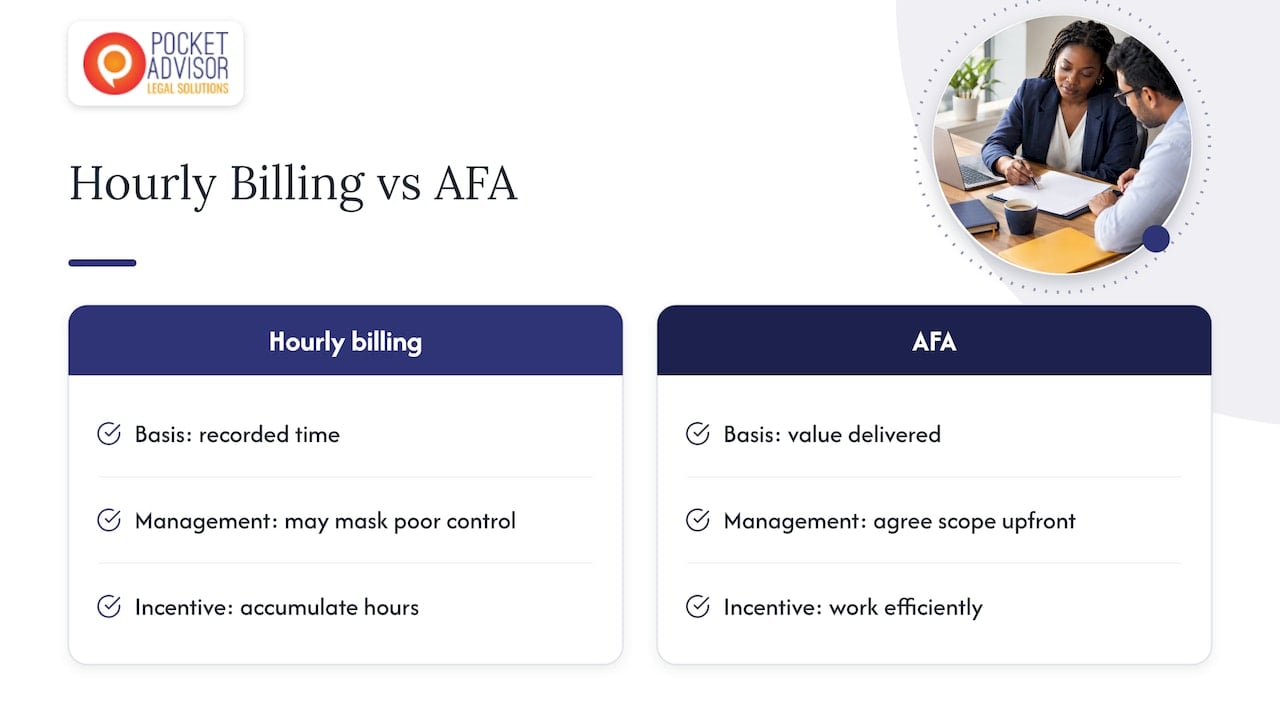
Hourly billing treats recorded time as a proxy for cost and value. An AFA focuses instead on the value delivered to the client, which gives the client predictability and gives the firm a reason to work efficiently rather than to accumulate hours.
It is a mistake to equate an AFA with a discount. Writing in the Michigan Bar Journal, Crawford and Davis argue that a well-crafted arrangement is a mechanism for aligning compensation with the value the client perceives, not a means of charging less. A firm that prices a due diligence at a fixed amount and completes it efficiently earns more per hour than one that bills time, and the client still gains certainty.
There is also a management point. Hourly billing is often treated as a standard cost-plus model, yet it can mask a failure to manage the engagement properly, whereas a fixed fee obliges both sides to agree on scope and value at the start.
Why the conversation is gaining ground in South Africa
The billable hour has been central to law firm economics in South Africa since the 1970s. One local commentator notes that client demand for transparency and the growth of automated work are driving a shift towards fixed fees. For corporate clients and in-house teams, the practical result is a simple request: tell us what this will cost before you start, and tell us what is included.
For firms, that request cannot be met by good intentions. It requires historical data on how long comparable matters take, a defined sequence of tasks, and an agreed method for handling work that falls outside the original brief. Those are project management disciplines, and we return to them below.
The main types of AFA used in South Africa
South African firms describe their own offerings in fairly consistent terms. One corporate practice in Randburg lists monthly retainers for ongoing advisory or company-secretarial work, fixed-fee quotes for routine tasks, structured fees with a retainer element for larger transactions, and success or completion fees where warranted. The table below summarises the principal models.
| Model | How the fee is set | Best suited to | Main risk |
|---|---|---|---|
| Fixed (flat) fee | A single Rand amount for a defined deliverable | Repeatable work: contracts, company registrations, standard transactions | Firm absorbs overruns; client may overpay for a quick task |
| Capped fee | Time-based fees up to an agreed ceiling | Matters with a known upper bound but uncertain effort | Cap too low erodes margin; cap too high gives the client little |
| Retainer | A recurring monthly fee for a defined scope of ongoing work | Continuing advisory, company-secretarial or compliance support | Under-use by the client or over-use beyond the stated scope |
| Hybrid or staged | Fixed fees per stage, or a retainer plus a completion element | Larger transactions with distinct phases | Complexity in drafting and tracking |
| Contingency or success fee | Fee linked to the outcome, within statutory limits | Litigation with reasonable prospects of success | Regulatory compliance; uncertain recovery |
Fixed fees
A fixed fee suits work whose steps are well understood. One South African firm’s terms of engagement show the pattern: fixed-fee items are quoted as a single Rand amount per deliverable, the proposal defines the scope, and work outside that scope or additional revisions may be billed separately. Further work is quoted and agreed in writing before it begins.
That last element is what makes a fixed fee commercially sustainable. The fee is fixed; the scope is not unlimited.
Capped fees
A cap differs from a flat fee because time is still recorded and the client’s exposure is limited. A 2023 study of public-interest law organisations in South Africa records reduced counsel rates with maximum caps of R50 000 for an opinion and R100 000 for an application, while allowing departures where a matter expanded through several court stages or unexpected interlocutory proceedings. The example is useful beyond its setting: a cap should come with a clear statement of the events that justify revisiting it.
Retainers
Retainers are frequently structured as a fixed monthly fee, which gives clients predictable costs and, in some models, reduced rates in exchange for a continuous flow of work. For the firm, the benefit is stable revenue and a deeper relationship. The discipline lies in defining what the monthly fee covers, how unused capacity is treated and when additional work is charged separately.
Contingency and success fees
In litigation, the Contingency Fees Act sets the boundaries. A practitioner may enter into a contingency fee agreement if, in their opinion, there are reasonable prospects that the client may be successful. The Act also permits an uplift model in which the practitioner charges normal fees plus an agreed additional fee on success. That additional fee may not exceed 100% of normal fees and, for monetary claims, may not exceed 25% of the amount awarded or obtained, excluding costs.
Third-party funding is a related but separate topic. It is permissible in South Africa and, according to one global guide, is not currently governed by specific legislation, with PriceWaterhouseCoopers Inc v National Potato Co-operative Ltd (2004) a significant case shaping the law.
Advantages and disadvantages
An American Bar Association review lists the benefits as price transparency, clearer expectations and greater efficiency. The drawbacks are symmetrical: the lawyer may do more work than anticipated, and a client may pay more than an hourly rate would have cost for a quick task. The same review suggests AFAs may also help to narrow the access-to-justice gap by making legal services affordable to clients who would otherwise be unable to instruct a lawyer.
For a partner deciding whether to offer an AFA, the question is rarely whether the model is attractive in principle. It is whether the firm can estimate effort reliably, hold the scope, and detect early when a matter is drifting. A firm that cannot do this is better served by hourly or capped fees until its data improves.
Professional and statutory rules that apply
Reasonable fees and overreaching
The LPC’s guide on legal costs states that overreaching occurs when a practitioner exploits a position of trust, vulnerability or superior bargaining power to extract excessive or unconscionable fees, and that this is unprofessional conduct. The guidance’s stated aim is that fees be reasonable and accessible. A fixed fee is not immune: a price that is agreed but out of proportion to the work, or that includes work not strictly necessary, remains open to scrutiny.
Written terms
The documentation requirements deserve precise attention:
- Engagement letter. Clients should sign a letter recording the scope of work, the method of calculating the fee and the payment terms, under sections 37(7) to (9) of the Legal Practice Act. Practitioners using fixed fees or retainers are advised to execute that letter so that the three elements are beyond doubt.
- Cost estimate notice. Under section 35(7), a practitioner must give the client a written cost estimate notice setting out the estimated fees and disbursements. The LPC guide pairs this with a written agreement appointing the attorney and recording payment of the estimated costs.
- Contingency fee agreements. These must be in writing, in the prescribed form, signed by client and practitioner, define success or partial success, explain fees and disbursements, and disclose the implications of alternative litigation financing and possible liability for the opponent’s costs.
Practitioners should confirm the current text of the Act, the regulations and the LPC rules before finalising any template, as these instruments are amended from time to time.
Choosing the right arrangement for a matter
There is no universally ideal model. The public-interest study referred to above concludes that the right choice depends on the predictability of scope, the budget risk and the commercial or public-interest context. A Dutch firm’s published approach puts the process well: choose collaboratively, by determining the scope of work and weighing the client’s preferences, the expected work and the legal spend.
In practice a partner can work through four questions:
- How predictable is the work? A shareholders’ agreement for a two-party start-up is more predictable than a contested commercial dispute.
- What data do we hold? Recorded time on comparable matters is the foundation of any credible fixed price.
- What does the client value? Some clients want certainty above all; others want a lower fee and will accept variability.
- What could change the scope? Identify the likely triggers (additional parties, regulatory approvals, document volume) and decide in advance how each will be priced.
A worked example
Consider a mid-sized firm asked to prepare a standard supply agreement and negotiate it with one counterparty. Historical files show the work usually takes between twelve and sixteen hours of attorney time, with one round of comments from the other side. The firm may quote a fixed fee based on the upper end of that range, state that it covers drafting and two rounds of revisions, and record that a third round, additional parties or a change of governing law will be quoted separately before work proceeds. The figures here are illustrative only; the method is what matters. The scope, the assumptions and the change trigger are all written down.
Managing scope so the arrangement remains profitable
The commonest reason an AFA fails commercially is scope creep. De Rebus guidance on the subject treats documentation as the principal control: changes should be recorded in an addendum or a new engagement document before additional work proceeds. Our own article on scope creep in law firms examines how to recognise and price it.
Several practices support this:
- Define deliverables, assumptions and exclusions in the engagement letter, not in an email thread.
- Set a budget by phase and compare actual effort with it at defined intervals.
- Nominate one person to approve changes to scope, and give clients a simple way to request them.
- Review each completed matter: what did it cost the firm in effort, and what should the next quote assume?
This last step is the continuous-improvement element. A firm that records the real cost of each fixed-fee matter will price the next one more accurately and will know which services to offer on a fixed basis and which to keep hourly. Our overview of law firm project management and of legal team management sets out how these routines fit into the wider operation of a practice.
Where legal project management fits
Pricing differently is a commercial decision; delivering profitably under that pricing is an operational one. Legal project management supplies the structure: scoping, budgeting, resourcing, risk identification, client communication and post-matter review. It is more than generic project management because it is built around the particular economics, ethics and client expectations of legal work. It also helps firms and legal departments decide where technology and automation add genuine value, for instance by identifying which repeatable steps in a fixed-fee matter justify a template or a workflow tool, and which do not. Our guide to legal project management for lawyers explains the discipline in more detail.
PocketAdvisor holds the exclusive right in South Africa to offer the internationally accredited programme of the International Institute of Legal Project Management (IILPM). The Applied Legal Project Management Course costs R9 500 and is designed for lawyers in firms, in-house counsel and legal team leaders who need to price, scope and deliver work with commercial discipline. Students who complete the course successfully receive IILPM accreditation, subject to the programme’s completion requirements, a professional credential that helps lawyers strengthen their expertise and distinguish themselves in a competitive profession.
Explore PocketAdvisor’s internationally accredited Legal Project Management Course: https://pocketadvisor.co.za/legal-project-management-course/

Implementing an AFA programme: a practical sequence
Firms moving from purely hourly billing need not change everything at once. A measured approach is more defensible, both commercially and professionally.
- Select two or three repeatable services. Company registrations, standard employment documents or routine property transactions are typical candidates.
- Analyse past matters. Establish the range of effort and the causes of variation.
- Draft the engagement letter and cost estimate notice. Make sure they record scope, fee method and payment terms, in line with the Legal Practice Act.
- Pilot with willing clients. Choose clients who understand the model and will give feedback.
- Review at fixed intervals. Compare quoted fees, effort and client satisfaction, and adjust the next set of quotes.
- Extend gradually. Add retainers for continuing relationships and capped or staged fees for larger matters only when your data supports them.
In-house teams can use the same sequence when instructing external counsel. Asking panel firms to quote on a fixed or capped basis, with the scope and assumptions stated, shifts the conversation from hours to outcomes and makes comparison between firms meaningful.
FAQ
What is the difference between a fixed fee and a capped fee?
A fixed fee is a set amount for a defined deliverable, regardless of the time spent. A capped fee is calculated on time but cannot exceed an agreed ceiling. Both should state which events permit the fee to be revisited.
Are success fees lawful in South Africa?
In litigation, yes, within the limits of the Contingency Fees Act. An uplift may not exceed 100% of normal fees and, for monetary claims, 25% of the amount awarded or obtained, excluding costs. The agreement must be in writing and in the prescribed form.
Do I still need an engagement letter for a fixed-fee matter?
Yes. The Legal Practice Act contemplates a written record of the scope, the method of calculating the fee and the payment terms, and the LPC guidance also calls for a written cost estimate notice. A clear letter also protects the firm if the client later requests additional work.
Can a fixed fee ever amount to overreaching?
It can, if the fee is excessive or unconscionable, or if it exploits the client’s position or includes work that is not strictly necessary. The LPC treats overreaching as unprofessional conduct, so the fee should always be defensible against the work required.
Is an AFA the same as charging less?
No. A well-designed AFA aligns the fee with the value the client perceives and the effort the firm can reliably estimate. Firms with good scoping and budgeting data frequently earn more per hour under fixed fees than under hourly billing.
Sources
- Alternative Fee Arrangements, Carlton Fields
- Show Me the Bill: Alternatives to the Hourly Rate, Michigan Bar Journal
- The Shift to Flat Fee Billing, AJS South Africa
- Corporate Lawyers in Randburg, Burger Huyser Attorneys
- Terms of Engagement, MJ Kotze Inc
- Public Interest Law Organisations in South Africa, Jason Brickhill, 2023
- Retainer Agreements, Botha Bezuidenhout Attorneys
- Contingency Fees Act 1997, SAFLII
- South Africa: Global Guide to Litigation Funding, Eversheds Sutherland
- Alternative Fee Arrangements Put the Focus on Value, Not Time, American Bar Association
- Legal costs, in terms of Regulation 6(10)(l), Legal Practice Council
- Legal Fees, Bregman Moodley Attorneys
- Fee Arrangements, Houthoff
- Managing the risk of scope creep, De Rebus
Recommended
This article is for educational and informational purposes only. It is not a substitute for professional advice.