
A board resolution is the formal, written record that your directors have made a decision on behalf of the company. In South Africa, the directors pass it for day-to-day management decisions. Shareholders pass their own resolutions for the matters the Companies Act 71 of 2008 or your Memorandum of Incorporation (MOI) reserves for them. Getting this right means asking three things before every important decision: who has the power to decide, how many votes are needed, and where the decision will be recorded.
Key Takeaways
- Directors decide most management and strategy matters. Shareholders decide the matters the Act or the MOI reserves for them, such as changing the MOI.
- An ordinary resolution needs more than 50% of the voting rights exercised. A special resolution needs at least 75%, unless the MOI changes the figures within the limits of the Act.
- Directors can pass a resolution without a meeting, but every director must receive notice and the required majority must consent in writing.
- Date and number each resolution, never backdate it, and keep the records for seven years.
- Check authority first. A resolution that is neatly voted but outside the board’s powers can still fall away.
Table of Contents
- Why resolutions matter more than they look
- Who decides: the board or the shareholders?
- Ordinary and special resolutions
- How the board passes a resolution
- Check authority before you vote
- What the record should contain, and how long to keep it
- Habits that make resolutions easy
- Building these foundations with a practical toolkit
- FAQ
- Sources
Why resolutions matter more than they look
Picture Thandi and Pieter, who run a small design studio as a private company. Pieter wants to sign a three-year lease for a bigger office. Thandi agrees over coffee. Months later the landlord, the bank and a prospective investor all ask the same question: where is the board’s approval?
That is the practical value of a resolution. It shows that the people with the power to decide did decide, and it gives the decision a date, a wording and a signature. When someone outside the company needs comfort, such as a bank opening an account, a landlord, a buyer or an investor, the resolution is the document that provides it.
It also shows you took the decision seriously. Directors have duties to act in good faith and in the company’s best interests, and a clear record of what was decided and why is a sensible way to show it. This is part of building a credible, well-run business, rather than a paperwork exercise.
If you want a plain-language walk-through of how directors take decisions, our guide to directors’ resolutions and decisions in South Africa covers the everyday side.
Who decides: the board or the shareholders?
The starting point is a split of roles. The board manages the business and affairs of the company. Shareholders keep a short list of fundamental powers, some set by the Act and some by the company’s own MOI. As a professional corporate governance guide for South Africa puts it, the board makes most strategy and general-management decisions, while shareholders approve reserved matters such as specified share issues, MOI amendments, auditor appointments and a voluntary winding-up.
The same guide notes that high-impact decisions, such as amending the MOI, fundamental transactions or a voluntary winding-up, legally require a special resolution of shareholders.
A simple way to think about it:
| Type of decision | Usually decided by | Everyday example |
|---|---|---|
| Running the business | Board resolution | Signing a supplier contract, opening a bank account, approving a budget |
| Appointing officers and signatories | Board resolution | Authorising Pieter to sign the office lease |
| Changing the company’s founding rules | Shareholders, by special resolution | Amending the MOI |
| Certain share issues | Shareholders, where the Act or MOI requires it | Issuing shares to a new investor |
| Ending the company voluntarily | Shareholders, by special resolution | Voluntary winding-up |
The Act and your MOI decide the final division, so always read your MOI before assuming the board can act alone. Many small companies have never looked at theirs since registration. Our comparison of the shareholders’ agreement and the MOI explains how the two documents work together, and why a decision may be governed by one, the other or both.
When the same people wear both hats
In a small company the directors and shareholders are often the same two or three people. That does not remove the distinction. You still decide in the right capacity: as directors for management matters, as shareholders for reserved ones. Many owners handle this by recording each decision under the correct heading, even if they are signed on the same day by the same people.
If you are bringing in a co-founder, the share-issue question matters. Existing shareholders may have rights to be offered new shares first, which is covered in our article on pre-emptive rights and the MOI.
Founders who are also thinking about how a company fits into a wider cross-border set-up may find it useful to see how international business formation decisions are structured, since the question of what the board can decide and what owners must approve comes up in every jurisdiction.
Ordinary and special resolutions
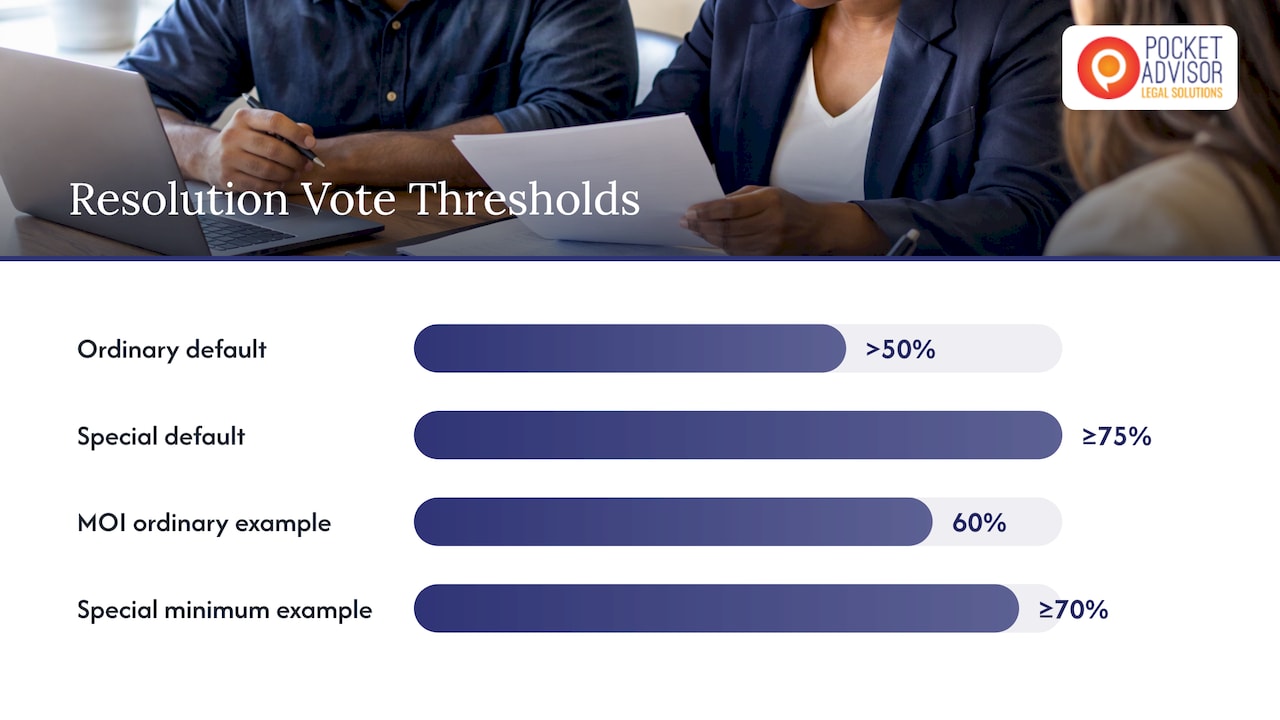
Shareholder decisions are passed as ordinary or special resolutions. The thresholds come from section 65 of the Companies Act. An ordinary resolution needs support from more than 50% of the voting rights exercised on the resolution. A special resolution needs at least 75% of the voting rights exercised, unless the MOI or the Act says otherwise (Companies Act, section 65; consolidated Act on SAFLII).
| Ordinary resolution | Special resolution | |
|---|---|---|
| Default threshold | More than 50% of voting rights exercised | At least 75% of voting rights exercised |
| Typical use | Routine shareholder approvals | Amending the MOI, fundamental transactions, voluntary winding-up |
| Can the MOI change it? | Yes, within the limits of the Act | Yes, within the limits of the Act |
The MOI may vary these default requirements, but a modified special resolution threshold must be at least 10 percentage points higher than the ordinary resolution threshold (corporate governance guide). So if your MOI sets the ordinary threshold at 60%, the special threshold cannot be lower than 70%.
Note the words “voting rights exercised”. The percentage is calculated on the votes actually cast, not on every share in issue. That is why quorum matters: a meeting needs enough people present for the vote to count at all. Unless the MOI changes it, the quorum for a shareholders’ meeting is at least 25% of the total votes exercisable, and where the company has three or more shareholders, at least three must be present (corporate governance guide).
Shareholders can also vote in writing
Shareholders do not always have to meet. The Act allows a resolution to be put to shareholders to vote in writing under section 60, and the same ordinary and special thresholds apply (section 65). For a small company with two or three owners, this is often the easiest route, provided the wording is clear and everyone entitled to vote receives it.
How the board passes a resolution
There are two common routes: at a meeting, or in writing without a meeting.
At a meeting
The MOI may regulate quorum and voting for board meetings, so check it first. Send a proper notice with an agenda, and circulate the papers beforehand. A board paper that is concise, backed by detail the directors can reach if they want it, usually gives a better discussion (Thomson Wilks). Then vote, and have the minutes record the outcome.
Without a meeting: the written route
Directors can pass resolutions by what is often called a round robin. According to Cliffe Dekker Hofmeyr’s note on section 74 of the Act, this works if all directors receive proper notice and a majority of the board gives explicit written consent, unless the MOI sets a higher threshold (CDH). Thomson Wilks adds that a written resolution may generally be adopted by the required majority after every director has received notice, and that resolutions should be dated and sequentially numbered (Thomson Wilks).
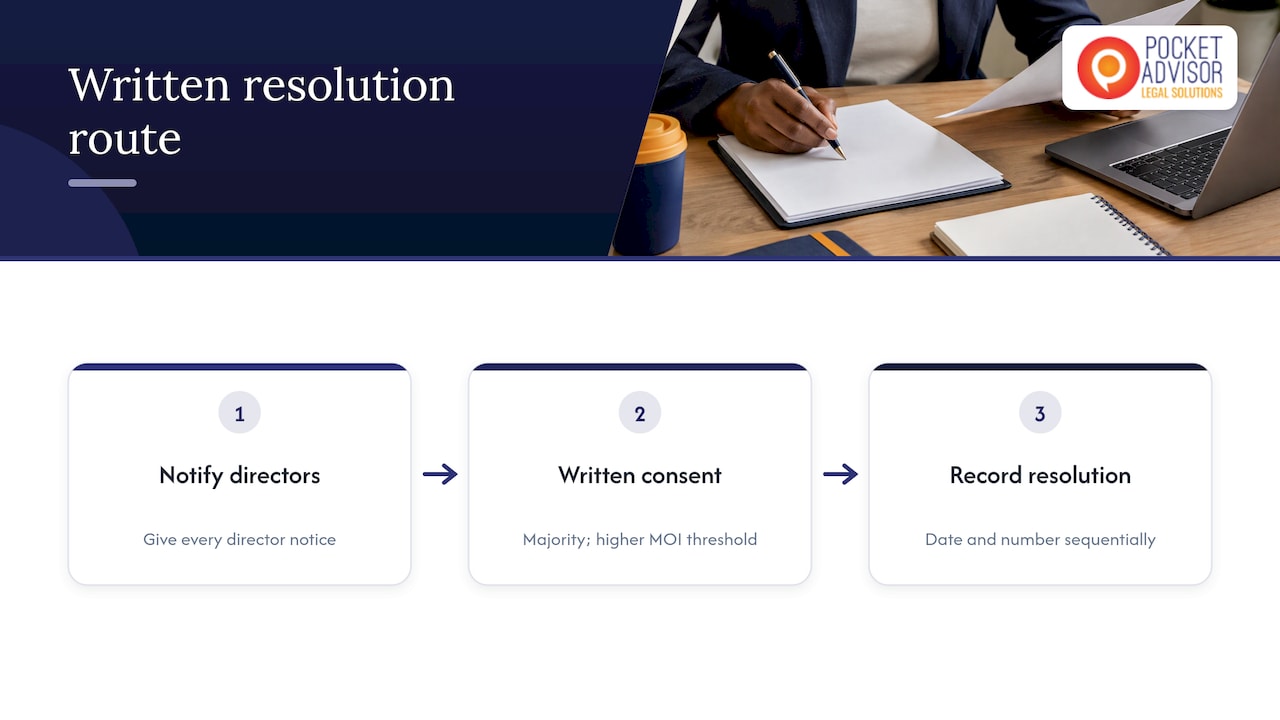
The point worth underlining is that every director gets the notice, even a director who is likely to disagree or who is travelling. A majority is enough to pass the resolution, but the process is only sound if nobody was left out.
A short checklist before you sign
- Read the MOI for any rule on quorum, voting or who must approve this type of decision.
- Confirm the board has the power to decide, or whether shareholders must approve first.
- Give every director notice, with the actual wording of the proposed resolution.
- Describe the matter accurately. The resolution should say what is really being decided.
- Record any director’s personal financial interest in the matter.
- Sign, date and number the resolution, then file it with the company records.
Check authority before you vote
This is the step small companies skip most often. Zakiya Shaik of Cliffe Dekker Hofmeyr stresses that the board must check whether shareholder approval is required before passing a resolution, because a board acting outside its authority can render even a procedurally correct resolution invalid (CDH, 2025).
Take a growing consulting firm that wants to issue shares to a key employee. The directors agree on the idea, vote 3 to 0 and sign a neat resolution. But if the Act or the MOI requires shareholder approval for that kind of share issue, the unanimous board vote does not fix the gap. The right order is to ask first, “Does this need shareholders?”, and only then draft.
The same discipline applies to wording. A resolution is not a formality to be filled in at the end of the week. It should describe the decision accurately, and directors should be able to say they considered the matter in good faith and in the company’s interests. These are real questions to ask yourself before you sign, and for significant or unusual transactions, a company lawyer or company secretary is the right person to consult.
What the record should contain, and how long to keep it
A resolution is only as useful as the record behind it. Practitioners summarising the Act note that board meeting minutes must include every resolution adopted and any director’s declaration of a personal financial interest, and that records of directors’ meetings and resolutions must be kept for seven years (Dommisse Attorneys). Thomson Wilks says the same about the Act’s requirement to maintain minutes of board and committee meetings, including all resolutions and section 75 declarations, for at least seven years (Thomson Wilks). The Act’s text is available from the CIPC’s published copy of the Companies Act, and shareholder meeting notices and minutes, including resolutions adopted, are subject to the same seven-year principle.
A good resolution record normally has:
- the company’s full name and registration number
- a short title describing the decision
- the resolution wording, starting with what is approved and who is authorised to act
- the date and a sequential number
- the names of the directors or shareholders who signed
- any declared personal financial interest
Do not backdate
It is tempting to sign a resolution today and date it last month, perhaps because a bank wants it urgently. Don’t. Thomson Wilks warns that backdated directors’ resolutions can create unauthorised “authority” and weaken the company’s governance records (Thomson Wilks). If something was agreed earlier but never documented, record a new resolution with today’s date that confirms or ratifies the earlier decision, and say so plainly.
Habits that make resolutions easy
A few routines turn this from a headache into a quick task:
- Keep one folder. Store the MOI, any shareholders’ agreement and all signed resolutions in one place, in date order.
- Number as you go. A running sequence makes gaps obvious.
- Draft before you decide. Circulate the proposed wording to everyone beforehand. It forces clarity about what exactly is being approved.
- Record the reasons. A sentence or two on why the board took the decision helps later, when nobody remembers the context.
- Revisit the MOI at each growth step. A new co-founder, a first employee or an outside investor often changes who must approve what.
These habits matter most at moments of change. Taking on a business partner, employing your first staff member, signing with a major supplier or preparing for investment all involve decisions that someone outside the company will later want to see evidenced.
Building these foundations with a practical toolkit
PocketAdvisor Legal Toolkits™ are digital boxes that bring together expert-led videos, workbooks and professionally drafted South African legal agreements, to help you understand and put in place the legal foundations a business needs. The Legal Toolkit™ for Start-Ups and Solopreneurs (R1 495, one-off) is built around those foundations. The Legal Toolkit™ for SMEs (R2 495, one-off) is aimed at the governance and commercial arrangements of growing businesses, which is where board decisions and shareholder approvals tend to become more frequent. Neither replaces professional legal advice when a decision is complex, but they help you ask better questions and make more informed decisions about your business’s legal readiness.

Explore PocketAdvisor Legal Toolkits™ and understand the legal foundations your business needs.
FAQ
What is a board resolution in South Africa?
It is the formal record of a decision taken by a company’s directors. It shows what was decided, when, and by whom. Banks, landlords, buyers and investors often ask for one as evidence that the company authorised a transaction.
What is the difference between a board resolution and a shareholders’ resolution?
The board manages the company and decides most operational and strategic matters. Shareholders decide the matters the Companies Act or the MOI reserves for them, such as amending the MOI or a voluntary winding-up. The MOI and the Act determine the exact split for your company.
What percentage is needed to pass an ordinary or special resolution?
By default, an ordinary resolution needs more than 50% of the voting rights exercised, and a special resolution needs at least 75%. The MOI can vary these, but a modified special resolution threshold must be at least 10 percentage points above the ordinary one.
Can directors pass a resolution without holding a meeting?
Yes. Directors can pass a written resolution, often called a round robin, if every director receives proper notice and the required majority consents in writing. If your MOI sets a higher threshold, that threshold applies.
How long must resolutions be kept?
Company records of board meetings and resolutions must generally be kept for seven years. Dating and numbering each resolution in sequence makes the file easier to maintain and check.
Sources
- Companies Act 71 of 2008, section 65: shareholder resolutions (acts.co.za)
- Companies Act 71 of 2008, consolidated (SAFLII)
- Companies Act 71 of 2008 (CIPC)
- Corporate Governance 2026, South Africa (Chambers Practice Guides)
- Board resolutions, legal precision and governance discipline (Cliffe Dekker Hofmeyr)
- Board Decisions and the Corporate Record (Thomson Wilks)
- Companies Act series, Part 4: Board meetings (Dommisse Attorneys)
- International Business Formation: 8 Decisions (No Borders Founder)
Recommended
This article is for educational and informational purposes only. It is not a substitute for professional advice.