
Improving legal service delivery means making the way legal work is scoped, resourced, performed, communicated and measured more consistent, more timely and more commercially sustainable. In South Africa the phrase has two lives. In the public sector it is a formal compliance discipline built on Batho Pele and Service Delivery Improvement Plans. In private practice and in-house teams it is less codified, but the same logic applies: define the standard, measure against it, and improve in deliberate steps. This guide draws on both traditions and shows how a firm or legal department can apply them to everyday matters.
Key takeaways
- Public-sector practice offers a tested model: published service standards, quarterly monitoring and an annual progress report, all feeding continuous improvement.
- Standards work only when they are specific, measurable and communicated to the client; measurement exists to raise standards progressively, not to produce reports.
- The operational weaknesses identified in state legal services (poor coordination, weak monitoring of external counsel, inconsistent fees) have close parallels in private firms and corporate legal departments.
- Legal project management gives practitioners the tools to apply these principles at matter level: scope, budget, workflow, risk and client communication.
- Improvement is a cycle. Technology should be introduced only where the data shows that it removes a real bottleneck.
Table of Contents
- What improving legal service delivery means in South Africa
- The public-sector framework worth borrowing
- Where legal service delivery typically breaks down
- A five-step approach to improving delivery in your practice
- Measuring more than output
- Applying project management at matter level
- Process improvement and the role of technology
- The regulatory backdrop
- Building the capability in your team
- Sustaining improvement over time
- Frequently asked questions
- Sources
What improving legal service delivery means in South Africa
The term is used in at least two senses, and it helps to separate them.
The first is access to justice. Research published in 2021 on the quality of legal aid argues that improving delivery means coordinating and integrating providers so that indigent clients receive high-quality, multi-faceted assistance rather than fragmented help. Its central point is instructive for any practitioner: coordination is itself a quality intervention. Providers working in silos deliver less than providers that collaborate.
The second is operational performance within a department, firm or legal team. Here the question is practical. Are matters scoped accurately? Do clients know what to expect and when? Is the work delivered at a cost that is both fair to the client and sustainable for the practice?
Both senses share a premise: quality is not left to individual diligence alone. It is designed into the way work is organised.
The public-sector framework worth borrowing
South African public institutions operate under an explicit improvement architecture. Private practitioners are not bound by it, but it is a well-documented template.
Batho Pele and service standards
The Department of Justice’s service charter applies Batho Pele through consultation, service standards, access, courtesy, information, openness and transparency, redress and value for money. Those eight themes translate readily to a professional services setting: ask clients what matters, state what they can expect, be accessible, communicate clearly, explain how decisions are made, provide a route for complaints and show that fees are justified.
The charter also sets concrete numbers. It provides, for example, for a maximum two-hour queue for domestic-violence and maintenance services and a final protection order within 60 working days after the interim order is issued. The lesson is the specificity: a standard that can be checked is a standard that can be improved.
The older 1999 Court Users Charter takes the same approach, describing minimum standards of professional, fair and equal treatment, identification of personnel, respect for dignity and mechanisms for information and complaints.
What makes a good standard
The DPSA’s Batho Pele handbook states that service standards should be SMART, developed through consultation, communicated to customers, measured continuously and linked to improvement plans. It also treats standards as a management tool for customer satisfaction rather than an end in themselves: measurement exposes shortfalls and makes progressively higher standards possible.
For a law firm, a SMART standard might read: “Every new instruction receives a written scope, fee estimate and responsible partner within two working days.” It is specific, measurable and meaningful to the client. “We will respond promptly” is none of these.
Plans, monitoring and reporting
The 2025 DPSA directive requires departments to maintain a five-year Service Delivery Improvement Plan aligned with the departmental strategic plan, to publish it, to submit it by 30 September of the first year of the cycle and to submit annual progress reports by 30 June. Implementation is monitored quarterly, with continuous assessment of efficiency, effectiveness, impact and sustainability against targets.
The Office of the Chief Justice’s 2025/26 to 2029/30 plan shows the model in a judicial setting. It treats improvement as continuous and incremental, integrated with the Operations Management Framework and Batho Pele. Its results chain links activities such as training, standard operating procedures, monitoring and automation tools to outputs, outcomes and the longer-term goals of improved access to justice and public confidence.
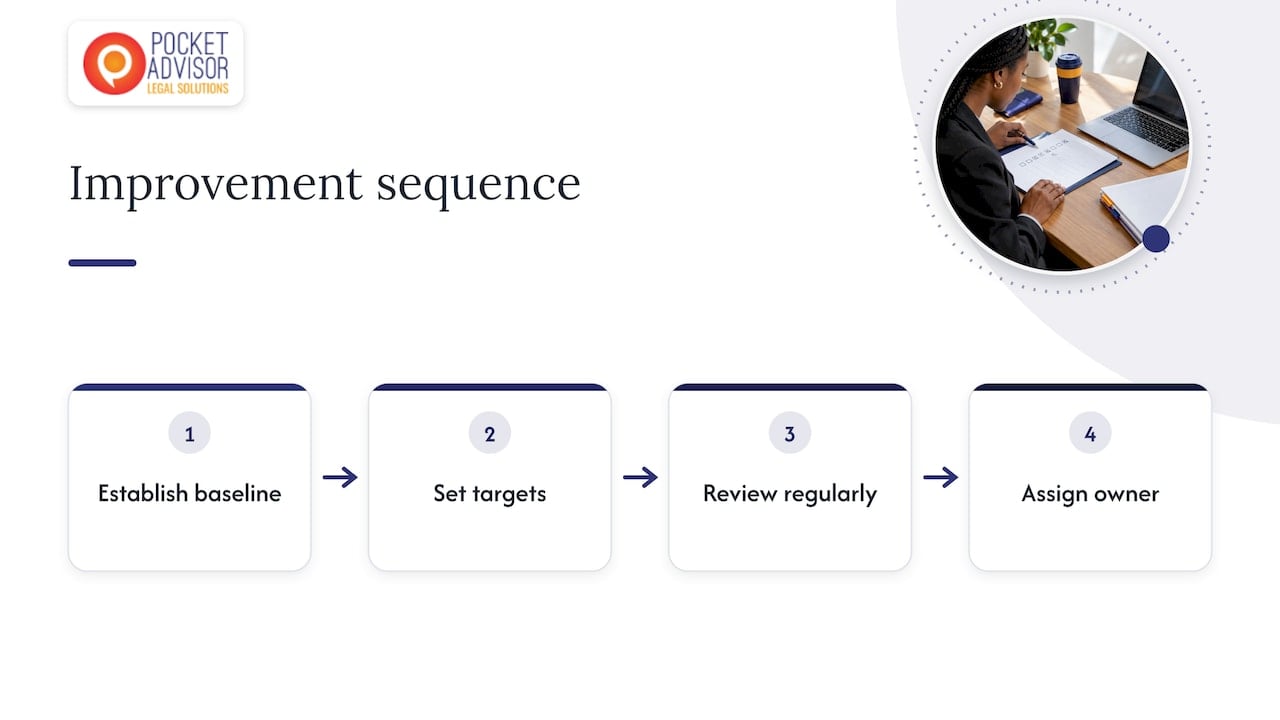
A private firm does not need a five-year plan on a prescribed template. It does need the underlying sequence: a baseline, a small set of targets, a regular review rhythm and a named owner for each improvement.
Where legal service delivery typically breaks down
In 2012 the Minister of Justice identified a set of operational problems in state legal work, attributing them to ineffective coordination: prescription of government claims, default judgments, inadequate preparation, unnecessary adverse cost orders, weak monitoring of attorneys’ outputs and inconsistent counsel fees. The same statement named professional efficiency, collegiality, accountability and value as guiding principles for transforming state legal services.
None of these is peculiar to government. Consider how they appear in private practice and in-house teams:
| Problem identified in state legal services | How it appears in a firm or legal department |
|---|---|
| Missed time limits | Diaries and deadlines held by individuals rather than in a shared matter plan |
| Inadequate preparation | Instructions accepted without a defined scope, evidence plan or timeline |
| Weak monitoring of external attorneys | Briefs sent out with no agreed budget, milestones or reporting rhythm |
| Inconsistent counsel fees | Fee arrangements negotiated matter by matter, with no comparison or standard terms |
| Poor coordination | Specialist teams working on one client matter without a single point of accountability |
The 2021 legal-aid research adds three further barriers: silos, lack of coordination and funding constraints. Its proposals, namely needs analysis, coordinated referrals and a representative association, show that the remedy for coordination failures is structural, not heroic.
A five-step approach to improving delivery in your practice
The following sequence adapts the public-sector model to a firm or legal department. It is deliberately modest in scope: begin with one practice area or one category of matter.
- Establish a baseline. Select a representative sample of recent matters. Record how long each took against the estimate, how fees compared with what the client expected, how often scope changed and how many client queries concerned progress. Data of this kind is more persuasive in a partners’ meeting than impressions.
- Ask clients and instructing colleagues what matters. Consultation is the first Batho Pele theme for good reason. Internal clients in a corporate legal department may value turnaround and risk clarity; external clients may prize fee predictability. Ask, rather than assume.
- Set three to five SMART standards. Resist the temptation to publish twenty. A short list that is measured is better than a long list that is ignored.
- Assign owners and a review rhythm. The public-sector cycle of quarterly monitoring and annual reporting is a sound default. One partner or senior counsel should own each standard.
- Review, adjust and raise the bar. When a standard is consistently met, tighten it. When it is consistently missed, establish whether the cause is capacity, process or the standard itself.
Measuring more than output
Case counts and billed hours tell only part of the story. The 2015 SERI study of public-interest legal services, based on interviews and focus groups, proposes that value be measured multidimensionally, including direct and indirect material impact and broader political and symbolic value. The principle carries over to commercial work. A measure set for a legal team might combine:
- Timeliness: matters delivered within the agreed timeframe.
- Cost accuracy: variance between the fee estimate and the final fee.
- Quality: rework required, partner review findings, client feedback.
- Client experience: responsiveness and clarity of communication.
- Wider value: risks avoided, precedents or templates created for reuse.
Black Sash offers a complementary lesson. It reports using surveys, case studies, focus groups and helpline data to monitor public services and provide evidence-based feedback. Structured client feedback is evidence, and a firm that gathers it systematically has an advantage over one that relies on the occasional compliment or complaint.
Applying project management at matter level
Standards and metrics set the direction. Legal project management is how they are achieved on a given matter. It is a specialised professional capability, not administration and not generic project management transplanted into a law firm, because it works within professional duties, privilege, billing models and the unpredictability of litigation and negotiation.
In practice it addresses five areas:
- Scoping. Defining what is in and out of the instruction before work begins, and recording assumptions on which the estimate rests.
- Budgeting. Breaking a matter into phases or tasks, estimating each and tracking actual effort against the estimate, so that a variance is noticed when it is still small. Our guide to legal project management in South Africa sets out the method in detail.
- Workflow. Standardising recurring steps, allocating work to the right level of seniority and making hand-offs explicit. See our discussion of legal workflow management for compliance-heavy work.
- Risk. Identifying the points at which a matter is likely to slip, such as third-party delays, information gaps or changes in instructions, and agreeing responses in advance.
- Client communication. Agreeing at the outset how and when progress will be reported, and raising scope changes in writing before they erode the margin.
A short example illustrates the effect. A mid-sized firm accepts a commercial lease portfolio review. Without a plan, the instruction is “review the leases”. With one, the team records the number of leases, the issues to be checked, the reporting format, the assumed turnaround from the client’s property manager and the fee for each phase. When the client then adds a further ten leases, the change is visible, priced and agreed, rather than absorbed.
The same applies to external counsel. A legal department that briefs outside firms can use the 2012 Ministerial diagnosis as a checklist: is there an agreed budget, are outputs monitored against milestones, and are fees comparable across firms? Our material on legal team management and legal operations management addresses these questions for leaders.
Process improvement and the role of technology
Improvement efforts often begin with a software purchase. A better sequence is to map the process, measure where time and cost accumulate, and then decide whether technology is the right remedy. The Office of the Chief Justice’s results chain places automation tools alongside training, standard operating procedures and monitoring, which is a reminder that tools are one input among several.
A firm that has mapped its workflow can answer practical questions: which steps are repetitive enough to automate, which require judgement and should stay with a lawyer, and where a poorly designed step would simply be made faster by automation. Our guide to legal process improvement walks through that mapping exercise. Technology adopted this way adds genuine value because it responds to a documented problem.
The regulatory backdrop
Private practitioners operate under the Legal Practice Act 28 of 2014, which establishes the South African Legal Practice Council and provincial councils to regulate legal practitioners and set norms and standards, and creates a Legal Services Ombud. Service delivery improvement does not replace these obligations. It supports them: clear scoping, documented communication and consistent fee practices make it easier to demonstrate professional, accountable service when a client or regulator asks.
Building the capability in your team
Improvement fails when it depends on one enthusiastic partner. It lasts when several people share a method and a vocabulary. That is the purpose of structured training in legal project management, which brings structure, commercial awareness and a continuous-improvement mindset to legal work.
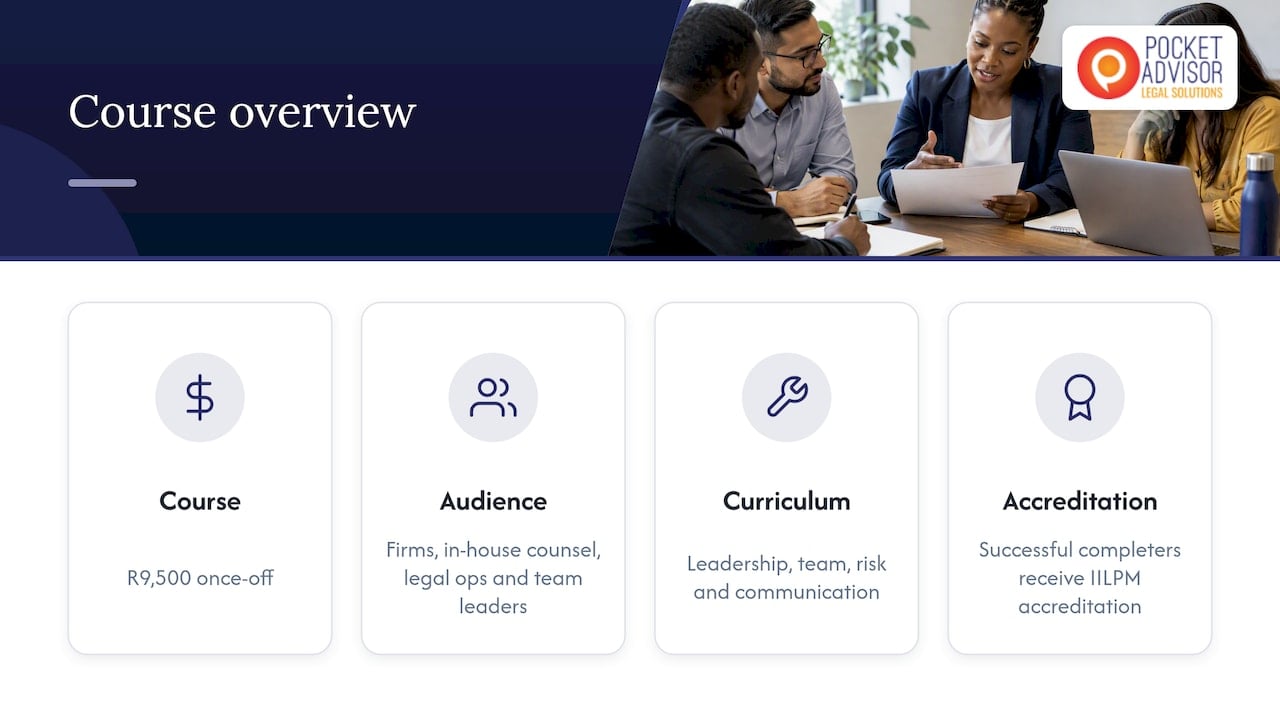
PocketAdvisor holds exclusive rights in South Africa to provide the internationally accredited programme of the International Institute of Legal Project Management (IILPM). Our Applied Legal Project Management Course (R9,500 once-off) is designed for lawyers in firms, in-house counsel, legal operations professionals and team leaders. It covers project leadership, team management, risk management and communication, and helps firms and legal departments decide where technology and automation add genuine value. Students who successfully complete the course receive IILPM accreditation, subject to the programme’s completion requirements, a professional development credential that helps lawyers strengthen their expertise and distinguish themselves in a competitive profession.
Explore PocketAdvisor’s internationally accredited Legal Project Management Course: https://pocketadvisor.co.za/legal-project-management-course/

Sustaining improvement over time
Three habits separate practices that improve from those that merely launch initiatives:
- Keep the measures few and visible. A one-page dashboard reviewed each quarter will do more than an annual report nobody reads.
- Close the loop with clients. Tell clients what changed because of their feedback. This is the openness and redress that Batho Pele describes, applied commercially.
- Treat each matter as a source of learning. A brief closing review, covering what the estimate got wrong, what was reusable and what the client valued, feeds the next baseline. Our overview of legal project management for lawyers shows how to build that review into routine practice.
Frequently asked questions
What is a Service Delivery Improvement Plan?
It is the public-sector instrument through which departments set service standards, targets and improvement actions. Under the 2025 DPSA directive, departments maintain a five-year plan, publish it and report annually on progress. Private practices are not bound by it, but its structure is a useful model.
Can a small law firm apply these principles without a large budget?
Yes. Start with one practice area, record a baseline from recent matters and set three or four SMART standards. The method depends on discipline and consistent review, not on expensive systems.
How often should service standards be reviewed?
The public-sector cycle monitors implementation quarterly and reports annually, which is a sensible default for a firm. Review sooner if a standard is repeatedly missed, and raise it once it is reliably met.
Is legal project management the same as general project management?
No. It draws on project management methods but adapts them to professional obligations, fee arrangements and the uncertainty inherent in legal work. It also adds commercial awareness, so that scope, budget and client expectations are managed together.
Sources
- Promoting the quality of legal aid in South Africa (SciELO SA, 2021)
- DPSA 2025 Service Delivery Improvement Plan Directive
- Batho Pele Handbook, Chapter 5: How to develop service standards
- Department of Justice Service Delivery Charter
- Customer Service Charter for Court Users, 1999
- Statement by the Minister of Justice and Constitutional Development, 2012
- Office of the Chief Justice Service Delivery Improvement Plan 2025/26 to 2029/30
- Public Interest Legal Services in South Africa (SERI, 2015)
- Black Sash: Sash in Action
- Legal Practice Act 28 of 2014
Recommended
This article is for educational and informational purposes only. It is not a substitute for professional advice.