If you want to send marketing by email, SMS, WhatsApp or any other electronic channel to someone who is not yet your customer, you need their consent first, and you can ask for it only once. If they already bought from you, you may market your own similar products without asking first, provided they could object when you collected their details and can object again in every message. These rules sit in section 69 of the Protection of Personal Information Act (POPIA), and they are easier to follow once you see the reasoning behind them.
This guide walks through the rules with the kind of situations a South African business owner actually meets: a newsletter sign-up, a bought contact list, a client you want to tell about a new service.
Key Takeaways
- Unsolicited electronic marketing to someone who is not your customer needs their prior consent under section 69(1) of POPIA.
- Consent must be voluntary, specific and informed. An unsubscribe link does not replace it, and you must be able to prove you obtained it.
- You may market your own similar products to existing customers without fresh consent if three conditions in section 69(3) are all met.
- Every marketing message must identify the sender and give contact details for stopping the messages.
- In 2026 the National Consumer Commission’s opt-out registry added a second layer to check alongside POPIA.
Table of Contents
- What counts as direct marketing
- When you need consent before you market
- What makes consent valid
- What to tell people when you collect their details
- Marketing to existing customers
- What every marketing message must contain
- Objections, unsubscribes and the opt-out registry
- A practical routine for your business
- Where legal readiness fits
- FAQ
- Sources
What counts as direct marketing
POPIA defines direct marketing broadly. It is any approach to a person, in person, by mail or by electronic communication, with the purpose of promoting or offering to supply goods or services in the ordinary course of business, or asking for a donation of any kind. That is in the Information Regulator’s Guidance Note on Direct Marketing.
Section 69 names automatic calling machines, fax, SMS and email. The Regulator’s guidance says the list is not closed: it also reaches push notifications, direct messages on Instagram or LinkedIn, and the use of cookies. Telephone calls count as electronic communication because of VoIP technology.
In practice, this means the channel you choose does not change the rule. A WhatsApp broadcast to a list you scraped is treated the same way as an email blast.
The test is purpose. The National Consumer Commission’s draft 2026 guidelines say communications without promotional intent, such as a service enquiry or account administration message, fall outside the opt-out registry. A message telling a client their invoice is ready is not marketing. The same message with a “20% off your next order” banner starts to look like it.
When you need consent before you market
Section 69(1) is the core rule. You may not send direct marketing by unsolicited electronic communication to a person unless they have given consent, or they are an existing customer who meets the section 69(3) conditions covered below.
Think about why the law is built this way. A person’s email address or cell number is personal information. Using it to sell to them is a separate purpose from the one they gave it for. The law asks you to check with them before you cross that line, rather than expecting them to chase you with a request to stop.
Opt-out is not consent
Many businesses assume that adding an unsubscribe link makes a cold email acceptable. It does not. The Regulator’s Guidance Note and Regulation 6.4 state that opt-out is not consent. This was confirmed in the Regulator’s first enforcement notice, issued in February 2024 against FT Rams Consulting. The media statement on that notice records the finding that offering an opt-out did not cure the failure to obtain consent first.
The enforcement notice itself is a useful model of good practice. It required that the first communication sent be one requesting consent, that the prescribed Form 4 be used, and that every message carry the sender’s identity and contact details for requesting cessation.
You get one request
The law lets you approach a person only once to ask for consent, and only if they have not previously refused (section 69(2)(a)). So the request is a single chance, not a reminder series. Write it well: say who you are, what you will send, through which channels, and roughly how often.
A short scenario shows the stakes. Naledi runs a small online skincare shop in Durban. At a market stall she collects forty email addresses on a clipboard headed “Win a hamper”. The sign-up sheet says nothing about newsletters. Those people have entered a competition, not agreed to promotions. Naledi’s cleaner route is to add a clear line to the sheet, such as a tick box beside “Send me offers by email and WhatsApp”, which is unticked by default.
What makes consent valid
POPIA defines consent as a voluntary, specific and informed expression of will. The Guidance Note and Regulation 6.1 add the practical detail:
- Voluntary: the person is not forced. Making a free download or a purchase conditional on agreeing to marketing is a weak position.
- Specific: it covers marketing, not general processing. A box that says “I agree to the terms” is not specific consent to receive promotions.
- Informed: the person knows who is asking and what they are agreeing to.
The consent may be obtained on a form substantially similar to Form 4 or in any manner that is expedient, free of charge and reasonably accessible. The regulations list email, telephone, SMS or WhatsApp, fax and automated calling among the ways a request can be made. So a double opt-in email, a clearly worded tick box or a recorded WhatsApp reply can all work, as long as they meet the three tests.
Keep proof
The burden of proving that consent was given rests on you as the responsible party (section 11(2)(a)). The Direct Marketing Association of South Africa’s Code of Conduct sets out what a sensible record contains: when and how consent was obtained, the wording used, the information given at the time, and your workflow for handling consent and withdrawals.
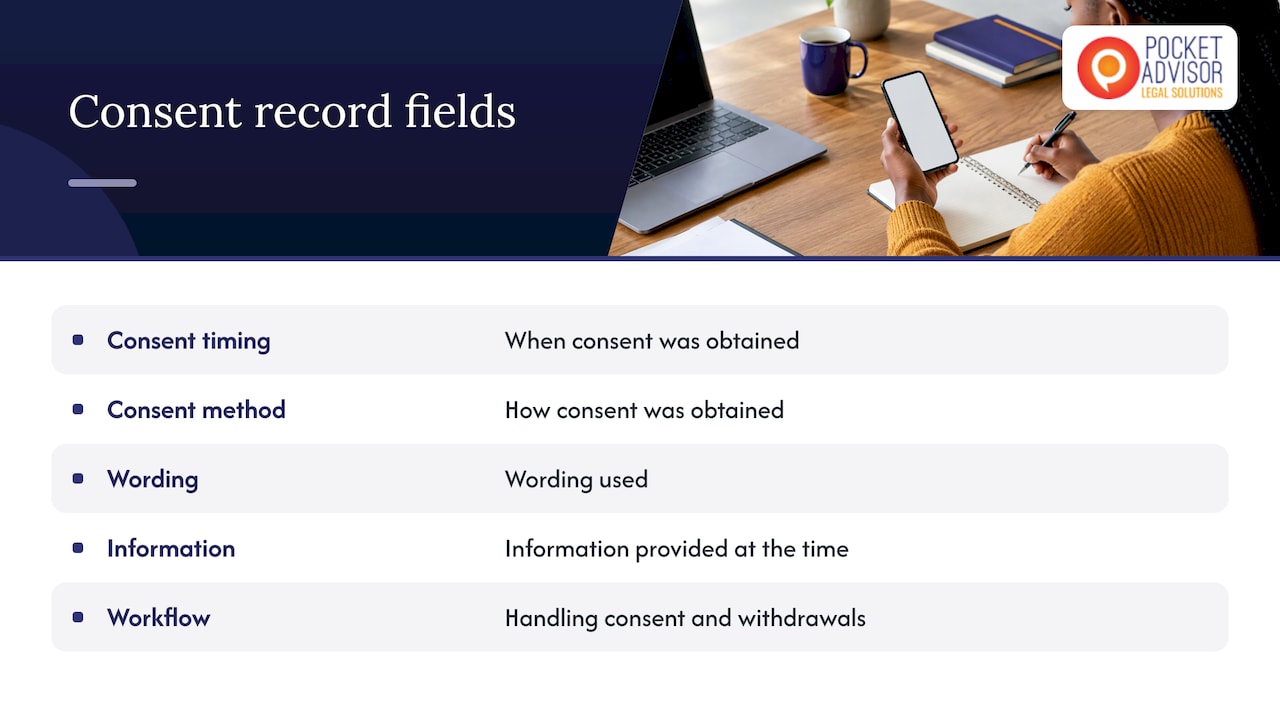
A simple consent log in a spreadsheet or your email platform can hold those fields. A screenshot of a sign-up page that has since changed is not enough on its own, so keep a dated copy of the wording that was live when each person signed up.
When you design the sign-up flow, it helps to think of the data as something you collect on purpose and govern from day one. This overview of a first-party data strategy covers how to collect, unify and govern that data, which fits the way the initial consent request should be set up.
What to tell people when you collect their details
Consent for marketing is only one layer. When you collect contact details directly, section 18 of POPIA expects you to take reasonably practicable steps to make the person aware of things such as:
- what information you are collecting and from where;
- your name and address;
- the purpose of collection;
- whether supplying it is voluntary or mandatory, and what happens if they do not;
- any law that authorises the collection;
- their right to object.
Section 18(2) requires that this notice come before collection when you collect directly from the person. A short privacy line beside the sign-up form, linking to a fuller notice, is the usual way to do it.
For a wider view of the obligations that sit around marketing, our POPIA compliance guide for small businesses and POPIA compliance checklist cover the steps in order.
Marketing to existing customers
You do not always have to ask first. Section 69(3) lets you send electronic marketing to a customer without fresh consent when all three of these are true:
- You obtained their contact details in the context of selling them a product or service.
- The marketing is for your own similar products or services.
- They were given a reasonable opportunity to object, free of charge and without unnecessary formality, when you collected the details and on each occasion you send a message, if they had not already refused.
The word “similar” matters. The Regulator’s Guidance Note gives the example of a clothing store: shoes and belts are similar products, but funeral insurance is not. The reasoning is about reasonable expectation. A customer who bought a dress would not be surprised to hear about a belt. They would be surprised to receive an insurance offer from the same shop.
Take Sipho, who runs a bookkeeping practice in Gqeberha. A client who signed up for monthly bookkeeping can reasonably receive a note about his payroll service. If Sipho instead sold that client list to a property agent, the agent would be a stranger and would need consent of their own. Section 69(3) covers your own similar offering, not a third party’s.
The objection chance must be real. Add a line at the point of sale, such as “We may email you about similar services. Tick here if you would rather we did not”, and include an unsubscribe route in every message.
What every marketing message must contain
Section 69(4) is short and strict. Any direct marketing communication must contain:
- details of the identity of the sender, or of the person on whose behalf it is sent; and
- an address or other contact details to which the recipient may send a request that the messages stop.
The National Consumer Commission’s draft 2026 guidance adds that the marketer should be clearly identified by name and contact details, including an email address and physical address where applicable. A footer with your trading name, physical address, email and a working unsubscribe link covers the ground for email. For SMS and WhatsApp, include a simple way to reply and stop.
Objections, unsubscribes and the opt-out registry
Once someone objects, you must stop processing their information for direct marketing and must not contact them again. For non-electronic marketing, the Guidance Note says a person may object at any time using Form 1 or a substantially similar form, free of charge.
Act on unsubscribe requests promptly and record them in the same log as consents. A suppression list that you check before every campaign is the simplest safeguard, because the most common slip is re-importing an old list that includes people who left.
The National Consumer Commission layer
In 2026 a second regime became relevant. The National Consumer Commission’s draft 2026 guidelines say direct marketers must register before marketing, cleanse their consumer databases monthly when planning marketing, respect pre-emptive blocks and remove opted-out names before sending. They also state that existing consent becomes invalid once a consumer registers a pre-emptive block on the Opt-Out Registry, and that fresh consent does not override a block unless the consumer removes it.
The guidelines are in draft, so check the National Consumer Commission’s site for the final wording before you rely on a detail.
The Information Regulator’s April 2026 media statement makes the relationship clear. POPIA compliance remains mandatory whether or not a consumer is on the registry. You still need consent under section 69(1) and (2), or must meet section 69(3) for customers. Think of the registry as a second gate. Passing it does not remove the POPIA gate.
A practical routine for your business
Here is a routine that suits a small business, built around the rules above.
- List where contacts come from. Website forms, event sheets, purchases, referrals, bought lists. Each source has a different legal footing.
- Separate customers from prospects. Customers who meet section 69(3) can receive your own similar offers. Prospects need consent first.
- Write one clear consent request. State who you are, what you will send and how. Use an unticked box or a double opt-in. Remember you get one approach.
- Record each consent. Date, method, wording and the person’s details.
- Build the footer. Sender identity, contact details and an unsubscribe route in every message.
- Clean before every campaign. Remove unsubscribes and objections, and check against any registry blocks that apply.
- Review once a year. Check that your forms and notices still match what you actually send.
Each of these steps is a decision, not a form to tick. Who may we contact? Why do we think they expect it? Can we show how we know? Those questions are the real substance of marketing compliance.
Where legal readiness fits
Marketing consent is one piece of a larger set of foundations: how you collect personal information, what you tell people, how you deal with suppliers who handle your data, and how you protect it. Our guides on data security and breaches and cross-border data transfers under POPIA cover the neighbouring topics.
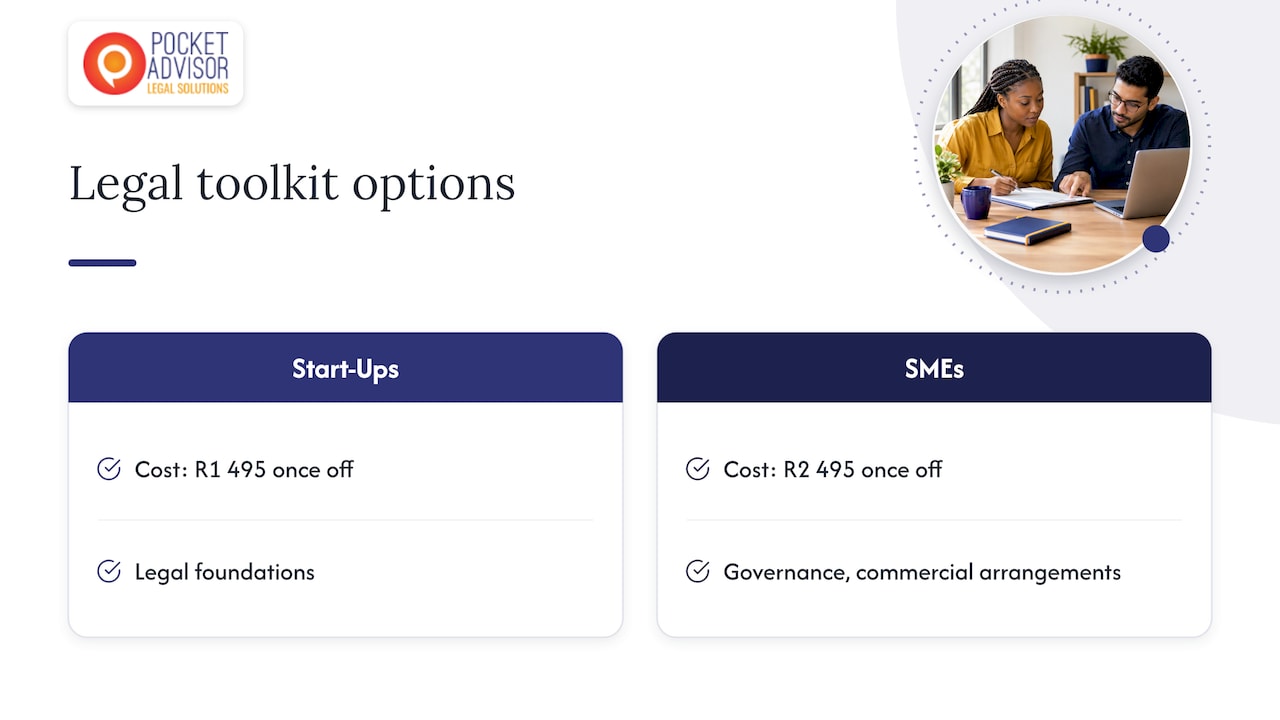
PocketAdvisor Legal Toolkits™ are digital boxes of expert-led videos, workbooks, professionally drafted South African legal agreements and compliance resources that help founders and SMEs understand and implement the legal foundations their business needs, including data protection. The Legal Toolkit™ for Start-Ups and Solopreneurs costs R1 495 once off, and covers legal foundations. The Legal Toolkit™ for SMEs costs R2 495 once off, and covers governance and commercial arrangements for growing businesses. Both are available on demand, so you can work through them at your own pace.
Understand the legal foundations your business needs: Explore PocketAdvisor Legal Toolkits™.

A toolkit helps you make informed decisions, and it sits alongside professional legal advice rather than replacing it. If a specific campaign raises a question, such as a large purchased list, consult an attorney.
FAQ
Do I need consent to email someone who gave me their business card?
Handing over a card is not consent to marketing. If the person is not your customer, you need their consent under section 69(1) before sending promotional email. A short, one-off request that explains what you would send is the right first message.
Can I send marketing to existing customers without asking?
Yes, if all three section 69(3) conditions are met. You collected their details in a sale, the marketing is for your own similar products or services, and they had a free, simple chance to object when you collected the details and in each message.
Is an unsubscribe link enough for cold emails?
No. The Information Regulator’s first enforcement notice found that providing an opt-out did not remedy the failure to obtain consent first. An unsubscribe link is still required in every message, but it works alongside consent, not in place of it.
Does POPIA apply to WhatsApp and social media messages?
Yes. Section 69 covers any form of electronic communication, and the Regulator’s guidance names direct messages on Instagram and LinkedIn. WhatsApp and SMS can also be used to request consent, provided the request meets the validity tests.
What proof of consent should I keep?
Keep the date and method, the exact wording shown, the information given to the person at the time, and your process for withdrawals. You carry the burden of proving that consent was given.
Sources
- Guidance Note on Direct Marketing under POPIA, Information Regulator
- Section 69, Protection of Personal Information Act, 2013
- Information Regulator media statement on its first enforcement notice
- FT Rams Consulting enforcement notice, February 2024
- Information Regulator media statement, April 2026
- National Consumer Commission draft 2026 guidelines
- DMASA Code of Conduct, February 2023
This article is for educational and informational purposes only. It is not a substitute for professional advice.