
A probation period in South Africa is a set time at the start of a job when you assess whether a new hire can do the work and fits the role. The law sets no fixed maximum. The period must be decided in advance and be reasonable for the job, and most employers use three to six months. Probation never switches off an employee’s rights: they are a full employee from the first day.
This guide is for business owners hiring their first people or growing a small team. It explains how probation works, why the rules exist, and how to run it so that both you and your new hire know where you stand.
Key Takeaways
- Probation is for evaluating performance and suitability. It is not a way to keep someone temporary, and the 2025 Code of Good Practice: Dismissal says it must not be used to deprive employees of permanent status.
- It does not apply automatically. Put the length, start date and end date in writing before the employee starts.
- There is no legal fixed limit, but three to six months is typical. Choose a length that matches how long it genuinely takes to judge the role.
- Give guidance, feedback and a chance to respond during probation, and keep notes. Do not save your concerns for the last week.
- Probationary employees still get their basic conditions, including annual leave, which accrues from day one.
Table of Contents
- A common story: the bakery that hired too fast
- What probation is, and why the law allows it
- Does every new hire have to serve probation?
- How long can probation last?
- Extending probation: when it works and when it does not
- What you owe a new hire during probation
- Rights during probation, including leave
- Confirming, or ending, an appointment fairly
- A practical probation plan in six steps
- Questions to ask yourself before you hire
- Making legal readiness part of how you hire
- FAQ
- Sources
A common story: the bakery that hired too fast
Imagine Thandi, who runs a growing bakery in Pietermaritzburg. Orders have doubled, so she hires a delivery coordinator on a handshake and a vague “let’s see how it goes”. Three weeks in, she is unsure whether he is a good fit, but she has never told him what “good” looks like. She does not know whether she can extend the trial, end it, or what she owes him in the meantime.
None of this is unusual. The problem is not Thandi’s intentions. She just never decided, up front, what probation was for, how long it would last, and how she would judge it. The rest of this guide fills in those decisions.
What probation is, and why the law allows it
Hiring is a bet. A CV and an interview tell you a lot, but not how someone handles your customers, your systems and your pace of work. Probation exists to give you a fair opportunity to find out before the appointment is confirmed.
The 2025 Code of Good Practice: Dismissal describes probation as a period for evaluating a new employee’s performance and suitability, which should be set in advance and be reasonable given the job and the time needed to judge suitability. You can read this in a published guide to the 2025 Code. The Code was published in the Government Gazette on 4 September 2025, and it replaced the older Schedule 8 Code that many articles online still quote.
The reasoning matters. Probation is meant to work in two directions. You find out whether the person suits the role, and they find out whether the role suits them. That is why the law expects you to support the person during the period, not simply wait and watch.
Does every new hire have to serve probation?
No. Probation is optional, and it is not automatically part of an employment relationship. According to LABOURED SA, probation must be explicitly included in the employment contract or written particulars of employment, with the length and the start and end dates.
If you want probation for a role, say so before the person starts. Trying to add it after they have begun work, or relying on a verbal remark, leaves you with an arrangement you cannot easily point to. That is an uncomfortable position for you and an unsettling one for the employee.
How long can probation last?
This is the question most people search for. The honest answer is that the law gives no single number. A 2024 legal commentary on probation aside, the Code’s test is reasonableness, based on the nature of the job and how long it takes to assess suitability.
In practice, SME Labour Support, a resource backed by the CCMA and Business Unity South Africa, notes that three to six months is typical. Think of it as a sliding scale:
| Type of role | What “reasonable” might look like |
|---|---|
| Simple, quickly learned tasks (for example, a till operator) | Towards the shorter end, such as three months |
| Roles with a learning curve (for example, a bookkeeper working on your systems) | Often around three to six months |
| Senior or highly technical roles | Longer, only if you can explain why the role needs it |
The table is a thinking aid, not a legal rule. The question to ask yourself is: how long would it really take, in this job, before I could judge whether this person is performing? Write down that reasoning. If you ever need to explain your choice, a clear answer is the strongest one.
Is six months normal?
Yes, it falls at the top of the usual range. LABOURED SA lists three to six months as the common range. Six months is easiest to justify when the job takes time to learn, such as a role with a full sales cycle or a technical process. For a role you could judge in eight weeks, six months is harder to defend.
Extending probation: when it works and when it does not
Sometimes a new hire shows promise but is not quite there. SME Labour Support says an employer may extend probation where the employee is not yet performing satisfactorily but may improve with more time. LABOURED SA adds that the extension should be reasonable and communicated in writing.
The key point is that extending is a decision, not a drift. CEO SA’s Carlien Nienaber stresses that employers should not extend arbitrarily and must act fairly and reasonably.
Before you extend, ask yourself:
- What specifically has fallen short, and have I told the employee?
- What would improvement look like, and what support will I give?
- Is the extra time proportionate, or am I just postponing a decision?
- Have I put the new end date and the expectations in writing?
If Thandi’s coordinator had struggled with route planning but was improving, a short, clearly explained extension with a defined goal would be sensible. An open-ended “let’s see” would not.
What you owe a new hire during probation
Guidance, not just observation
The Code expects the employer to provide reasonable guidance during probation, such as instruction, training or counselling, appropriate to the job and the size of the business, according to the 2025 Code guide. A small business is not expected to run a formal academy. It is expected to show the person how things are done and tell them how they are doing.
Feedback early, not at the end
SME Labour Support advises that employers should not wait until probation ends to raise performance concerns, because doing so defeats the supportive and evaluative purpose. It also recommends documenting performance discussions and any interventions.
A simple rhythm helps. Meet at the end of week one, again at about the one-month mark, and then regularly. At each meeting:
- Name what is going well.
- Name one or two things to improve, with a concrete example.
- Agree what support you will give.
- Write a short note and share it with the employee.
This takes thirty minutes a month and protects the relationship as much as the business. A new hire who hears feedback early can fix things. One who hears it at the end cannot.
Rights during probation, including leave
A probationary employee is not a lesser kind of employee. According to LABOURED SA, they are full employees from day one and enjoy most of the same rights, including Basic Conditions of Employment Act (BCEA) protections and protection against automatically unfair dismissal. The Department of Employment and Labour has likewise stated that employees remain protected against automatically unfair dismissals, such as those linked to discrimination, union activity and whistleblowing.
Can a new hire take annual leave during probation?
Leave is the question people ask most often after the time limit. The BCEA regulations provide for 21 consecutive days of annual leave, or, by agreement, one day for every 17 days worked or one hour for every 17 hours worked. Because that entitlement builds up as the person works, probation does not pause it.
In practice, a new hire in their first few months will have accrued only a small amount, so many employers agree when leave can be taken, or whether the employee takes unpaid leave for something urgent. Agree this in writing at the start, so no one is surprised. For a deeper look at turning these rules into workable policies, see our guide to a South African leave policy built on BCEA rules.
Confirming, or ending, an appointment fairly
Most probations end happily with a confirmation letter. Say so in writing, with the date the appointment becomes permanent, so there is no doubt.
When it does not work out, the standard is fairness. Under the 2025 Code, as summarised here, an employer must have a fair reason and follow a fair procedure, which includes giving the employee an opportunity to make representations and considering them before deciding. SME Labour Support says the same about a decision not to confirm an appointment.
The same guide notes that for poor work performance during probation, decision-makers should accept reasons that are less compelling than those needed once probation is over. That reflects probation’s evaluative purpose. It is a lower bar, not an absent one.
One practice the Code specifically warns against is using probation to deny people permanent status. The 2025 Code guide records that using probation in that way may amount to an unfair dismissal. Probation should always be about the person in front of you and the role they are in.
If you are unsure about a specific decision, such as an employee who is unwell, pregnant or has raised a complaint, speak to a labour law attorney or labour consultant before acting. Those situations carry extra protections and are not a place to guess.
A practical probation plan in six steps
Here is how Thandi could have set up her hire so that everyone knew the rules.
- Decide whether the role needs probation. If you can judge suitability from the interview and references, you may not need it.
- Choose a reasonable length. Base it on how long it takes to see the job done well, and note your reasoning.
- Put it in writing. Include the length, start date and end date in the employment contract or written particulars.
- Define what success looks like. Three to five clear expectations, such as delivery accuracy, customer communication and use of your scheduling tool.
- Give guidance and meet regularly. Short, documented check-ins, with early feedback on any concern.
- Decide before the end date. Confirm, extend with reasons in writing, or, after giving the person a chance to respond, end the appointment fairly.
Questions to ask yourself before you hire
Probation works best when it is part of a bigger picture of how you employ people. Before the next hire, ask:
- What exactly will this person be responsible for, and how will I know if they are doing it well?
- What will I tell them in their first week, and who will train them?
- Have I agreed leave, working hours and pay clearly in the contract?
- Who in my business makes the final call on confirmation, and what will they base it on?
- What do I need to have in place before day one, beyond the contract?
Our checklist for hiring your first employee in South Africa walks through these preparations step by step.
Making legal readiness part of how you hire
Good probation practice is not about paperwork for its own sake. It builds a business where people know what is expected, managers give honest feedback, and decisions can be explained calmly. That is what a credible, well-run employer looks like.
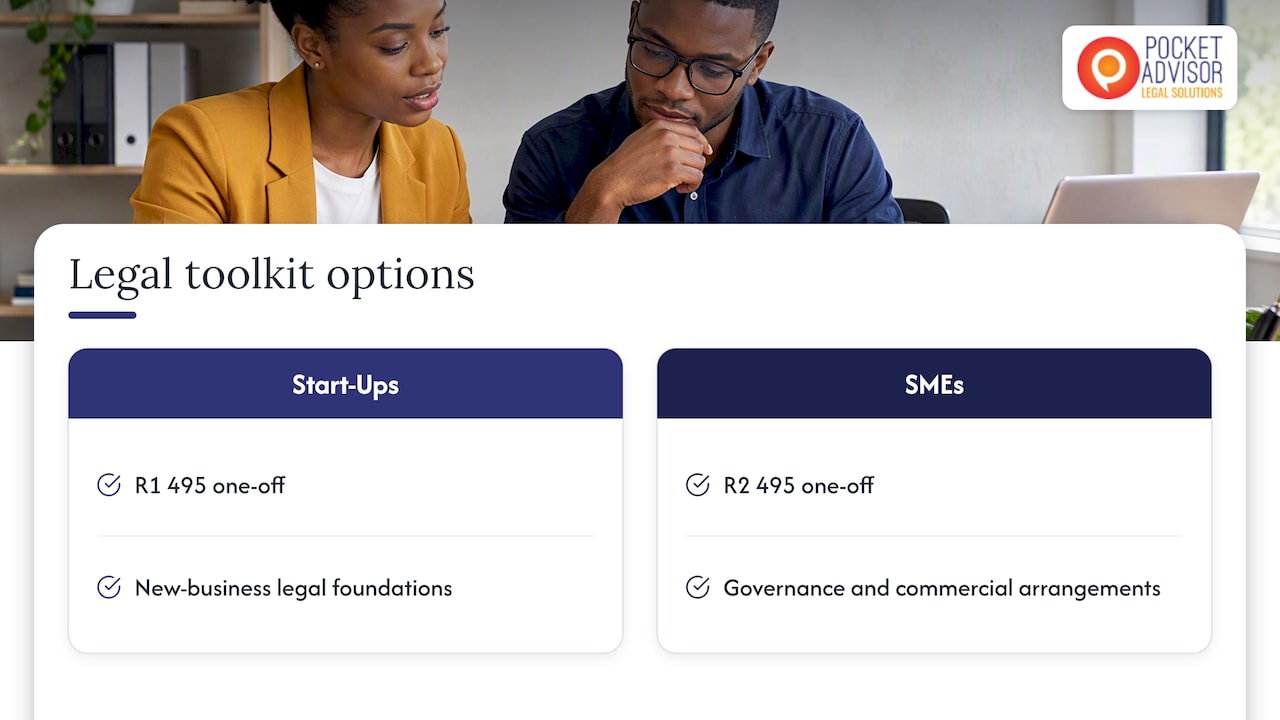
PocketAdvisor Legal Toolkits™ are digital boxes of practical legal resources: expert-led videos, workbooks, professionally drafted South African agreements and compliance resources, designed to help you understand and put in place the legal foundations your business needs. The Legal Toolkit™ for Start-Ups and Solopreneurs (R1 495, one-off) focuses on the legal foundations for a new business, while the Legal Toolkit™ for SMEs (R2 495, one-off) covers governance and commercial arrangements for a growing business.

If you are preparing to hire, explore PocketAdvisor Legal Toolkits™ and understand the legal foundations your business needs. They are a practical starting point, and they sit alongside professional legal advice when your situation calls for it.
FAQ
What is the time limit for probation in South Africa?
There is no fixed statutory maximum. The 2025 Code of Good Practice: Dismissal says the period must be set in advance and be reasonable for the job. SME Labour Support notes that three to six months is typical.
Can I use annual leave during probation?
Yes, leave entitlement builds up from the first day of work, so probation does not suspend it. The BCEA regulations provide for 21 consecutive days a year, or one day for every 17 days worked by agreement. Because a new hire will have accrued little, agree in writing how leave is requested and approved.
What are the five rights of employees?
There is no official list of five. Probationary employees do have wide protections: BCEA conditions such as leave and working hours, protection against automatically unfair dismissal, and the right to a fair process, including the chance to respond before a decision. Ask a labour attorney if you need the detail for a specific situation.
Is six months of probation normal?
It is at the upper end of what is common. Six months is easier to justify for roles with a long learning curve. For simpler roles, a shorter period is more reasonable.
Sources
- The 2025 Code of Good Practice on Dismissal (guide)
- Probation at Work: What an Employer Must Do Before Letting You Go
- A Guide to Managing Employees on Probation, LABOURED SA
- How to manage an employee who is on probation, SME Labour Support
- Extending or Concluding Probation, CEO SA
- Department of Employment and Labour on the Code of Good Practice on Dismissal
- Basic Conditions of Employment Act: Regulations: Amendment
Recommended
This article is for educational and informational purposes only. It is not a substitute for professional advice.