South African law does not give customers a general right to return goods because they changed their mind. It gives them specific rights: to return defective or unsuitable goods, to cancel certain direct marketing and online purchases, and to have a clear policy to read before they buy. A good returns policy for your business sets out those rights accurately, and then adds whatever extra generosity you choose to offer.
This guide walks through the rules in plain language, explains the reasoning behind each one, and shows how a small business can turn them into a policy that customers trust.
Key Takeaways
- Change of mind is not a legal ground for a return under the Consumer Protection Act (CPA). Many retailers offer it anyway as a service, and that is a business decision.
- Customers can return goods that fail the quality standard within six months, and they choose between repair, replacement and refund (a supplier may insist on repair for a non-major defect).
- Online sales carry a seven-day cooling-off right under the Electronic Communications and Transactions Act (ECTA), with exceptions such as personalised goods. Your website must show your returns, exchange and refund terms.
- A sign saying “No returns, no refunds” is misleading, and an “as is” clause cannot take away the quality guarantee.
- Write the policy in plain language, and draw attention to any term that limits your liability.
Table of Contents
- Why a returns policy is more than a notice at the till
- When customers can return goods under the CPA
- Online sales: the seven-day right and what your website must show
- What you can and cannot put in your policy
- Writing the policy so customers actually understand it
- Questions to ask before you publish
- Where the returns policy fits in legal readiness
- How PocketAdvisor can help
- FAQ
- Sources
Why a returns policy is more than a notice at the till
Imagine Naledi, who sells handmade candles and soaps through her own website and at weekend markets. Her first returns policy is one line copied from a big retailer: “Goods may be returned within 30 days.” A month later a customer wants to return a candle that has been burnt for three weeks. Another says her parcel arrived cracked. A third bought a gift set from a Facebook advert and wants to cancel the next day.
Three different situations, and three different legal answers. That is the real reason a returns policy matters. It is how you decide, in advance and calmly, how each of these situations is handled, rather than negotiating each one under pressure.
The rules sit mainly in two laws. The Consumer Protection Act 68 of 2008 covers the quality of goods, direct marketing and how you communicate with consumers. The Electronic Communications and Transactions Act 25 of 2002 (ECTA) covers sales concluded online. Your policy needs to respect both.
When customers can return goods under the CPA
The CPA lists specific situations in which a consumer can return goods. Outside those situations, returns are a matter of your own policy.
Defective or unsafe goods: the six-month right
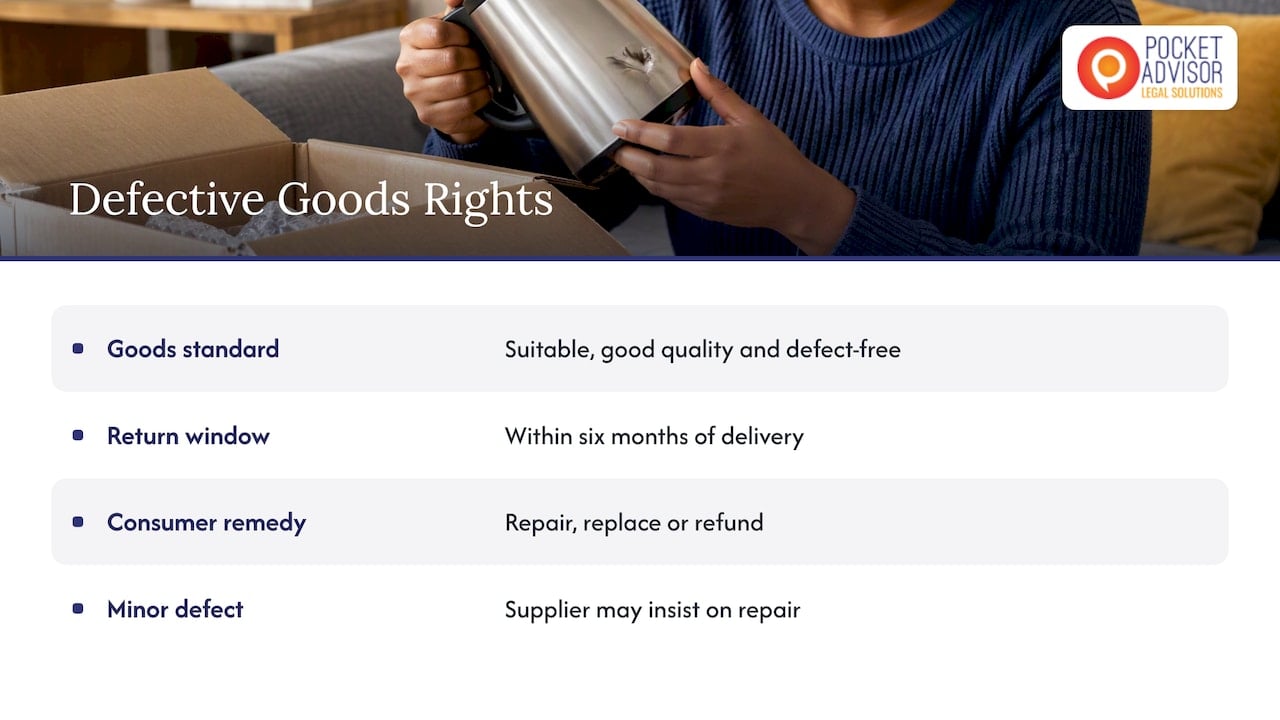
Every consumer is entitled to goods that are reasonably suitable for their purpose, of good quality and free of defects. Under the implied warranty in section 56, a consumer may return goods that fail that standard within six months of delivery. The supplier must then repair, replace or refund, at the consumer’s choice.
The reasoning is simple. Customers cannot always inspect quality before buying, so the law puts the risk of hidden faults on the seller, who is better placed to deal with the manufacturer or wholesaler.
The National Consumer Commission has also explained that the consumer chooses the remedy, except that a supplier may insist on repair when the defect is not a major one. For Naledi’s cracked parcel, this means she cannot simply offer a discount voucher if the customer would rather have a replacement or her money back.
The 10 business day right
The Act also allows a consumer to return goods within 10 business days of delivery in a few narrow cases. The research behind this guide identifies three: goods bought through direct marketing, goods the consumer did not have the chance to examine before delivery, and goods that turn out unsuitable for a particular purpose the consumer made known to you. These are set out in the Act itself.
The third case is where good conversations at the point of sale pay off. If a customer tells you what a product is for and you recommend it, you have taken on some responsibility for whether it does the job. Asking “What will you be using it for?” is good service, and it also tells you which promises you are making.
Direct marketing and the five business day cooling-off
Where a sale results from direct marketing, such as a cold call, a door-to-door visit or an unsolicited message, the consumer can cancel within five business days of the transaction or delivery, without giving a reason or paying a penalty. The thinking is that a person approached by a salesperson did not choose the moment of the sale and deserves time to reconsider.
Change of mind
For an ordinary shop purchase, the CPA contains no right to return goods simply because the buyer changed their mind or the colour looks different at home. Retailers that allow it do so voluntarily. That choice is entirely yours, but once you publish it, you should honour it consistently.
Online sales: the seven-day right and what your website must show
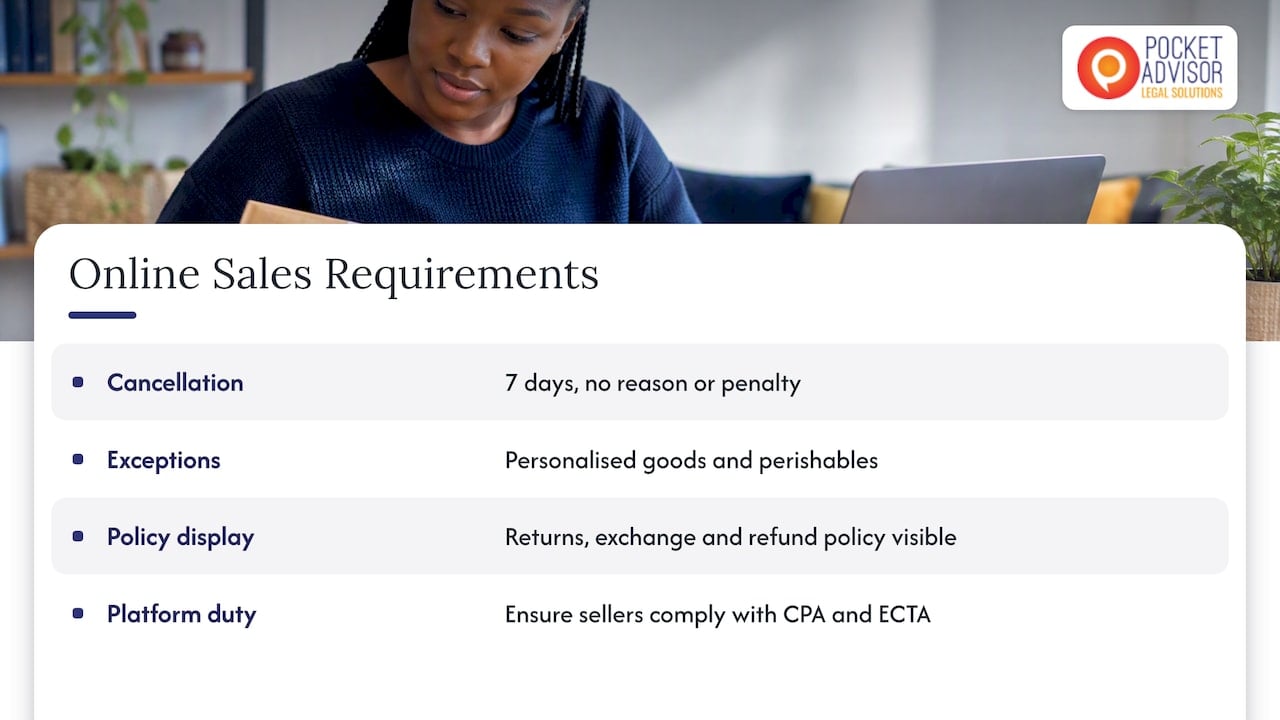
If you sell through a website, social media shop or app, ECTA adds more. A consumer buying goods online generally has seven days to cancel without giving a reason or paying a penalty, subject to exceptions, for example for personalised goods and perishables.
There is also a disclosure duty. A supplier selling online must make its returns, exchange and refund policy visible on the website. If your policy is hidden in the footer in tiny print, or only appears after payment, it will not do its job.
If you sell through a marketplace or platform, note that the National Consumer Commission has stated that platforms hosting third-party sellers remain responsible for making sure those sellers comply with the CPA and ECTA. In practice, you may find the platform asks you for a compliant policy before it lets you list.
A clear website policy sits alongside your other online documents. If you are tidying those up, the decisions in website terms of use and in a privacy policy for your business are worth working through at the same time, because customers read them together.
What you can and cannot put in your policy
Things you may include
- A reasonable fee to restore goods for resale. When a consumer returns goods that are not defective and where no statutory cooling-off or direct marketing right applies, the supplier may charge a reasonable fee to put them back in a re-stockable condition.
- Conditions for voluntary returns. If you accept change-of-mind returns, you can require unused goods, original packaging and proof of purchase, within a period you choose.
- Exclusions the law recognises. Goods that have been altered, combined with other things or permanently installed are not returnable in the ordinary way, and neither are goods where public health regulations prohibit returns. The same applies where you told the customer about a specific defect and they agreed to accept the goods in that condition, as the Act explains.
Things you cannot rely on
- “No returns, no refunds” signs. The National Consumer Commission has described these as inappropriate and misleading, because they suggest customers have fewer rights than they do. If you want to explain that you do not accept change-of-mind returns, say so accurately and add that defective goods are handled under the law.
- “As is” or “voetstoots” wording. In 2025 the National Consumer Tribunal confirmed in a matter involving a motor dealer that such clauses do not override the quality guarantee under the CPA. A second-hand item can still be sold at a lower price, but the legal baseline stays.
- Penalty fees on statutory returns. No handling or administration charge should be added where the customer is exercising a statutory right to return.
Writing the policy so customers actually understand it
Two requirements in the CPA shape how your policy should read.
First, documents given to consumers must be in plain and understandable language. The test in section 22 is whether an ordinary consumer with average literacy skills could understand it without undue effort. Legalese is not just unfriendly; it falls short of the standard.
Second, section 49 requires that terms which limit your liability, make the consumer assume risk, or oblige the consumer to indemnify you must be drawn to the consumer’s attention in a conspicuous way. If your policy contains such a term, do not bury it in paragraph nine. Put it in its own clearly headed line before the customer pays. The reasoning is fairness: a customer cannot be held to a surprising term they had no realistic chance of noticing.
A practical structure
Most small businesses do well with this order:
- Your promise in one sentence. For example: “If something is faulty, we will fix it, replace it or refund you.”
- Faulty or incorrectly described goods. Six months, customer’s choice of remedy, and how to contact you.
- Cancelling online orders. The seven-day right and the exceptions, such as made-to-order items.
- Change of mind. Whether you offer it, for how long, and in what condition.
- How refunds are paid. The method and a realistic time frame.
- Contact details. A real email address or phone number.
A worked example
Take Sipho, who runs a small online shop selling running gear. He decides to offer a 14-day change-of-mind return on unworn shoes, because his competitors in the same price bracket do and he wants customers to feel safe ordering the wrong size. His policy says this clearly, and in a separate heading it says that faulty items can be returned within six months with a repair, replacement or refund. He does not charge a restocking fee on faulty items or on cancellations within the seven-day online window. He does state that custom-printed club kit cannot be returned unless faulty, because it is personalised.
Nothing in that policy is complicated, and each choice has a reason a customer can follow. That is the goal.
Questions to ask before you publish
A returns policy is a set of business decisions that happen to have legal edges. Before you finalise yours, work through these:
- What do I sell, and how is it sold? Online, in person, by cold outreach? Each route triggers different rights.
- What do I want to offer beyond the law? A longer return window can be a selling point, but only if you can afford to honour it.
- Who handles a return in practice? If you are a one-person business, a promise of a refund within 48 hours may be unrealistic.
- Which goods are personalised, perishable or altered? Those are the ones you may need to carve out, clearly and in advance.
- Do my supplier terms match my promises? If you promise customers a six-month remedy but your supplier will only take returns for 30 days, the gap comes out of your margin. Check this when you agree supply terms.
- Where will customers see this? On the product page, at checkout and in the order confirmation, not just in a footer.
The last two questions in particular connect returns to the rest of your commercial relationships. The thinking behind protecting client relationships through terms and conditions covers how your standard terms and the CPA fit together in practice.
Where the returns policy fits in legal readiness
A returns policy is one small piece of a wider picture. Customers judge a business on how clearly it explains what happens when something goes wrong, and so do suppliers, banks and potential partners. Having your customer terms, your website documents and your supplier arrangements aligned shows a business that is well run.
It also saves you from reinventing the wheel. Founders often spend hours rewriting documents they only half understand, when what they need is to understand the decision behind each clause and then apply it to their own business.
That is how we approach it at PocketAdvisor. Our Legal Toolkits™ are a digital box of expert-led videos, practical workbooks, professionally drafted South African agreements and implementation guides that help you understand the foundations your business needs. They are not a substitute for advice on a specific, complicated situation, and a returns policy for a regulated or high-value product line is a good example of when to ask an attorney.
How PocketAdvisor can help
If you are setting up or growing a business and want to make more informed decisions about your business’s legal readiness, there are two toolkits to choose from. The Legal Toolkit™ for Start-Ups and Solopreneurs (R1 495, one-off) covers the legal foundations a new business needs. The Legal Toolkit™ for SMEs (R2 495, one-off) is built for growing businesses that need governance and commercial arrangements in place.

Both are available on demand, so you can work through them at your own pace. Explore PocketAdvisor Legal Toolkits™ to see what is inside each one and which fits your stage.
FAQ
Do I have to accept returns if the customer simply changed their mind?
Not under the CPA. A change of mind is not a legal ground for returning goods, although you may choose to offer it as a service. If you do, apply your policy consistently, and remember that online sales still carry the seven-day cancellation right under ECTA, subject to its exceptions.
How long does a customer have to return a faulty item?
Six months from delivery for goods that fail the quality standard in the CPA. The customer chooses between repair, replacement and refund, although you may insist on repair if the defect is not a major one.
Can I put “no refunds” on my invoices or shop wall?
It is better not to. The National Consumer Commission regards such signs as misleading, because customers keep their statutory rights regardless. Say instead what you do and do not accept, and note that faulty goods are dealt with according to the law.
Does my website need a returns policy?
Yes. Under ECTA, businesses selling online must make their returns, exchange and refund terms visible on the website. Put it where customers see it before they pay, and write it in plain language.
Can I charge a fee when a customer returns goods?
Only in limited circumstances. You may charge a reasonable fee to restore non-defective goods to a re-stockable condition, but not where the goods are defective or where the customer is using a statutory cooling-off or direct marketing right.
Sources
- Consumer Protection Act 68 of 2008 (Government Gazette)
- Section 56, implied warranty of quality
- National Consumer Commission, Explanatory Note 7 of 2023
- Electronic Communications and Transactions Act 25 of 2002
- National Consumer Commission, Consumer Protection in e-Commerce
- National Consumer Commission, business education exhibit on returns and refunds
- National Consumer Commission media statement on a Tribunal refund order
Recommended
This article is for educational and informational purposes only. It is not a substitute for professional advice.