Yes, a legal template can be valid in South Africa. A contract does not become binding because a lawyer wrote it from scratch, and it does not become void because you downloaded it. What decides whether a template works is whether it fits your deal, your business and the statutes that apply to you. A template that ignores those things can look polished and still let you down.
This guide is written for business owners, not lawyers. It explains why a template holds up or falls apart, how to check one before you sign, and what to do about free downloads and AI-drafted contracts.
Key takeaways
- A template is valid or not because of its content and fit, not because it is a template, or because it was signed on a screen.
- Clauses that try to override mandatory rules, such as consumer or employment protections, can be unenforceable however neatly they are worded.
- Free downloads and AI tools give you a starting draft. They do not know your facts, so you must adapt and check them.
- Some documents, such as a company’s Memorandum of Incorporation and shareholder arrangements, need to match each other and the law, which a generic form rarely does.
- Legal readiness is part of running a credible business. Use templates as a foundation, and still ask a legal professional about high-stakes or unusual deals.
Table of Contents
- What makes a contract valid in the first place
- Does signing on a screen count?
- Where templates quietly go wrong
- Are free contract templates from Google safe?
- Can ChatGPT or another AI draft my business contracts?
- A short checklist before you rely on any template
- Which documents can you do yourself?
- From a loose template to a proper legal foundation
- Putting it together: a worked example
- FAQ
- Sources
What makes a contract valid in the first place
Imagine Naledi, a freelance designer in Johannesburg. A client sends a two-page agreement copied from a website. She wonders whether it “counts”.
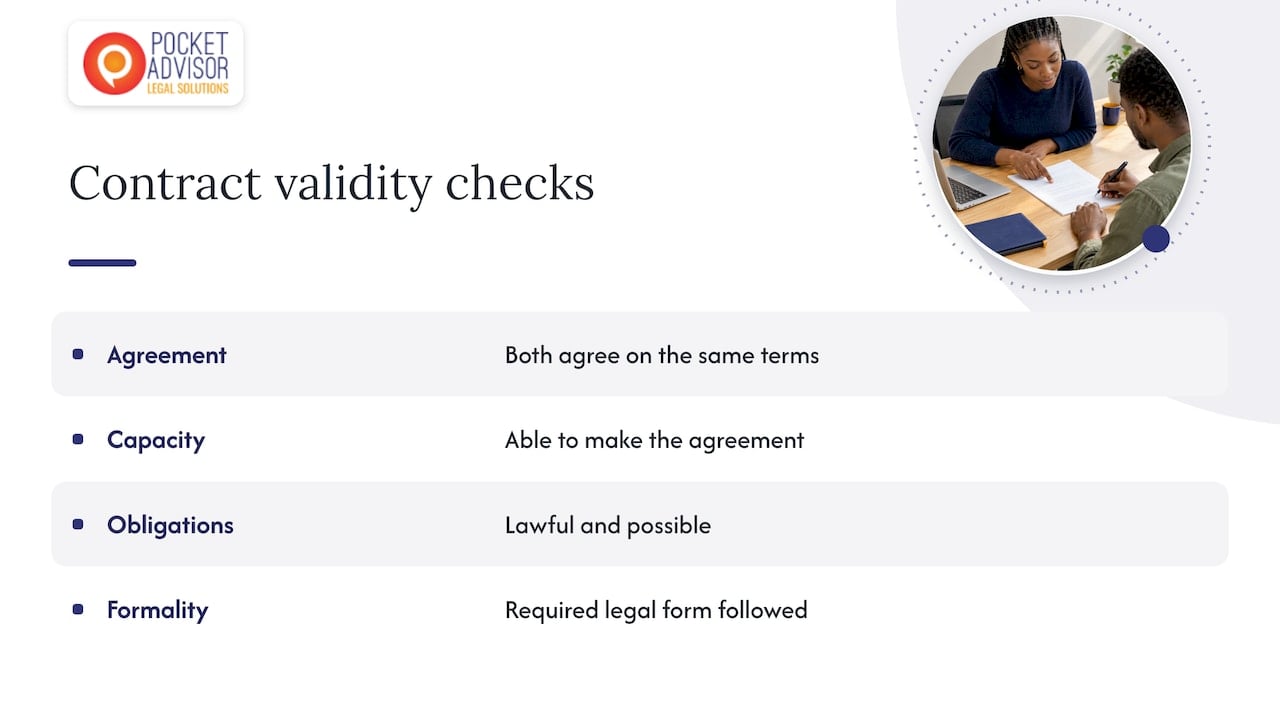
In plain terms, a contract works when the people involved genuinely agree on the same terms, they are able to make the agreement, what they promise is lawful and possible, and any formality the law demands for that type of deal has been followed. Most everyday business agreements need no special format. Some do, and that is where templates trip people up.
The format of the paper is not the test. A Word file, a PDF, a printed form and a lawyer’s bespoke draft can all be valid, or all fail, for the same reasons: unclear terms, missing parties, or clauses that the law does not allow.
So the useful question is never “is this a template?” It is “does this document do what I need, for this deal, under South African law?”
Does signing on a screen count?
Many owners worry that an emailed PDF or a signature app is somehow second best. In most commercial situations it is not.
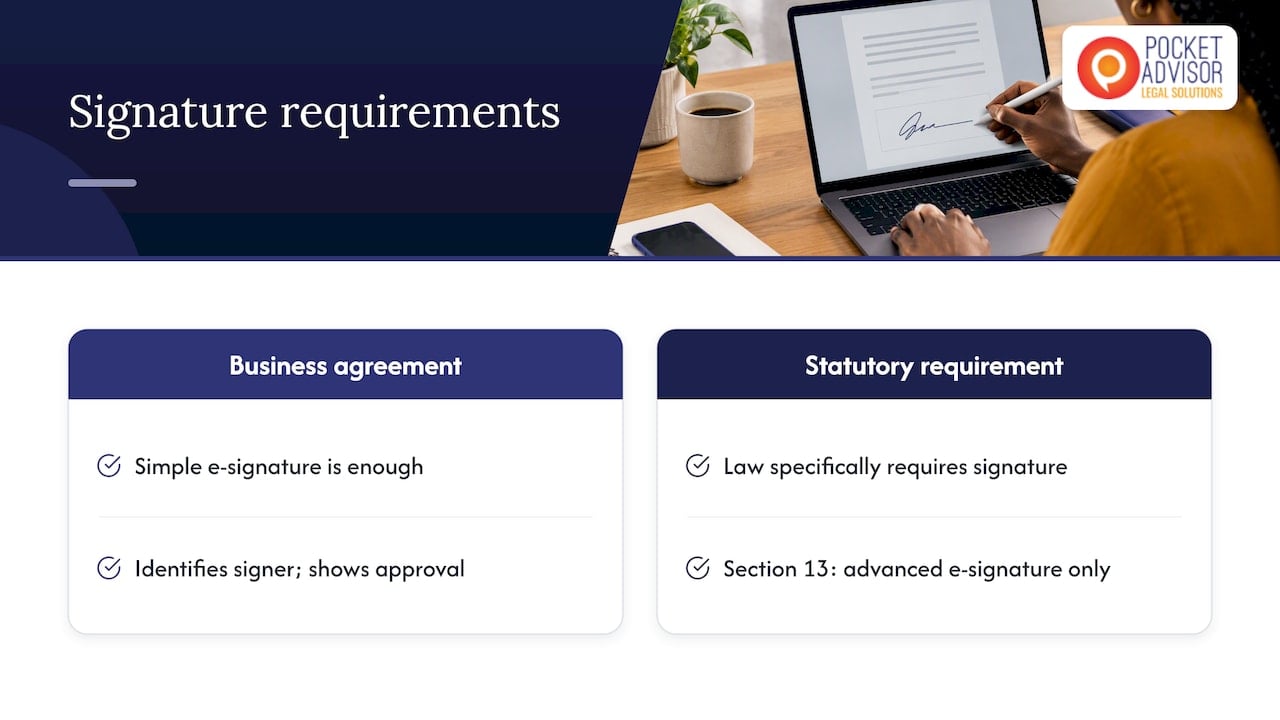
The Electronic Communications and Transactions Act 25 of 2002 (ECTA) is the law that deals with this. It gives electronic communications and signatures legal recognition, so a deal cannot be denied simply because it was concluded electronically. For most business agreements, a simple electronic signature that identifies the signer and shows they approve the document is enough.
There is a twist worth knowing. An academic review of the Act in the Obiter law journal points out that where a law specifically requires a signature, section 13 says that requirement is met only with an advanced electronic signature. So the answer depends on the document. A routine supplier agreement is one thing. A document that a statute says must be signed is another.
Digital signing is not a South African peculiarity. If you are curious how far it goes elsewhere, electronic conveyancing in New South Wales shows property settlements handled online under Australian rules. Those rules are Australian, and you should not assume they apply here.
What this means for you: a digitally signed template is not weaker for being digital. Check whether any law requires a particular kind of signature or formality for the specific document, and ask a legal professional if you are unsure.
Where templates quietly go wrong
Most template problems are not dramatic. They are small mismatches that sit unnoticed until the day you need the document to do its job. Here are the common ones.
The template was written for a different situation
A service agreement written for a large corporate customer may not suit a one-person consultancy. A rental form may assume things about notice and deposits that your arrangement does not share. Think of it like buying a suit off the rack: the cloth may be excellent, but it still needs to fit.
Clauses that fight the law
Some rules cannot be switched off by agreement. If a template contains a clause that tries to override them, that clause may simply not work, even though the rest of the document does.
The Consumer Protection Act 68 of 2008 is a good example for anyone selling to the public. It limits fixed-term consumer agreements to 24 months unless the supplier can show a financial benefit to the consumer, and it gives consumers a right to cancel with written notice, subject to a reasonable fee. A subscription template copied from an overseas site may say something quite different. If your customers are ordinary consumers, your terms need to sit comfortably alongside those rules.
The same Act expects consumer agreements to be written in plain language that the consumer can understand, as the Act’s text explains. Dense legalese is not a sign of a strong contract. For consumer-facing terms, it can work against you.
Employment paperwork has built-in requirements
Suppose Thabo opens a small coffee shop in Durban and hires his first barista. He finds an employment contract online and reaches for it.
The Basic Conditions of Employment Act requires employers to give employees certain particulars in writing when employment starts, such as the job description, place of work, how often pay is made and notice periods. If the employee cannot understand them, the employer must explain them in a language and manner the employee understands. Records must be kept for at least three years after employment ends.
So the right question for Thabo is not “does this template look professional?” It is “does it cover what the law expects, in words my barista actually understands, and does it match how I will really run the shop?”
Company documents have to agree with each other
A private company’s Memorandum of Incorporation (MOI) is its core rulebook. The Companies Act says a company’s MOI provisions are void to the extent that they contravene the Act, as section 15 of the Act sets out. It also deals with shareholder agreements alongside the MOI, so the two need to be consistent.
The Companies and Intellectual Property Commission (CIPC) offers a standard MOI for private companies. For a simple company with one owner, that may be enough. When two or more people are going into business together, they usually want to settle things the default form leaves open: who decides what, what happens if one wants out, and how disagreements are handled.
If this is your situation, these guides explain the thinking in plain language:
- A South African guide to the Memorandum of Incorporation
- How a shareholders agreement differs from an MOI
- Pre-emptive rights and the MOI
Data protection is easy to forget
If you share customer or staff details with anyone who handles them for you, such as a bookkeeper, an IT provider or a payroll service, the Protection of Personal Information Act (POPIA) matters. Section 21 says that you, as the responsible party, must have a written contract with that operator, so that the operator maintains proper security measures. Many general-purpose templates simply do not mention this.
For a practical walk-through, see this guide to POPIA for small businesses and the POPIA checklist for small business.
Are free contract templates from Google safe?
Some are fine as a starting point. Many are not, and you often cannot tell which is which from the download page.
Here is a quick way to judge a free template:
| Question to ask | A good sign | A warning sign |
|---|---|---|
| Is it written for South Africa? | Refers to South African law and institutions | Uses foreign terms, courts or statutes |
| Is it dated? | Shows when it was last reviewed | No date, no author |
| Is the language clear? | Plain, short sentences you can follow | Long, archaic wording you cannot explain |
| Does it match your deal? | Has places for your specific terms | Generic blanks with no guidance |
| Does it explain itself? | Tells you why each clause is there | Just a block of clauses |
| Who stands behind it? | Identifiable author or provider | Anonymous download |
Notice what a free template cannot do. It cannot ask you questions. It does not know whether you are selling to consumers, hiring staff, handling personal information, or going into business with a friend. The cost of that is rarely visible on day one. It shows up when you need the document to say something specific and it is silent.
The Western Cape Government’s contracts booklet is a useful general reference on how contracts work in practice for consumers and small businesses.
Can ChatGPT or another AI draft my business contracts?
AI tools can produce a tidy-looking contract in seconds. That is exactly why they need care. A smooth draft reads as if somebody checked it, but nobody has.
Here is what an AI draft can reasonably help with:
- Producing a first outline so you know what topics a contract of that type usually covers.
- Rewording a clause into plainer language once you know what it is meant to do.
- Generating a list of questions to bring to a meeting with your co-founder, supplier or adviser.
And here is where it cannot be relied on:
- It does not know your facts unless you tell it, and it cannot tell what you have left out.
- It may blend rules from other countries, so a clause may sound right but not fit South African law.
- It cannot confirm that a statute it mentions exists, is current, or says what it claims. Check every legal reference yourself against the official text.
- It will not warn you when your deal needs a particular formality or a specialist’s input.
A sensible rule: use AI to think and to draft questions, not to decide. Anything involving significant money, ownership of the business, staff, or personal information should be built from a reliable South African foundation and reviewed by someone who knows the area.
A short checklist before you rely on any template
Whether the template came from a friend, a website, an AI tool or a purchased resource, run through these steps.
- Name the deal in one sentence. For example: “I am hiring a part-time bookkeeper as a contractor.” If the template does not match that sentence, it is the wrong template.
- Identify the rules that apply. Selling to consumers? Hiring staff? Handling personal information? Setting up a company? Each points to a specific law.
- Read every clause and explain it in your own words. If you cannot, you do not yet understand what you are agreeing to. Ask, or remove it.
- Fill every blank deliberately. Names, amounts, dates, deliverables, notice periods. Vague blanks create vague promises.
- Check consistency. A shareholder arrangement should not contradict your MOI. An employment contract should not contradict your policies.
- Decide how it will be signed. Check whether anything in the law requires a specific form of signature for this document.
- Get advice where the stakes are high. A lawyer is worth the fee for unusual structures, large sums, or anything you could not afford to get wrong.
- Keep a record. Store the signed version and note when you plan to review it.
Which documents can you do yourself?
Not everything needs a lawyer, and not everything should be done alone. Simple, low-risk, well-understood documents are usually manageable with good guidance. Anything that sets up ownership, binds you for long periods, or involves other people’s rights deserves more care. PocketAdvisor has a plain guide on which legal documents you can safely do yourself.
Two examples where the details matter:
- Working with a freelancer or contractor. Who owns the work produced? What are you paying for and when? A guide to a freelancer contract and IP ownership shows the questions to settle upfront.
- Engaging a consultant. Scope, confidentiality and payment terms all need to be clear. See what to include in a consulting agreement.
In both, the document is only as good as the thinking behind it. Agreeing the scope, the price and the handover before you write anything down saves a lot of awkward conversations later.
From a loose template to a proper legal foundation
The problem with scattered templates is that nobody explains how they fit together. You end up with a folder of unrelated documents and no clear picture of what your business needs next.
That is the gap PocketAdvisor Legal Toolkits™ are built to close. Each toolkit is a digital box with expert-led videos, practical workbooks, professionally drafted South African legal agreements and compliance resources, so you understand why each document matters and how to use it, not just where to sign. It is not a course and it is not just a folder of templates.
There are two toolkits, and they suit different stages:
| Start-Up and Solopreneur Toolkit | SME Toolkit | |
|---|---|---|
| Price | R1,495, one-off | R2,495, one-off |
| Focus | Legal foundations for a new or one-person business | Governance and commercial arrangements for a growing business |
| Good for | Founders, freelancers, solopreneurs | Established small and medium-sized businesses |
They are available on demand, so you can work through them at your own pace, alongside your day-to-day business. They are a practical, affordable way to build legal readiness, and they do not replace professional advice when your situation calls for it.
Explore PocketAdvisor Legal Toolkits™ and understand the legal foundations your business needs.

Putting it together: a worked example
Let us follow two friends, Lerato and Sipho, who start an online skincare shop in Cape Town.
They find a free partnership template and sign it digitally. That is fine: the electronic signature is not the problem. What they have not considered is that they plan to register a company, so their arrangement will need to line up with a Memorandum of Incorporation. They have also not decided what happens if Sipho wants to leave in two years.
Their customers are ordinary consumers, so their online terms need to respect consumer rules on things like plain language and cancellation. They plan to hire a part-time packer, so they need written particulars of employment. And their courier and payment providers will handle customers’ details, so POPIA enters the picture.
None of this is scary. It is a short list of decisions to make once, in the right order, with guidance. They start by agreeing the questions between themselves, then gather the documents that answer them, and then ask an adviser to look over the parts that carry the most risk. That is what legal readiness looks like in practice: a business that is easier to trust, easier to grow, and easier to explain to a bank, an investor or a new partner.
FAQ
Is a legal template legally binding in South Africa?
It can be. Binding force comes from genuine agreement on lawful terms, plus any formality the law requires for that type of deal, not from the document being bespoke. A template that is incomplete, unclear or in conflict with mandatory rules may be only partly enforceable.
Is an electronic signature on a contract valid?
For most commercial agreements, yes, under ECTA. The exception is where a law requires a signature, in which case an advanced electronic signature is needed. If you are unsure which applies to your document, check with a legal professional.
Can I rely on ChatGPT to write a contract for my business?
Use it for brainstorming, outlines and plain-language rewording, not as the final word. It does not know your facts and can mix up legal systems. Verify any law it cites against the official text and have important agreements checked by someone who practises in that area.
Do I still need a lawyer if I use a toolkit or template?
Not for every document, but for some situations yes. Complex ownership structures, large transactions and unusual terms are worth professional advice. A good foundation helps you walk into that conversation prepared, so the time you pay for is spent on the hard questions.
Sources
- Electronic Communications and Transactions Act 25 of 2002
- Obiter: validity of e-signatures in South African law
- Consumer Protection Act overview, the dtic
- Consumer Protection Act 68 of 2008
- Basic Conditions of Employment Act
- Companies Act, section 15
- CIPC: private company with a standard MOI
- POPIA section 21
- Western Cape Government contracts booklet
- Electronic conveyancing in New South Wales
Recommended
This article is for educational and informational purposes only. It is not a substitute for professional advice.