
An after-action review (AAR) is a short, structured discussion held once a matter or a major phase has finished, in which the team compares what was intended with what happened and agrees what to do differently next time. For a law firm, it is one of the least expensive ways to improve scoping, budgeting and client service, because it uses experience the firm has already paid for. This guide sets out how to run one, what to ask, who should attend and how to turn the findings into changes in practice.
Key Takeaways
- An AAR is a structured professional discussion that tests the intended outcome of a matter against the actual outcome, and converts the difference into actionable process changes.
- Hold it soon after the matter or phase ends, include everyone involved, and keep it free of blame so that people speak candidly.
- Five questions carry most of the value: what was the goal, what happened, why did the results differ, what did we learn, and what will we do next time.
- A review has value only if findings are recorded and reused as lessons, action plans, training and templates for later matters.
- Confidentiality, privilege and the Protection of Personal Information Act (POPIA) continue to apply when a firm reviews a client matter internally.
Table of Contents
- What an after-action review is
- Why law firms benefit from reviewing a matter
- The questions a legal AAR should ask
- When to hold the review and who should attend
- Facilitating the discussion
- A worked example: a commercial lease dispute
- Recording findings and turning them into change
- Confidentiality, privilege and POPIA
- Building review capability across the firm
- Develop the capability behind better reviews
- FAQ
- Sources
What an after-action review is
An AAR is a structured conversation, not a report and not a performance appraisal. The team reviews a defined piece of work, whether a completed litigation, a transaction, an advisory mandate or a phase within a longer matter, and asks how the result compares with the plan. The purpose, as the Association of Corporate Counsel describes it in its guidance for law departments, is to evaluate the intended against the actual outcome and to learn from the gap.
Two features distinguish an AAR from the informal chat that often follows a closing dinner. First, it is planned: it has a facilitator, an agenda and a time limit. Second, it produces output: a short written record and a list of specific actions with owners.
An AAR can also be held whether or not a formal legal project management framework guided the matter. The same source notes that a review is possible regardless of whether such a framework was in place. A firm without a project management discipline can therefore begin with reviews and build structure from what they reveal. Firms that already work with a defined approach will find the review a natural closing step. Our guide to legal project management for lawyers explains how the pieces fit together.
Why law firms benefit from reviewing a matter
Legal work is usually judged on the outcome alone: the judgment, the signed agreement, the settlement. The process that produced it, including how the matter was scoped, how the budget held, how work was allocated and how the client was kept informed, is rarely examined once the file is closed. Yet that process determines profitability, client satisfaction and the strain placed on the team.
The ACC guidance identifies several benefits of responding constructively to review findings: greater efficiency, cost-effectiveness, responsiveness, professional development, and improved managerial skills and knowledge. Each of these has a commercial counterpart in a South African practice:
- Scoping accuracy. A review shows whether the original scope matched the work actually required, and which assumptions failed.
- Budget predictability. Comparing estimates with actual time and disbursements reveals where fees drifted and why.
- Workflow. The team can identify handovers that stalled, tasks given to the wrong level of seniority and duplicated effort.
- Client communication. The review asks whether the client received the updates, warnings and explanations it needed, at the right moment.
The discipline is more than administration. It asks lawyers to apply commercial judgement to their own delivery, and to treat each matter as a source of evidence about how the firm works. That mindset of continuous improvement is central to legal project management as a specialised professional capability, rather than generic project management borrowed from other industries.
The questions a legal AAR should ask
The ACC guidance recommends that reviews ask what the goal was, what actually happened, why the results differed, what was learned and what specific steps will be taken next time. These can be adapted to legal practice as follows.
- What was the goal? State the client’s objective and the firm’s own objectives (outcome, timing, budget, relationship). Where the team gives different answers, that in itself is a finding.
- What actually happened? Set out the facts in sequence: key decisions, turning points, variations in scope, the final result and the final cost.
- Why did the results differ from the plan? Probe root causes of both successes and shortfalls. A good outcome reached through luck or heroic overtime is not a repeatable process.
- What did we learn? Separate lessons about the law and the facts of the matter from lessons about how the firm worked.
- What will we do next time? Convert each lesson into a specific step with an owner and a date.
The same guidance suggests discussion should also test the alignment between the legal strategy and the client’s objectives. In practice, this is the question that most often produces insight: a technically excellent result that did not serve what the client actually needed.
Supplementary prompts for legal matters
The core questions can be supplemented with prompts specific to professional services:
- Was the initial scope document clear enough that the client and the team read it the same way?
- At what point did we first know the budget would be exceeded, and who was told?
- Which tasks could have been delegated, standardised or templated?
- Where did technology help, and where did it add steps without adding value?
- What would the client say we did best, and what would they say we should improve?
The last two prompts matter because they bring in both successes and weaknesses. Reviews that dwell only on problems become discouraging; reviews that also record what went well allow the firm to repeat it deliberately.
When to hold the review and who should attend
Timing affects quality. The ACC guidance advises that reviews be held as soon as possible after a matter ends or after a key phase, while details are still fresh. Waiting until a file is archived invites vague recollection and a tendency to remember only the final weeks.
For long matters, do not wait for the end. A review at the close of each significant phase, for example after discovery, after the hearing, or after due diligence and before signing, lets the team adjust while the matter is still live.
On attendance, the guidance is that all involved team members should take part. In a law firm this normally means the supervising partner, the associates and candidate attorneys who did the work, the paralegal or legal secretary who managed the file, and, where relevant, the person who handled billing. Including the junior members is deliberate: they often see the process defects that seniors have stopped noticing.
Leadership should be conscious of its own weight in the room. The same source cautions that leaders should not dominate the discussion, because that can stifle openness. A practical measure is for the supervising partner to speak last on each question.
A review for a sole practitioner
A small practice may have a team of one. Miles B. Cooper of Coopers LLP observes that a review can be performed by a single person, but that being a fair witness to oneself is difficult, and he recommends an observer technique to preserve perspective. In practice, this means writing the answers as if describing a colleague’s matter, or asking a trusted peer at another practice to act as the questioner for an hour.
Facilitating the discussion
The ACC guidance recommends trained facilitators, clear ground rules and a timed written agenda circulated in advance. Leaders may facilitate where their style suits it, but a neutral colleague or a practice manager is often better placed.
A workable format for a 60 to 90 minute session:
| Segment | Purpose | Suggested time |
|---|---|---|
| Ground rules and goal | Confirm purpose, confidentiality of the discussion, no blame | 5 to 10 minutes |
| What was intended and what happened | Agree the facts and timeline | 15 to 20 minutes |
| Why results differed | Identify root causes of successes and shortfalls | 20 to 30 minutes |
| Lessons and actions | Agree specific steps, owners and dates | 15 to 20 minutes |
| Close | Confirm who records and circulates the output | 5 minutes |
The most important ground rule is the absence of fault-finding. The guidance states that reviews must avoid blaming if people are to be candid. A useful way to keep to this is to frame every observation about the process, not the person: “the instruction letter did not capture the client’s deadline” rather than “the associate missed the deadline”.
Legal commentators also stress that reviews should be living practices and not box-ticking exercises, with an environment in which egos are left at the door. If the same review format is used without any visible change following, participants will quickly stop investing in it.
Firms that want to improve how they run these sessions can draw on general guidance about how to enhance team collaboration, including how to schedule and facilitate conversations that encourage openness and produce practical improvements.
A worked example: a commercial lease dispute
The following scenario is illustrative and not drawn from any actual matter.
A mid-sized Johannesburg firm acts for a retailer in a dispute with a landlord. The matter was quoted at an estimate based on a single round of correspondence and a mediation. It settled at mediation, a good result, but fees exceeded the estimate by roughly a third. Two weeks after settlement, the team meets.
- Goal. The client wanted continued occupation on revised rental terms and a predictable legal spend. The partner had focused on the first aim; the client had cared equally about the second.
- What happened. The landlord raised new allegations after the first letter, adding two rounds of correspondence. A document review was staffed by an associate when a candidate attorney with a checklist could have done the first pass.
- Why the results differed. The estimate assumed no escalation, and no trigger was set for informing the client when the assumptions changed. Client updates were irregular.
- Lessons. Estimates for disputes should state their assumptions; a defined point should prompt a revised estimate; first-pass review can be standardised.
- Actions. The practice manager drafts an estimate template with an assumptions section, the associate prepares a first-pass review checklist, and the partner agrees to send a short budget update at each stage.
None of these actions required a new system. Each was specific, owned and small enough to be done within a month.
Recording findings and turning them into change
The review matters only if its findings alter later work. According to the ACC guidance, outputs can include lessons learned, new action plans, training opportunities and templates for use in other matters. A one-page record is usually enough, with the following headings:
- Matter or phase reviewed, date and attendees
- Intended outcome and actual outcome
- Root causes identified
- Lessons, separated into legal or factual and process
- Actions, each with an owner and a due date
Store the records where other teams can find them, and review them periodically for patterns. A single late client update is an incident; the same pattern across six matters is a process defect worth fixing at firm level.
The feedback loop is especially valuable for scoping and pricing. The ACC material describes reviews as a means of validating initial scoping and budgeting against actual performance, identifying the drivers of fee volatility and improving communication, all of which increase predictability for future client engagements. For related reading, see our guides on legal service delivery improvement, legal process improvement and how to manage a legal matter. A legal project charter written at the outset also gives the review a clear baseline to test against.
Reviews are also the right place to decide where technology and automation add genuine value. If a lesson is that first-pass document review consumed disproportionate hours, the question is whether a checklist, a template or a tool would remove that work, and whether the cost and supervision burden are justified. Reviews supply the evidence for that decision.
Confidentiality, privilege and POPIA
An internal review discusses real client matters, so the professional duties that attach to the file apply equally to the review. Three points deserve attention.
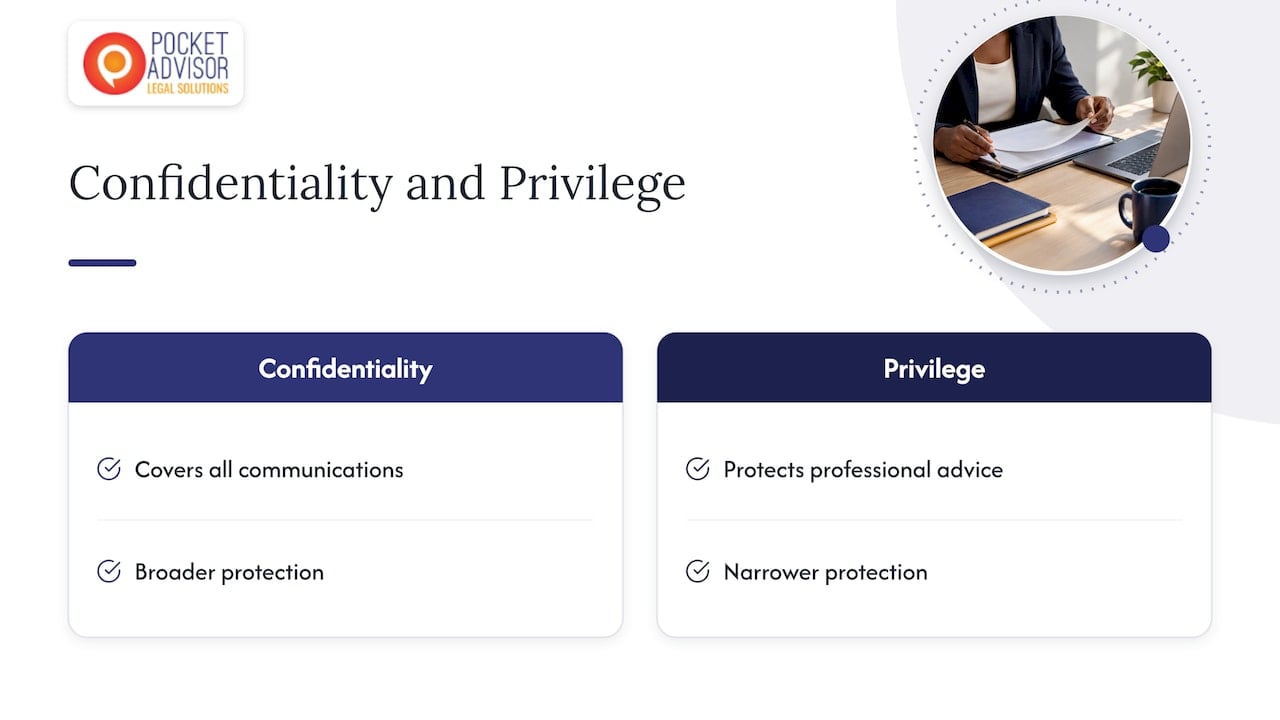
Confidentiality and privilege are different. As described in De Rebus, information held by attorneys in South Africa is protected by both, but confidentiality is broader and covers all communications, while privilege is narrower and protects advice given in a professional capacity. Keep review attendance to people who are already within the firm’s duty of confidentiality, and be cautious before sharing a review record outside the firm, including with the client, since doing so may raise questions about how privileged material is treated. If in doubt, seek advice from the firm’s own ethics or risk partner.
POPIA applies. The same source notes that attorneys and law firms must comply with the Protection of Personal Information Act. A practical approach is to write review records at the level of process and avoid including client names, personal information or sensitive facts unless they are essential. The Act is not the subject of this guide; for a plain-language overview of its requirements for businesses, see our POPIA compliance guide for small businesses.
Regulatory context. Attorneys fall under the regulatory jurisdiction of the Legal Practice Council, and the Law Society of South Africa notes that clients are entitled to professional, honest and unbiased advice at all times. A review that surfaces a concern about the quality of advice given should be handled through the firm’s usual risk and ethics channels, not left in a lessons-learned document. The LSSA also notes that the duty to disclose information about money deposited with an attorney can override confidentiality, for instance under the Financial Intelligence Centre Act, a reminder that confidentiality has limits that the firm’s compliance function should manage.
Building review capability across the firm
One well-run review is useful. A consistent practice is transformative. Firms that adopt reviews as routine tend to do four things: they set a threshold (for example, every matter above a certain fee value and every matter that overran), they train a small group of facilitators, they assign one person to track actions to completion, and they report patterns to partners at regular intervals.
This is where legal project management training adds value. The skills involved, namely defining scope, estimating, managing risk, communicating with clients and improving delivery, are the same skills that make reviews productive. Our overview of law firm project management in South Africa and our guide to legal matter management set out how these disciplines connect.

Develop the capability behind better reviews
PocketAdvisor holds exclusive rights in South Africa to provide the internationally accredited Legal Project Management programme of the International Institute of Legal Project Management (IILPM). The Applied Legal Project Management Course is priced at R9 500 as a one-off fee, and the Premium option at R19 995. It brings structure, commercial awareness and a continuous-improvement mindset to legal work, and helps firms and legal departments decide where technology and automation add genuine value. Students who successfully complete the course receive IILPM accreditation, subject to the programme’s completion requirements, a credential that helps lawyers strengthen their expertise and distinguish themselves in a competitive profession.

Explore PocketAdvisor’s internationally accredited Legal Project Management Course: https://pocketadvisor.co.za/legal-project-management-course/
FAQ
What is the difference between an after-action review and a post-mortem?
A post-mortem tends to look backwards to establish what went wrong, and can slide into assigning fault. An AAR covers successes and shortfalls alike and is aimed at improving future work. It ends with specific actions, not a verdict.
How long should a law firm after-action review take?
Most reviews fit within 60 to 90 minutes if a written, timed agenda is circulated beforehand. Smaller matters may need only 30 minutes. The length matters less than ensuring that the session ends with owned, dated actions.
Can a sole practitioner or small firm run an after-action review?
Yes. A review can be done by one person, although it is difficult to be an objective witness to one’s own work. Writing the answers as though reviewing a colleague’s file, or inviting a peer to ask the questions, helps preserve perspective.
Should the client be involved?
The ACC guidance focuses on internal team participation. A firm that wishes to gather client views can do so separately, through a short feedback conversation, and keep the internal review candid. Consider privilege and confidentiality before sharing any written review record outside the firm.
Sources
- Law Departments and After-Action Reviews: Using Lessons Learned (Association of Corporate Counsel)
- Iterative improvement: make reflective learning work for your firm (Solicitors Journal)
- As the dust settles (Coopers LLP)
- De Rebus, November 2017
- Your Rights as a Client (Law Society of South Africa)
Recommended
This article is for educational and informational purposes only. It is not a substitute for professional advice.