
A legal project status report is a short, structured update that tells a partner, a client or a general counsel where a matter stands, what it is costing, what could go wrong and what decision is needed next. Done well, it replaces ad hoc emails and anxious telephone calls with one predictable document. This guide sets out what to include, how often to report, how to tailor the report to each reader and how to keep it brief enough to be read.
Key Takeaways
- A status report should cover progress, budget and resourcing, risks and mitigation, changes in approach, completed work, milestones and next steps.
- Lead with the decision you need from the reader. A report that does not prompt action has not done its job.
- Report weekly inside the team and monthly to clients or executives, unless a statute or court order sets the rhythm, as it does in South African business rescue.
- Keep the format fixed and the length short. A three-heading, three-bullet structure is easier to read, and therefore easier to act on, than a narrative.
- Choose measures that match the audience: matter-level budget and milestones for clients, practice-level financial indicators for firm management.
Table of Contents
- What a legal project status report is
- Status report or progress report?
- What to include in a legal project status report
- The 3×3 model: short enough to be read
- How often to report, and to whom
- When reporting is a statutory duty: business rescue
- Choosing the right measures
- Presenting status so that readers act
- A worked example: an in-house regulatory project
- Common weaknesses to remove from your reports
- Build the skill with accredited training
- FAQ
- Sources
What a legal project status report is
Practical Law describes the legal project management update report as a structured document that keeps lead partners, team members and clients informed about progress, status, budget and resourcing. It also records risks and how they are being mitigated, changes to methodology, completed tasks, milestones and next steps.
In practice the same document goes by several names: project update report, matter status report, client update, or simply the “status update”. The label matters less than the discipline behind it. The report is the point at which the plan agreed at the outset is compared with reality, and where the team is honest about the gap.
That is why status reporting belongs within legal project management as a specialised capability rather than as administration. A competent report depends on a defined scope, a realistic budget and a clear view of who is doing what. If those foundations were never set, the report has nothing to measure against. Our guides on the legal project charter and legal project budgeting cover those foundations.
Status report or progress report?
The two terms are often used interchangeably, and in a law firm that is usually harmless. There is, however, a commonly drawn distinction that can help you decide what to send to whom.
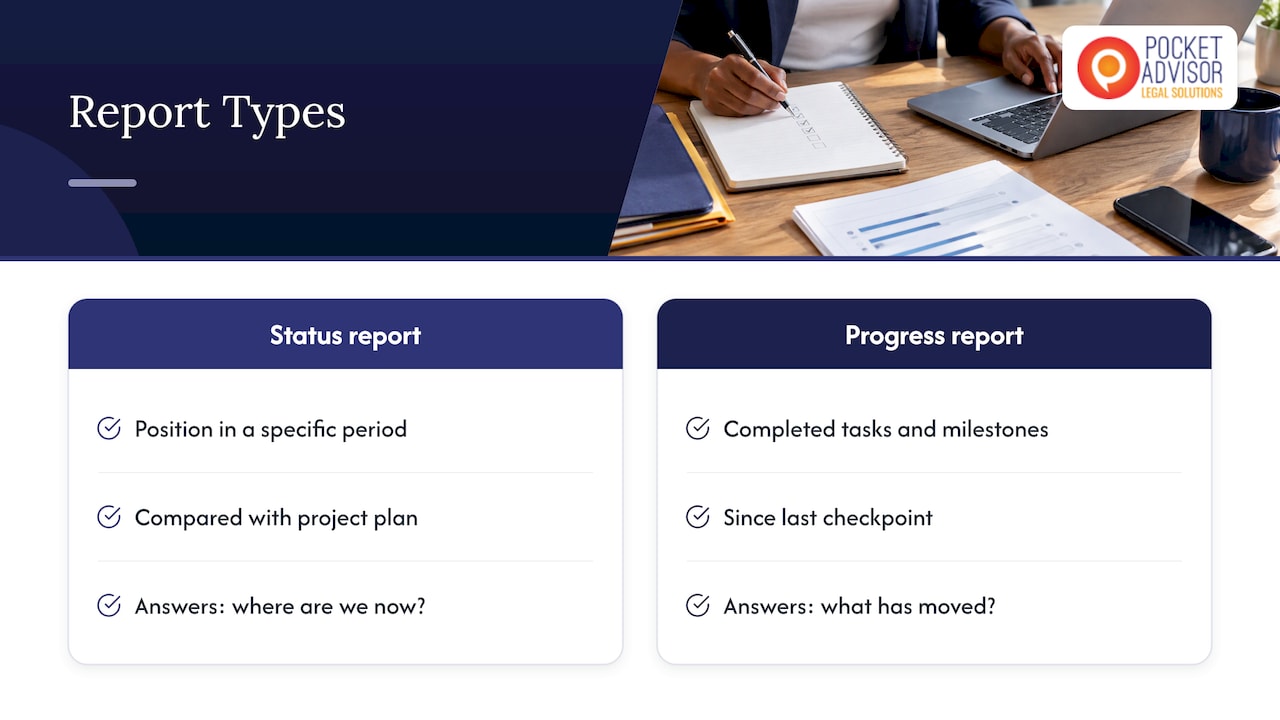
According to ProjectManager.com, a status report describes progress within a specific period and compares it with the project plan. A progress report goes further and lists the specific tasks and milestones completed, showing that the work is keeping pace with the schedule. Put simply, the status report answers “where are we now?” and the progress report answers “what has moved since the last checkpoint?”
For legal work, a sensible approach is to combine them in one document for clients (current position plus movement since last report) and to keep a more granular task-level progress view for the internal team. Whatever you call the document, define it once in the engagement terms so the client knows what to expect.
What to include in a legal project status report
The contents should be consistent from one report to the next, so that the reader learns where to look. Drawing on the Practical Law outline above, a matter-level report should include:
- Progress and current status: a one-line overall position (on track, at risk, off track).
- Budget and resourcing: spend to date against the agreed estimate, and any change in staffing.
- Risks and challenges: what could affect time, cost or outcome, and what is being done about it.
- Changes in approach: any shift in methodology or implementation since the last report.
- Completed tasks and milestones: what has been delivered.
- Next steps: what happens in the coming period, and who owns each item.
It is also useful to include the identifying details. Sitemate notes that a report should record the reporting period, the project identity and the preparer, so that it can be filed and found later.
Adapting the contents to the matter type
A transactional matter, a regulatory project and a litigation file need different emphasis. The table below is a practical guide, not a rule.
| Matter type | Add to the core contents | Typical reader |
|---|---|---|
| Corporate transaction | Conditions precedent outstanding, signing and closing dates, third-party approvals | Client deal team, partner |
| Regulatory or compliance project | Filing deadlines, regulator correspondence, owners of each workstream | General counsel, compliance head |
| Litigation | Court and case number, upcoming hearings and deadlines, proceedings history, billing summary, recommendations | Client, instructing attorney, partner |
| Internal legal project (for example, a contract-review clean-up) | Volume completed against volume planned, process changes, technology use | Head of legal, business sponsor |
For litigation, a case status report template typically provides for case name and number, court and jurisdiction, lead and assisting counsel, a case summary, upcoming deadlines and hearings, a billing summary and recommendations. Adopt only what your reader will use.
The 3×3 model: short enough to be read
The commonest failure in status reporting is length. A five-page narrative is rarely read beyond the first paragraph, and the client action buried on page four is missed.
Steven Levy’s 3×3 status report, published on Slaw, offers a disciplined alternative. It uses three headings, with no more than three bullets under each:
- Progress This Period: what was achieved.
- To-Do Next Period: what will be done next.
- Action Needed/Alerts: what the client must decide or do, and by when.
An approximate spend to date can be added as an optional line. The same article makes a useful point about the third heading: it is for the client action, alert or decision required and any due date, not for disclaimers or repeated caveats.
The constraint forces prioritisation. If you cannot decide which three things matter most this period, the matter probably needs a conversation, not a longer report.
A sample, in the 3×3 format
Consider a commercial lease renegotiation for a retail client:
- Progress This Period: landlord’s revised draft received; three of five disputed clauses agreed; turnover-rent mechanism clarified.
- To-Do Next Period: respond on the remaining escalation and sublet clauses; circulate a revised draft to the client’s finance director; confirm the landlord’s availability for a call.
- Action Needed/Alerts: client to confirm by Friday whether a longer term is acceptable in exchange for a lower escalation rate; spend to date is roughly 60% of the estimate, in line with the plan.
The reader can see the position, the cost and the decision in under a minute.
How often to report, and to whom
Cadence should follow the pace of the matter and the needs of the reader. A common pattern, reflected in the templates published by Sitemate, is a weekly internal update and a monthly report for clients or executives. For fast-moving matters, such as a deal approaching signing, weekly external updates are reasonable. For a slow regulatory process, monthly may be generous.
Three principles help:
- Agree the rhythm at the start. Record the frequency, format and recipients in the engagement letter or project charter.
- Tailor the detail, not the facts. The partner needs staffing and profitability, the client needs outcomes and decisions, the finance team needs spend. The underlying facts should be identical in each version.
- Report exceptions immediately. A risk that crystallises on Tuesday should not wait for the monthly report.
For in-house teams the audience shifts: business sponsors and executives want to know whether the legal workstream is holding up their project, and what is needed from them. Our guide to legal project management for in-house counsel addresses that relationship in more detail.
When reporting is a statutory duty: business rescue
Sometimes the cadence is not a matter of preference. Under section 132(3) of the Companies Act 71 of 2008, a business rescue practitioner whose proceedings have not ended within three months, or a longer period allowed by the court, must prepare a progress report and update it at the end of each subsequent month. The CIPC’s Practice Notice 02 of 2025 addresses the filing of these progress reports.
The lesson for any legal team is that a report can carry real weight. Where reporting is statutory, a missed or late update is a compliance matter and not merely a communication lapse. Even for non-statutory work, building the habit of a fixed calendar, a named author and a defined recipient list reflects the same discipline.
Choosing the right measures
What you measure depends on the level at which you report.
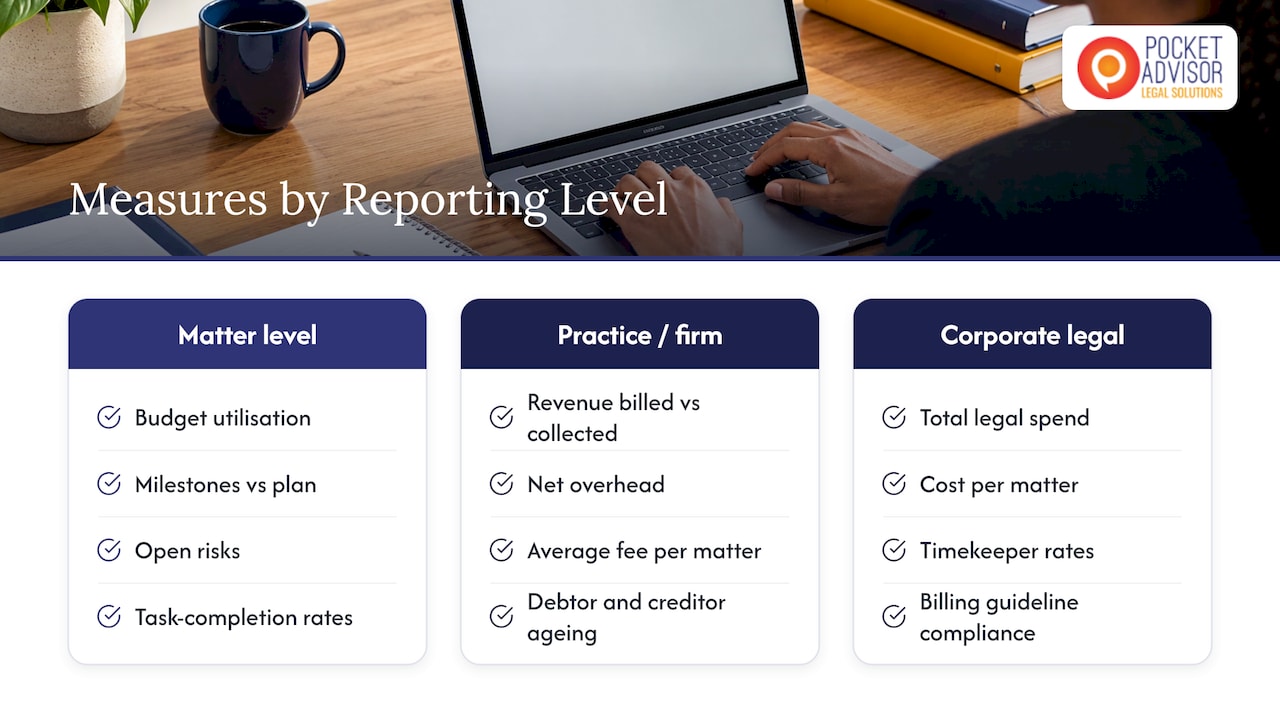
At matter level, the measures are those in the core contents: budget utilisation, milestones achieved against plan, and the status of open risks. Asana suggests choosing relevant performance indicators such as budget utilisation and task-completion rates to show progress.
At practice or firm level, financial reporting adds further indicators. South African practice-management commentary lists the following as standard management information: revenue billed against collected, net overhead, average fee per matter, debtor and creditor ageing, and work in progress or unbilled work, as set out by AJS South Africa.
For corporate legal departments, Thomson Reuters Africa points to total legal spend, cost per matter, timekeeper rates and compliance with billing guidelines, together with evaluations of outside counsel on outcomes, responsiveness and the effectiveness of alternative fee arrangements.
A practical rule: include no measure that nobody will act on. If the client never asks about timekeeper rates, leave them out of the client report and keep them for the internal one.
Presenting status so that readers act
A status report that informs but does not prompt a decision is half finished. Four habits make the difference:
- Put the ask first. If you need instructions, say so in the opening line, not in the final paragraph.
- Be candid about slippage. Where progress is behind plan, say why and what you propose. LSNTAP’s monitoring guidance recommends using the project timeline or Gantt chart to compare completed work with planned work, explaining barriers where the project is behind, recognising important contributions and stating next steps.
- Attach a recommendation to every risk. “Counterparty may delay” is a worry. “Counterparty may delay; we recommend a deadline letter on 15th” is a plan.
- Use a traffic-light summary sparingly. A single overall rating at the top helps skimming, but only if the criteria for amber and red are agreed in advance.
A worked example: an in-house regulatory project
Imagine a head of legal at a mid-sized financial services business running a policy-refresh project across five departments, with an external firm supporting on two policies.
The weekly internal report, one page, lists each policy, its owner, its stage and any blocker. The monthly report to the executive committee reduces this to the 3×3 format: policies approved, policies in drafting, and decisions required (for example, approval of an extra budget line for specialist input). The external firm provides its own short update in the same structure, so the head of legal can consolidate without rewriting.
Two things make this work. First, every item has one named owner. Second, legal contributes input at defined approval points without becoming the keeper of the entire project calendar. Where the wider project has its own manager, the legal report should feed that plan, not duplicate it.
Common weaknesses to remove from your reports
- Activity lists instead of outcomes. “Reviewed documents” tells the reader nothing; “completed review of 120 of 300 contracts, 14 need renegotiation” does.
- Moving baselines. If the budget is revised silently, spend-to-date becomes meaningless. Show the original estimate and the revised one.
- Legalese and disclaimers. The report is a management document. Keep reservations to the point where they affect a decision.
- Inconsistent templates. A different format every month forces the reader to relearn the report each time.
- Reporting that nobody uses. Ask the recipients once a quarter what they read and what they ignore, then adjust.
Technology can lighten the load, for example by drawing time and budget data straight from practice-management systems. The question is where automation adds genuine value and where a human summary remains essential. That judgement is itself a legal project management skill.
Build the skill with accredited training
Status reporting is one component of a wider discipline that includes scoping, budgeting, resourcing, risk management and client communication. For lawyers who want to work through all of it in a structured way, PocketAdvisor offers the Applied Legal Project Management Course at R9 500 (one-off), with a Premium option at R19 995 (one-off). The course brings structure, commercial awareness and a continuous-improvement mindset to legal work, and helps firms and legal departments decide where technology and automation add real value.

Students who successfully complete the course receive international accreditation through the International Institute of Legal Project Management (IILPM), subject to the programme’s completion requirements. For lawyers, the credential is a way to strengthen their expertise and distinguish themselves in a competitive profession.
Explore PocketAdvisor’s internationally accredited Legal Project Management Course: https://pocketadvisor.co.za/legal-project-management-course/
For wider context, see our guides to legal project management in South Africa and law firm project management.
FAQ
How do you prepare a legal project status report?
Start from the plan agreed at the outset, then compare completed work, spend and milestones against it. Explain any variance, set out the risks with a proposed response, and end with next steps and any decision you need. Use a fixed template so each report is comparable with the last.
What is the difference between a progress report and a status report?
A status report describes where a project stands at a point in time against its plan. A progress report details the tasks and milestones completed over a period, showing movement between checkpoints. Many legal teams combine both in a single client update.
How long should a legal status report be?
As short as the reader’s needs allow. The 3×3 model limits each of three headings to three bullets, which usually fits on one page. Detailed supporting schedules can be attached for those who want them.
How often should a legal team report on a matter?
Weekly for the internal team and monthly for clients or executives is a common pattern, adjusted to the pace of the matter. Where a statute or court order requires reports, as with business rescue progress reports under the Companies Act, that timetable governs.
Sources
- Legal project management: project update report, Practical Law
- Project Management Toolkit: Monitor the Project, LSNTAP
- Practice Notice 02 of 2025 on progress reports, CIPC
- An Effective (and Maybe Even Useful) Recurring Status Report, Slaw
- Example of a project status report, Sitemate
- Project Status Reports, ProjectManager.com
- Legal Case Status Report Template
- How Project Status Reports Work, Asana
- Accounting and Reporting, AJS South Africa
- Legal reporting and analytics, Thomson Reuters Africa
Recommended
- Law Firm Project Management: A 2026 Guide for SA Practices
- Legal Project Management: A 2026 Guide for SA Practice
- Legal Project Charter: A Practical Guide for SA Lawyers
- Legal Project Management for Lawyers
This article is for educational and informational purposes only. It is not a substitute for professional advice.