
Legal budgeting is the discipline of forecasting what legal work will cost, whether you are pricing a single matter for a client, planning a firm’s year or setting an in-house department’s spend, and then managing actual cost against that forecast. Done well, it rests on three things: a defined scope, a realistic estimate of effort, and a routine for tracking variances and communicating them early. This guide sets out how each works in South African practice.
Key Takeaways
- A legal budget operates at three levels: the matter, the practice (firm or department) and the client relationship. Each needs its own method, but all depend on a clearly defined scope.
- In South Africa, an attorney’s duty to explain likely costs is part of the client relationship itself, so a written estimate is a professional discipline as well as a commercial tool.
- A firm’s budget starts from capacity: roughly 1 200 billable hours per fee earner per year on one widely cited method, set against a full allocation of overheads.
- Tracking variance monthly, and reporting changes in scope before the work is done, protects both margin and the client relationship.
- Legal Project Management (LPM) gives budgeting its structure, commercial awareness and a continuous-improvement loop.
Table of Contents
- What legal budgeting covers
- Start with scope, not with price
- Methods for budgeting a matter
- A worked example: a commercial agreement review
- Budgeting for the firm: capacity, overheads and reserves
- Budgeting for an in-house legal department
- Tracking spend and managing variance
- Communicating the budget to the client
- Common budgeting mistakes in legal practice
- Why legal budgeting is a project management skill
- Build the capability: the Applied Legal Project Management Course
- FAQ
- Sources
What legal budgeting covers
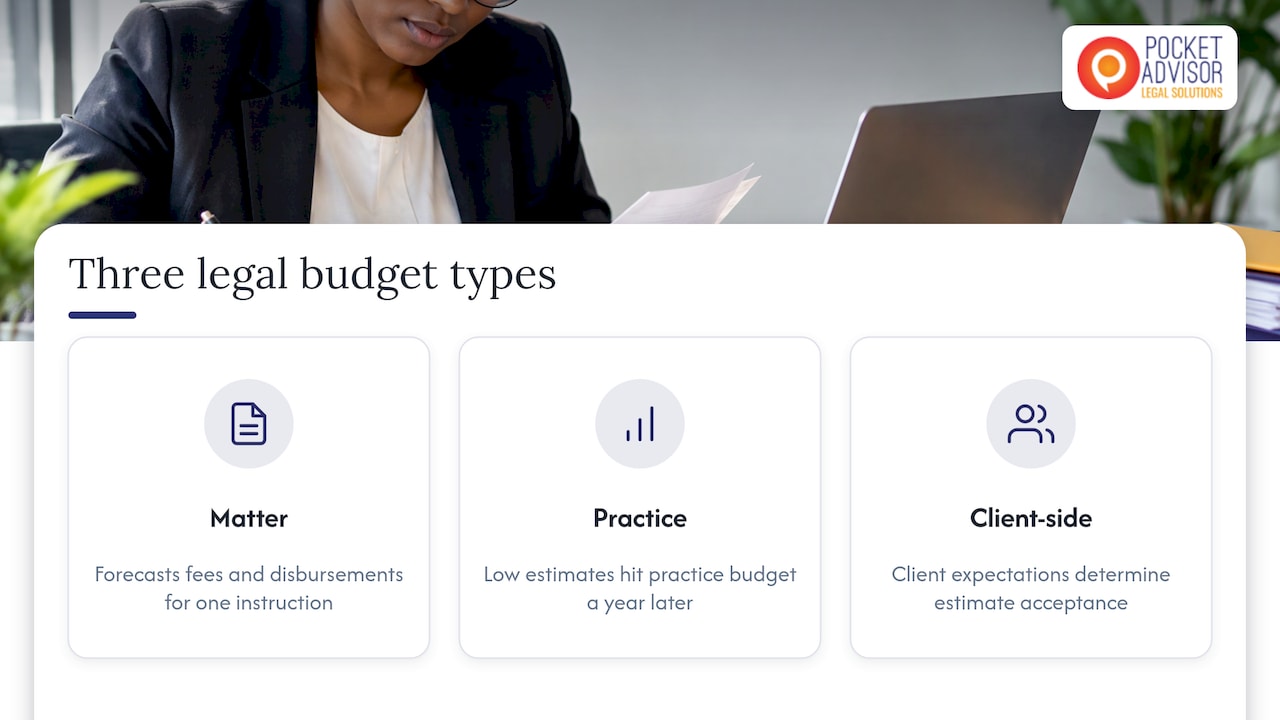
The phrase is used in three related ways, and it helps to separate them.
Matter budgets forecast the fees and disbursements of a specific instruction: a sale of business, a High Court action, a restructuring. They are the document a client sees.
Practice budgets are the annual financial plan of a law firm, or the department budget of an in-house team. For a firm, this means projected income from billable time and recoverable disbursements against all expenses. For in-house counsel, it typically covers salaries, outside counsel, technology and operating costs.
Client-side budgets are what a business or individual sets aside for legal services. They matter to you because the client’s expectation, rather than your internal model, determines whether an estimate is accepted.
The three are linked. A firm whose matter estimates are consistently too low will see the shortfall in its practice budget a year later. An in-house team that cannot forecast outside counsel spend will struggle to defend its annual budget to finance.
Start with scope, not with price
A budget is only as reliable as the scope beneath it. Most overruns trace back to ambiguity at the outset: what is included, what the client must supply, which assumptions the estimate relies on, and what counts as additional work.
Before any number is written down, record:
- Objective and deliverables. What outcome has the client asked for, and what documents or steps will be produced?
- Assumptions. For example, that the counterparty will respond within a stated period, that documents are supplied complete, or that the matter settles before trial.
- Exclusions. Work that is expressly outside the estimate, such as appeals, regulatory filings or foreign-law advice.
- Change triggers. The events that will cause the estimate to be revisited.
This is the first step of the approach described in our guide to legal project budgeting for South African lawyers, and it is the step most often skipped under time pressure.
Methods for budgeting a matter
Task-based (bottom-up) estimates
Break the matter into phases and tasks, estimate hours per task by seniority, apply rates and add disbursements. This is the most defensible method because every figure can be traced to an assumption. Its weakness is effort: it takes time to build, so firms often reserve it for larger instructions and use templates for recurring work.
Benchmarking against comparable matters
For repeatable work, historical data is the better starting point. If your firm has closed twenty residential conveyancing or employment-contract matters, the median and range of actual hours give you a tested baseline. Firms with no matter data should start capturing it now; even a simple record of estimated against actual hours per phase builds a useful dataset within a year.
Market ranges as a sense check
Published ranges can help you test whether an estimate is in a plausible band, though they are no substitute for your own costing. One South African firm, for instance, publishes indicative attorney fees for the sale of a business: R25 000 to R80 000 for deals under R10 million in enterprise value, R80 000 to R250 000 for deals between R10 million and R100 million, and R250 000 to R2 million or more above that, excluding VAT, with a fee estimate and engagement letter advised at the outset. The width of those bands is itself instructive: deal complexity, not deal value alone, drives cost, which is why scoping comes first.
Value-based and fixed-fee pricing
Where the work is predictable, you may convert an estimate into a fixed fee. De Rebus describes value billing as an attempt to calculate the cost of a service in advance and give the client a fairly accurate estimate, and notes that it works only if you can estimate the hours required at the outset. That is exactly the discipline a task-based budget builds. Our guides on alternative fee arrangements for South African law firms and on value-based pricing and eliminating wastage set out how to move from estimate to fixed price without surrendering margin.
A worked example: a commercial agreement review
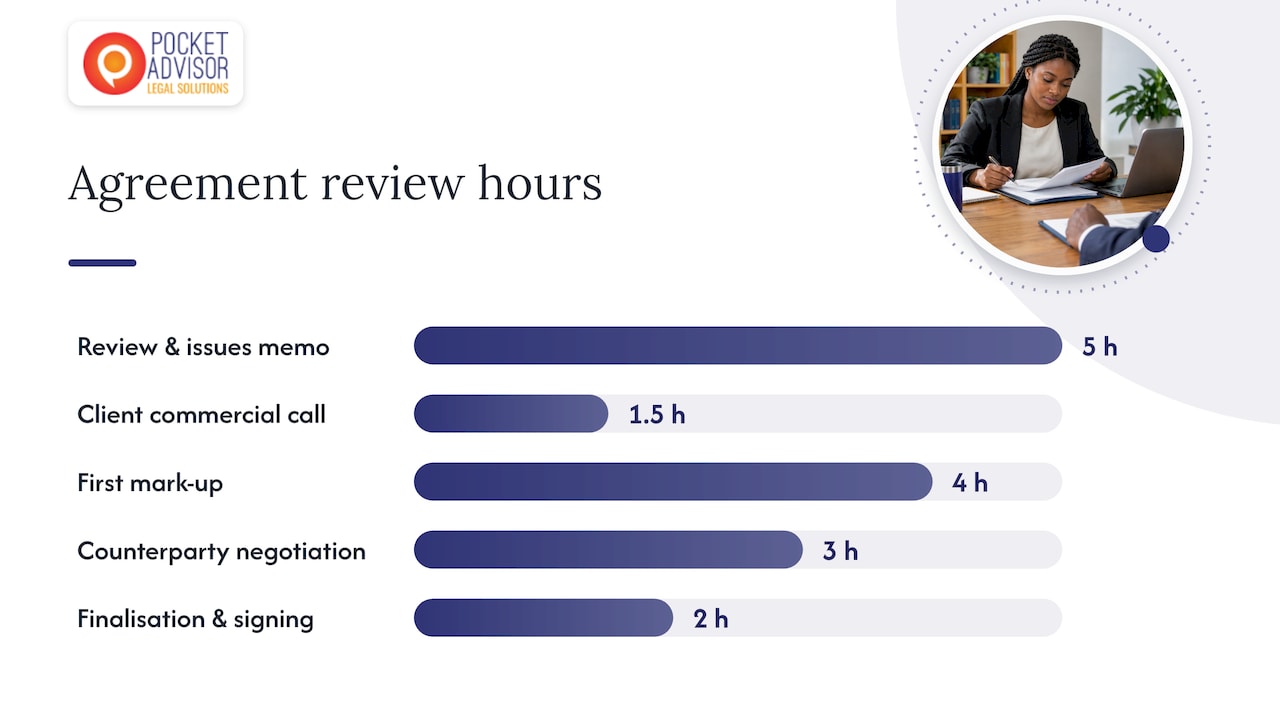
The figures below are illustrative, not benchmarks. A mid-sized client asks for review and negotiation of a supply agreement.
| Phase | Fee earner | Hours | Assumption |
|---|---|---|---|
| Review and issues memo | Associate | 5 | Contract under 30 pages |
| Client call on commercial points | Partner | 1.5 | One call |
| First mark-up | Associate | 4 | One round of changes |
| Counterparty negotiation | Partner | 3 | Two exchanges |
| Finalisation and signing | Associate | 2 | Signature by e-signature or in person |
The assumptions column matters more than the totals. If the counterparty returns a wholly new draft, the second assumption fails and the change trigger applies: you tell the client before the additional hours are worked, with a revised figure. A budget built this way converts a possible fee dispute into a routine scope conversation.
Disbursements belong in the same document. If the matter requires formalities such as notarial attestation, your estimate should say who arranges and pays for it. Clients comparing options often ask how notarisation of business contracts works when parties are in different places, and a single line in the estimate saves a later query.
Budgeting for the firm: capacity, overheads and reserves
A matter estimate is credible only if the practice budget behind it is sound.
Capacity
The starting point is how many hours a fee earner can realistically bill. De Rebus sets out a simple method: take 365 days, deduct weekends and public holidays, then 15 working days of annual leave and 5 of illness, leaving about 240 working days. At an average of 5 billable hours a day, that yields roughly 1 200 billable hours a year per fee earner. Your own figure may differ by seniority and practice area, but the logic of working from capacity rather than aspiration is sound.
Overheads
The same article describes preparing an expense budget for a 12-month period covering all usual expenses: rent, equipment leases, stationery, library, auditors, telephone, and all staff salaries plus a monthly salary for the partner. It then removes fee earners’ salaries and adds back the cost of staff who serve all fee earners in common, such as the bookkeeper and receptionist, and divides by the number of fee earners to find each fee earner’s share of expenses.
The result is a cost per fee earner that sets a floor under your hourly rate or fixed-fee pricing. Illustratively, if a fee earner’s share of annual expenses and salary is R900 000 and capacity is 1 200 hours, the break-even rate is R750 an hour before any profit. Every discount, write-off and unrecorded hour pushes the effective rate below that.
Why the rate is not the whole story
Realisation matters as much as rate. The ACC’s Legal Services Management curriculum lists the controls that sit behind law firm profitability: time entry, billing (work in progress, receivables and collections), productivity or realisation measurement, demand forecasting and staffing models, and the underwriting of alternative fee arrangements. A practice budget should carry targets for each, not just for revenue.
Budgeting for an in-house legal department
In-house counsel face a different problem: the department produces no revenue, so its budget is defended by forecasting accuracy and by the value it can demonstrate.
The same ACC curriculum describes in-house systems as tools for optimising resources, with basic controls such as managing engagement variables like rates and the number of timekeepers, aligning actual spend with accruals and the annual department budget, and comparing firms, service providers and service delivery models when making sourcing decisions.
In practice, a department budget usually contains four blocks:
- People: salaries and benefits, typically the largest block.
- Outside counsel: the most volatile block, driven by litigation, transactions and regulatory matters that nobody planned.
- Technology and tools: matter management, contract management, research subscriptions.
- Operating costs: training, professional memberships, travel.
A sensible method is to divide outside counsel spend into the known (matters already open, with estimates in hand), the partially known (recurring transactional work, forecast from last year’s volumes) and the unknown (a contingency, agreed with finance in advance). Asking panel firms for task-based estimates, and holding them to the change-trigger discipline described above, turns that block from a guess into a forecast. Our guides for in-house counsel on legal project management and on the in-house counsel approach develop this further.
Technology deserves its own discipline. Before adding a tool, ask which step in the process it improves, what that step costs today and how you will know the saving has been realised. Automation adds genuine value where work is repetitive and well scoped, which is one more reason scoping comes first.
Tracking spend and managing variance
A budget that is not tracked is a forecast that nobody checks. A workable routine has four parts.
- Record estimates in the matter file. Keep the phase-level budget where the team can see it, not only in the engagement letter.
- Compare actual against budget monthly. Look at hours by phase, not only the running total. A matter can be on budget overall while its first phase has already consumed the contingency.
- Classify every variance. Was it a scope change, an estimating error, a client delay or inefficiency in your own process? Only the last two are yours to fix; the first should trigger a revised estimate.
- Feed the result back. At matter close, compare estimate and actual and record the lesson. This continuous-improvement loop is what makes next year’s estimates better than this year’s.
The last step is where LPM differs from administration. Tracking records what happened; LPM changes what happens next.
Communicating the budget to the client
In South Africa, communication about cost is part of the professional relationship. The Law Society of South Africa states that a client has the right to an explanation of the cost implications and how costs are likely to be calculated, to be kept informed of costs so that they can judge whether a course of action is financially worthwhile, to a clear bill showing work done and amounts charged, and to have an account assessed and taxed if they consider it too high. The Legal Practice Council’s guide to legal costs addresses the same ground, including advice to the client and the estimate of costs, deposits and agreed fees.
Three habits follow:
- Give the estimate in writing, before work starts, with assumptions and exclusions visible.
- Report early. A client told in week two that scope has grown rarely objects; a client told at billing often does.
- Offer choices. When costs rise, set out options (narrow the scope, change the staffing mix, move to a capped fee for the next phase) so the client takes part in the decision.
The LSSA also notes that clients are responsible for asking about costs and settling bills timeously. A clear estimate makes both easier.
Common budgeting mistakes in legal practice
- Estimating from the top down. A round number agreed in a meeting, with no task breakdown, cannot be defended or tracked.
- Ignoring unbilled time. Capacity calculations that treat every working hour as billable overstate income and understate the true cost of each billable hour.
- Treating disbursements as an afterthought. Counsel fees, expert reports, filing and attestation costs can alter the client’s view of the total.
- Never closing the loop. Without a post-matter review, the same estimating errors repeat.
- Budgeting in isolation. Pricing, staffing, technology and client expectations affect one another; a budget that considers only one of them will fail on the others.
Why legal budgeting is a project management skill
Budgeting sits within a wider set of capabilities: defining scope, allocating people, managing risk, meeting deadlines and keeping the client informed. Legal Project Management treats these as one system. It is more than traditional project management because it is built around the realities of legal work: billable time, professional duties to the client, uncertain counterparties and the commercial pressure on firm and department alike.
That is why budgeting skills improve most when taught alongside scoping, resourcing and risk. Firms and legal departments that adopt LPM tend to gain structure in how matters are planned, a clearer commercial view of what each matter earns or costs, and a habit of reviewing and improving process. It also gives them a principled way to decide where technology and automation add genuine value, rather than adopting tools for their own sake.
Build the capability: the Applied Legal Project Management Course
PocketAdvisor’s Applied Legal Project Management Course is designed for lawyers, in-house counsel and legal team leaders who want to put these methods into practice. It covers project leadership, team management, risk management and communication, and is offered in South Africa under our exclusive rights to the internationally accredited IILPM programme. Students who successfully complete the course receive accreditation through the International Institute of Legal Project Management (IILPM), subject to the programme’s completion requirements, a credential that helps lawyers strengthen their expertise and distinguish themselves in a competitive profession.
The Applied Legal Project Management Course is priced at R9 500 as a one-off fee, and the Premium option at R19 995 as a one-off fee.

Explore PocketAdvisor’s internationally accredited Legal Project Management Course: https://pocketadvisor.co.za/legal-project-management-course/
FAQ
What is legal budgeting?
Legal budgeting is the forecasting and control of the cost of legal work. It applies to a single matter, to a law firm’s annual finances and to an in-house department’s yearly spend. In each case it combines a defined scope, an estimate of effort and a routine for tracking actual cost.
How do I budget for a legal matter?
Define the scope, assumptions and exclusions first. Then break the matter into phases, estimate hours by fee earner for each, apply rates, add disbursements and state the events that would trigger a revised estimate. Give the client the result in writing before work begins.
How many billable hours should a South African fee earner budget for?
One method published in De Rebus arrives at about 1 200 billable hours a year, based on roughly 240 working days and an average of 5 billable hours a day. Your own figure should reflect seniority, practice area and your firm’s actual time records.
What should an in-house legal budget include?
Most department budgets cover salaries and benefits, outside counsel, legal technology and operating costs such as training and travel. Outside counsel is usually the least predictable block, so it is best divided into known matters, forecast recurring work and an agreed contingency.
What must a client be told about legal costs in South Africa?
The LSSA states that clients have the right to an explanation of the cost implications and how costs are likely to be calculated, and to be kept informed of costs as the matter proceeds. Written estimates and early notice of changes put that into practice.
Sources
- Business Sale FAQ South Africa: 20 Common Questions, MJ Kotze Inc
- Calculating legal costs: Changing the way we charge, De Rebus
- Legal Services Management 3.0 Core Curriculum, ACC
- Your Rights as a Client, Law Society of South Africa
- Legal costs, in terms of Regulation 6(10)(l), Legal Practice Council
- Business Contract Notarisation
Recommended
This article is for educational and informational purposes only. It is not a substitute for professional advice.