
Legal project communication is the planned, agreed way a legal team shares scope, progress, cost and risk with the client and with each other across the life of a matter. It is not the occasional status email. It is a set of decisions made at the start of a matter and kept to until closure. Done well, it removes the surprises that damage client relationships and profitability. Legal Project Management (LPM) gives lawyers the structure to do this consistently, and the Applied Legal Project Management Course at PocketAdvisor teaches that structure to South African and African legal professionals.
Key Takeaways
- Agree the client’s definition of success, responsiveness and budget at the start of the matter, then record it in a short communication plan.
- South African professional rules already expect timely replies and clear progress reporting, so a defined update routine protects both client and practitioner.
- Report against the plan: tasks completed, budget against actual, changes in scope and open risks.
- Every change to scope, timing, people or budget should be communicated together with its consequences.
- Test your routine with a few simple measures: response times, surprises at invoicing and the number of unplanned client queries.
Table of Contents
- Why communication sits at the centre of legal project management
- Start with a communication plan at kick-off
- Run updates that report against the plan
- Coordinate inside the team and with external counsel
- Communicate change: scope, budget and deadlines
- Tools and routines, and how to tell whether they work
- Building the skill: the Applied Legal Project Management Course
- FAQ
- Sources
Why communication sits at the centre of legal project management
Legal project management means defining, planning, executing and evaluating a matter so that it meets the objectives of both client and firm, usually within an agreed budget. The LPM Institute’s white paper adds that communication with the key people in the client organisation and the internal team matters most at the beginning, when success criteria, limits on the matter and cost expectations are set.
The American Bar Association makes a similar point: LPM helps legal team and client reach a mutual understanding of expectations, limits surprises and establishes agreed methods of communication.
This is more than administration. The Association of Corporate Counsel notes that LPM requires deliberate integration of planning, budgeting and communication, and is not achieved simply by buying matter management software. Software records information. Someone still has to decide who is told what, when and in what form.
What South African practice rules already require
The Code of Conduct published under section 36(1) of the Legal Practice Act 28 of 2014 (Government Gazette 42337, Notice 168 of 2019) sets the baseline for attorneys:
- Rule 3.3 treats the client’s interests as paramount, subject to the stated duties.
- Rule 3.4 requires undertakings to be honoured unless prohibited by law.
- Rule 3.6 requires privilege and confidentiality to be maintained according to law.
- Rule 16.1 requires a reply within a reasonable time to communications that need an answer, unless there is good cause for refusing.
- Rule 18.15 prohibits representing anything untrue or making statements calculated to mislead or intimidate in communications on a client’s behalf.
The Law Society of South Africa lists what clients are entitled to expect: to be kept updated on developments, to receive responses to letters and calls within a reasonable time, to get clear explanations in terms they understand, and to know who is handling the matter. It also observes that many complaints stem from a lack of communication.
“Reasonable time” is not defined in numbers. That is exactly why a matter-level agreement with the client is useful: it turns a vague standard into a concrete one.
Start with a communication plan at kick-off
The first conversation sets the tone for the whole matter. De Rebus advises lawyers to understand how the client defines success and responsiveness, for example whether a revert is expected within two hours or 24 hours, and to assume less and communicate more so that nothing is lost in translation.
For in-house teams the same logic applies at intake. The Corporate Legal Operations Consortium describes intake as the stage that drives everything after it, with the legal team and business client clarifying the scope of the request, anticipated resources, desired outcome, perceived value and timetable before work starts.
What the plan should record
The same Consortium paper says the planning stage sets out the activities, the people doing them, the schedule, the budget or potential costs, the assumptions behind the estimate and the client’s communication preferences. For higher-risk matters it adds a stakeholder register, a responsibility matrix, a communication plan and a schedule and budget. A practical one-page plan for an ordinary matter can cover:
| Element | Question to settle | Example |
|---|---|---|
| Stakeholders | Who needs to hear what? | Client’s general counsel, finance manager, the CEO for escalations |
| Channel | How will updates arrive? | Fortnightly email summary, calls for urgent issues |
| Responsiveness | What is a timely reply? | Acknowledge within 4 working hours, substantive reply within 24 |
| Content | What will every update contain? | Progress, budget against actual, next steps, decisions needed |
| Escalation | When does the partner step in? | Any forecast overrun or change to a court date |
| Success | What does a good result look like? | Settlement within a stated range, or an agreement signed by a date |
The ACC adds a useful discipline: a formal project initiation lets everyone affected know that the matter has begun and clarifies expectations for each team member. A short kick-off note to the client and the internal team achieves this.
A worked example
A mid-sized Johannesburg firm is instructed to handle a commercial lease dispute for a retail group. At kick-off the attorney asks the client’s legal manager what a good outcome is, how often she wants news, and who must approve spend. The answers are recorded: she wants a short email every second Friday, a phone call before any step costing over an agreed amount, and copies to the finance director. Six weeks later, when the other side asks for an extension, the attorney already knows who to call and what the client will want to know. No one is surprised, and the client has not had to chase.
Run updates that report against the plan
The ACC describes the project plan as the primary reporting tool, showing task progress by timing and percentage complete, supported by periodic budget-to-variance reports that show whether spending is on track. The LPM Institute likewise describes building a template of how the work will be done, with a budget based on it, and then monitoring budget to actual, key milestones, changes in scope, and risks or influencers throughout the matter.
That gives a sound structure for every update:
- Where we are: tasks completed and milestones reached since the last update.
- What it has cost: fees and disbursements against the budget, with any forecast variance. Our guide to legal project budgeting shows how to build the budget the update reports against.
- What has changed: scope, timetable, team or risk.
- What happens next: the next steps and dates.
- What we need from you: decisions, documents or approvals, with a date.
How often to update
There is no single right frequency. The ACC suggests the project manager hold team meetings daily for short-deadline projects and weekly or monthly for longer ones, and tracks progress and variances at those meetings. Client updates can follow the same rhythm, adjusted to what the client said it wanted at kick-off. Whatever cadence is chosen, rule 16.1 and the LSSA’s guidance on keeping clients updated mean that an urgent development should never wait for the next scheduled report.
Coordinate inside the team and with external counsel
Clear client communication depends on clear internal communication. The ABA Young Lawyers Division describes LPM as developing a framework for communication among the project team, and notes that once communication inside the firm is in sync, firms can update clients at every step because they understand where the project stands.
In practice that means settling a few things before the work spreads across people:
- One named point of contact. The LSSA lists the client’s right to know who is handling the matter. Name the person, and name who covers when they are away.
- A shared task list. Everyone should see who owns each task and its due date, so a client question does not depend on one person’s memory.
- Briefing external counsel and experts. Give them the success criteria, budget assumptions, reporting format and escalation triggers, not only the legal question.
- Short internal check-ins. Brief regular meetings keep scope and budget visible before they drift.
For in-house teams managing panel firms, the same plan can be shared as an expectation: the format of updates, the budget assumptions and the trigger points for a conversation. For wider context on how firms organise this, see our guide to law firm project management in South Africa.
Communicate change: scope, budget and deadlines
Most difficult client conversations are about change. The ACC points out that scope, schedule, people and budget are linked constraints: a change to one may affect the others, so adjustments and their ramifications must be communicated to both team and client. The team needs to understand how the change affects its work, and the client how it affects its business objectives.
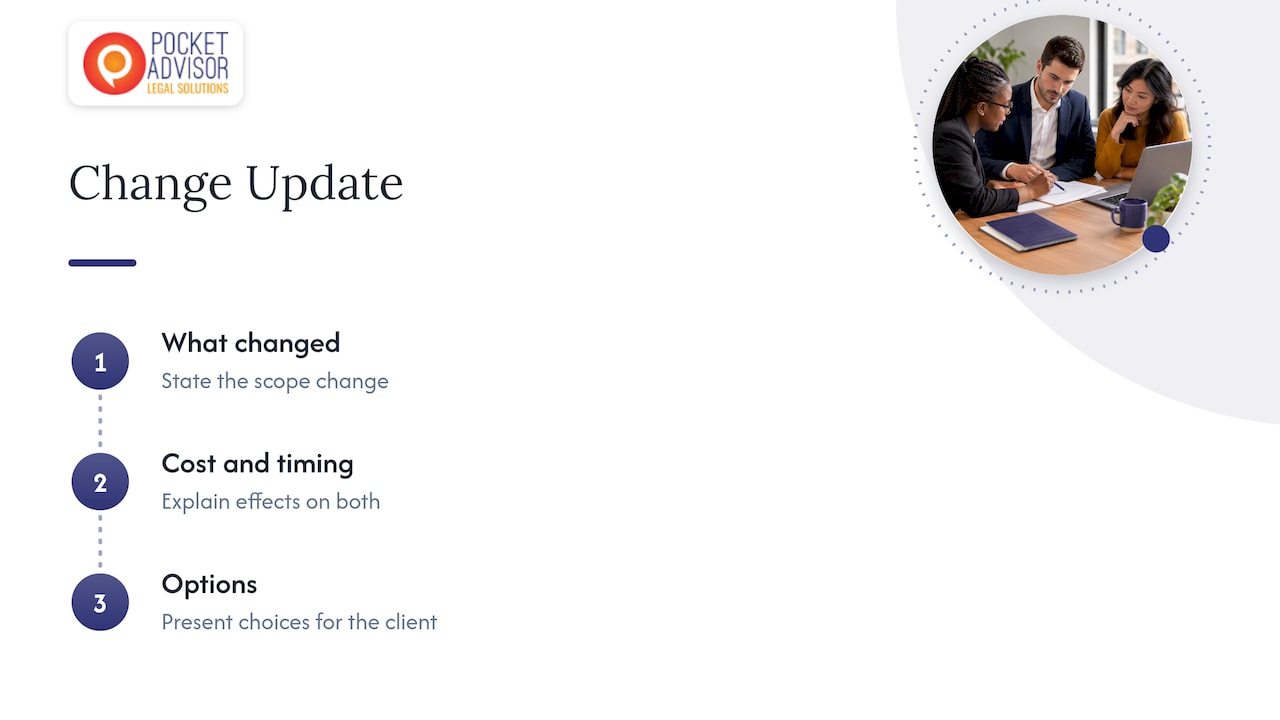
A useful habit is to present every change in three parts: what has changed, what it does to cost and timing, and the options. For example, if a due diligence expands because the target has more subsidiaries than first disclosed, the update states the new number, the additional hours estimated, the effect on the closing timetable, and two choices: widen the review or keep to the original scope with a stated limitation. The client decides with the facts in hand. Our article on scope creep in law firms goes further into spotting and handling that drift early.
When the message is difficult, the Code of Conduct sets the boundary: communications on a client’s behalf must not state anything untrue or be calculated to mislead (rule 18.15). Candid, early reporting of a problem is both the professional standard and good project practice.
Tools and routines, and how to tell whether they work
Tools are the easy part. A shared matter folder, a task tracker, a standard update template and a calendar of reporting dates are enough for most practices. The ACC’s warning applies: software helps only when planning, budgeting and communication are deliberately integrated.
To judge whether the routine is working, review each closed matter against a few simple questions:
- Did the client ever have to chase for news, and how long did replies take compared with the agreed standard?
- Did any invoice surprise the client?
- Were scope changes raised before the work was done, or after?
- Could any team member answer a client’s question without searching through emails?
- Did the client’s stated measure of success at kick-off match the result at closure?
Keeping these answers matter by matter shows where the routine fails, and feeds a continuous-improvement habit: adjust the template, retrain the team, repeat. Our guide to legal service delivery improvement develops this review cycle.
Building the skill: the Applied Legal Project Management Course
Communication planning, budgeting, scope control and risk management are learnable methods, and they work best when taught together and applied to legal work. PocketAdvisor’s Applied Legal Project Management Course is internationally accredited through the International Institute of Legal Project Management (IILPM), subject to the programme’s completion requirements, and PocketAdvisor holds the exclusive rights to provide it in South Africa. It brings structure, commercial awareness and a continuous-improvement mindset to legal work, and helps firms and legal departments decide where technology and automation add genuine value. The accreditation is a professional credential that helps lawyers strengthen their expertise and distinguish themselves in a competitive profession. The course is priced at R9 500 one-off, and the Premium option at R19 995 one-off.

Explore PocketAdvisor’s internationally accredited Legal Project Management Course: https://pocketadvisor.co.za/legal-project-management-course/
For an overview of the discipline first, read our introduction to legal project management for lawyers.
FAQ
What is legal project communication?
It is the agreed plan for who is told what, when and how during a legal matter, covering client, internal team and any external counsel. It is set at kick-off and kept to through reporting on scope, cost, progress and risk.
How often should I update a client on a matter?
Ask the client at the start and record the answer. Professional guidance expects replies within a reasonable time and regular progress reporting, and project guidance suggests cadence follows the matter’s length. Urgent developments should be reported at once, not held for a scheduled update.
What should a legal matter update contain?
Progress against the plan, fees against budget, any change to scope or timing, the next steps and any decision needed from the client. Keeping the same five headings every time makes updates quick to write and easy to read.
Does the Code of Conduct say anything about communicating with clients?
Yes. Rule 16.1 requires a reply to communications within a reasonable time, and rule 18.15 bars untrue or misleading statements in communications on a client’s behalf. Rules 3.3, 3.4 and 3.6 cover the client’s interests, undertakings and confidentiality.
Sources
- LPM Institute White Paper, 2015
- American Bar Association: A Quick Guide to Legal Project Management in Litigation
- Association of Corporate Counsel: Legal Project Management
- Code of Conduct, Government Gazette 42337, Notice 168 of 2019
- Law Society of South Africa: Your Rights as a Client
- De Rebus: Controlling outcomes, project management
- Corporate Legal Operations Consortium: Matter Life Cycle Management
- ABA Young Lawyers Division: A Beginner’s Guide to Legal Project Management
Recommended
- Law Firm Project Management: A 2026 Guide for SA Practices
- Eliminate the Hidden Costs of Miscommunication in Legal Teams
This article is for educational and informational purposes only. It is not a substitute for professional advice.